
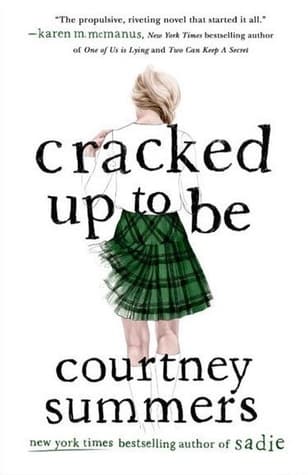
Synopsis
Covers the whole plot, including the ending.
- Difficulty
- Medium
- Pacing
- Moderate
- Mood
- Introspective, melancholic, suspenseful, emotionally charged
Cracked Up to Be Plot Summary
Covers the whole plot, including the ending.
The Fall of Parker Fadley
The story begins with Parker Fadley, once the most admired girl at St. Peter's High, now living in self-imposed isolation. She fails classes, drinks at school, and has ruined her carefully built image. Her parents monitor her for suicide, and school counselors push her to explain her dramatic change. Parker stays silent, wanting to be left alone. She avoids old friends and her ex-boyfriend, Chris, who remains popular and seems unaffected by their breakup. The story immediately creates a strong sense of mystery about Parker's sudden decline, suggesting a major, traumatic event she desperately hides.
Enter Jake
During her self-destruction, a new student named Jake arrives. He is not put off by Parker's new, harsh personality. He is kind and persistent, seeing past her defenses. Jake's genuine interest and steady support start to break down Parker's decision to stay isolated. He does not judge her but offers quiet understanding, slowly drawing her out. Their talks are at first difficult, with Parker using sarcasm and trying to push him away, but Jake's gentle nature proves surprisingly strong, offering a bit of hope for Parker's recovery and connection.
Flashbacks and Whispers
As Parker deals with her new life, the story includes flashbacks and broken memories of her past. These glimpses show a perfectly maintained image: a dedicated student, a loyal girlfriend to Chris, and a popular cheerleader. However, these memories often have an underlying tension and unease. Whispers and rumors at school also mention a specific incident involving a party, a car, and something 'horrible' that happened, though details are vague. These fragments build suspense and deepen the mystery around Parker's current state, pointing to a specific event that caused her breakdown.
The Pressure Mounts
The adults in Parker's life, especially her parents and school counselors, grow more frustrated and worried by her silence. They set stricter rules, therapy sessions, and constant monitoring, all to get her to open up. Parker, however, sees these as intrusions, making her even more silent. The pressure from her family and school highlights the expectation for her to conform and 'fix' herself, further isolating her as she feels unable to explain the true depth of her pain and what changed her.
A Developing Connection
Despite Parker's initial resistance, her bond with Jake slowly grows. He provides a safe place where she can be vulnerable without judgment. Their conversations, at first guarded, become more open, and Parker finds herself confiding in him in ways she has not with anyone else. Jake's steady belief in her, even in her darkest moments, begins to melt her frozen emotions. He encourages her to face her past, not by forcing her, but by simply being there and supportive. This growing relationship becomes an important anchor for Parker, offering hope and a path toward healing.
The Ghost of Chris
Chris, Parker's popular ex-boyfriend, remains a strong presence, both in her memories and in the school's social order. Flashbacks show the seemingly perfect look of their relationship, but also suggest an underlying possessiveness and emotional manipulation from Chris. Parker's current dislike for him is clear, suggesting he played a part in the traumatic event. Their interactions are tense, full of unspoken accusations and a history of shared secrets. Chris's continued popularity and seemingly unbothered attitude further fuel Parker's anger and isolation, as she struggles with the unfairness of her own downfall compared to his apparent freedom from trouble.
The Revelation of Sarah
As Parker's memories become clearer, the name 'Sarah' starts to appear as a key figure in the events leading to her breakdown. Sarah was a friend, perhaps even a rival, and their relationship seems to have been complicated and full of unspoken tensions. The fragmented details about Sarah suggest her involvement in the party and the accident. The revelation of Sarah's identity and her connection to the incident increases the mystery, pushing Parker closer to facing the full truth of what happened and her part in it. The emotional weight of Sarah's absence or fate heavily influences Parker's memories.
The Party and the Car
Through increasingly clear and upsetting flashbacks, the full picture of the party and the car accident begins to emerge. It is revealed that Parker, Chris, Sarah, and another friend were involved. The night included alcohol and reckless behavior. The car accident was severe, and the immediate aftermath was chaotic and traumatic. Parker's guilt comes from her actions and decisions that night, especially her part in the circumstances that led to Sarah being in the car and the tragic results. The details paint a picture of a disastrous night that permanently changed the lives of everyone involved.
The Truth About Sarah's Death
In a final confession to Jake, and eventually to her parents and the authorities, Parker finally tells the horrifying truth. Sarah died in the car accident, and Parker was driving. She admits to being drunk and reckless, and to making a critical mistake that led to her friend's death. The weight of this confession is immense, showing the depth of her self-hatred and the reason for her self-destructive behavior. The truth is not just about the accident, but also about the cover-up and the silence that has suffocated her. This revelation is a turning point, allowing Parker to begin genuine grieving and seeking amends.
Facing the Consequences
With the truth finally out, Parker begins to face the legal and emotional results of her actions. She accepts responsibility for Sarah's death, understanding that her perfect image was a lie that ultimately cost a life. While recovery is long and hard, she is no longer alone. Jake stays by her side, offering steady support. Her parents, though devastated, can now help her. The ending suggests Parker will confront the legal system and public scrutiny, but she does so with new honesty and a bit of hope for redemption, knowing that true healing starts with the truth.
Cracked Up to Be Characters
Parker Fadley
Protagonist
The 'perfect' girl whose life unravels after a tragic secret.
Parker Fadley begins the story as a shell of her former self: withdrawn, self-destructive, and burdened by immense guilt. Previously the epitome of perfection – a top student, cheerleading captain, and popular girlfriend – she intentionally dismantles her life to punish herself for a past tragedy. She uses sarcasm and isolation as defensive mechanisms, pushing away anyone who tries to get close. Beneath her hardened exterior lies a deeply wounded and self-loathing individual struggling to cope with the consequences of her actions.
Relationships: Jake (romantic interest, confidant); Chris (ex-boyfriend, co-conspirator); Sarah (friend, victim); Parents (strained, concerned)
Jake
Supporting
The kind, persistent new student who sees past Parker's facade.
Jake is the new kid in school, characterized by his quiet strength, empathy, and unwavering kindness. He is the antithesis of the judgmental and superficial students at St. Peter's High. Jake is patient and observant, seeing through Parker's self-destructive behavior to the pain beneath. He doesn't try to 'fix' her but rather offers unconditional support and understanding, slowly earning her trust and becoming her most significant ally. His presence is a catalyst for Parker's eventual confession and healing.
Relationships: Parker Fadley (romantic interest, confidant)
Chris
Supporting
Parker's popular ex-boyfriend, who shares a dark secret with her.
Chris is Parker's popular, charismatic ex-boyfriend. On the surface, he appears to have moved on from their breakup and the mysterious incident that shattered Parker's life. However, he is deeply entangled in the secret surrounding Sarah's death, and his calm demeanor hides a potential manipulation or complicity. He represents the part of Parker's past she desperately wants to escape, and his continued presence and seemingly unbothered life highlight the injustice Parker feels, further fueling her self-loathing.
Relationships: Parker Fadley (ex-boyfriend, co-conspirator); Sarah (friend, victim)
Sarah
Supporting
The victim of the car accident, whose death haunts Parker.
Sarah is a character primarily seen through Parker's fragmented memories and flashbacks. She was a friend or acquaintance who died in the car accident that serves as the central trauma of the novel. Her presence, though unseen in the present, is profoundly felt, as her death is the catalyst for Parker's self-destruction. The gradual revelation of Sarah's identity and the circumstances of her death are crucial to understanding Parker's guilt and the full scope of the tragedy. She represents the devastating consequences of Parker's actions.
Relationships: Parker Fadley (friend); Chris (friend)
Parker's Parents
Supporting
Concerned but often misguided figures trying to help their daughter.
Parker's parents are initially portrayed as loving but overwhelmed by their daughter's sudden and inexplicable change. They are desperate to understand what is happening to her and resort to suicide watch, therapy, and strict rules, often exacerbating Parker's feelings of isolation. Their efforts, though well-intentioned, are largely ineffective due to Parker's refusal to open up. They represent the adult world's struggle to comprehend and address mental health issues when faced with a teenager's silence and rebellion.
Relationships: Parker Fadley (parent-child)
Counselors
Supporting
School professionals tasked with uncovering Parker's issues.
The school counselors are part of the institutional response to Parker's crisis. They represent the formal channels for support and intervention, but their attempts to get Parker to talk are met with resistance. They are focused on diagnosis and solutions, often without fully grasping the depth of Parker's trauma or the specific nature of her secret. Their interactions with Parker highlight the limitations of a structured approach when dealing with profound personal guilt and grief.
Relationships: Parker Fadley (counselor-student)
The 'Popular' Group
Supporting
Parker's former friends who ostracize her after her fall from grace.
This group represents the superficial social hierarchy of St. Peter's High. Once Parker's allies, they quickly abandon and gossip about her when she falls from grace. Their judgmental attitudes and quickness to ostracize highlight the fickle nature of high school popularity and the harsh consequences for those who deviate from the 'norm.' They serve as a constant reminder of Parker's lost status and the public perception of her downfall.
Relationships: Parker Fadley (former friends/social circle); Chris (friends/social circle)
Cracked Up to Be Themes
Guilt and Self-Punishment
The main theme is Parker's overwhelming guilt over her role in Sarah's death. This guilt shows as intense self-hatred and a deliberate effort to destroy herself. She ruins her academic future, pushes away her friends, and acts indifferent, believing she deserves to suffer. Her refusal to confess is a way of punishing herself, as she forces herself to live with the heavy weight of her secret, feeling unworthy of happiness or redemption.
“I was cracked up to be perfect. Now I'm just cracked.”
The Façade of Perfection
The novel explores the immense pressure on teenagers, especially young women, to maintain a 'perfect' image. Parker carefully built an image of being the ideal student, girlfriend, and daughter, hiding her weaknesses and true feelings. This theme highlights the dangers of trying to meet impossible standards and the devastating results when that image breaks, revealing the flawed person underneath. The 'perfect' image prevented her from seeking help and worsened her trauma.
“Everyone thought they knew me. They knew a version of me. The one I wanted them to see.”
Truth and Consequences
The story is driven by Parker's journey to reveal the truth about Sarah's death and accept the consequences. The book argues that true healing cannot begin until the truth, no matter how painful, is acknowledged. Parker's initial silence traps her in a cycle of suffering, but her eventual confession, though leading to potentially serious results, is presented as the only way to genuine peace and redemption. It shows that avoidance only makes suffering last longer.
“The truth had always been there, waiting for me to be brave enough to say it.”
Redemption and Forgiveness
While Parker's guilt is deep, the novel subtly explores the chance for redemption, not just through outside forgiveness, but through internal acceptance and the willingness to face one's past. Jake's steady belief in Parker, despite her flaws, offers a bit of hope that forgiveness, both from others and from herself, is possible. The ending suggests that redemption is a difficult, ongoing process that starts with honesty and accountability, rather than a single event.
“Maybe I didn't deserve to be happy, but maybe I deserved to try.”
Grief and Trauma
The story looks closely at the psychological impact of grief and trauma on a young person. Parker's self-destructive behavior, isolation, and emotional numbness all come from unprocessed grief and the trauma of witnessing and causing Sarah's death. The novel accurately shows how traumatic events can lead to major changes in personality and behavior, and how important it is to process these emotions, even when they are very painful, to begin healing.
“It was like a hole had been punched right through me, and everything I ever was had just drained out.”
Plot Devices & Literary Techniques
Non-linear Narrative / Flashbacks
Fragmented memories gradually reveal the past.
The story employs a non-linear narrative structure, interweaving Parker's present-day self-destruction with fragmented flashbacks to her past. These memories are initially vague and emotionally charged, slowly revealing details about the fateful night and Sarah's death. This device builds suspense, keeping the reader as disoriented and curious as Jake about Parker's secret, and allows for a gradual, impactful reveal of the central trauma, mirroring Parker's own struggle to confront her memories.
Unreliable Narrator
Parker's perspective is clouded by guilt and self-deception.
Parker Fadley serves as an unreliable narrator due to her overwhelming guilt, self-loathing, and deliberate attempts to suppress and distort the truth. Her initial accounts of events are vague, defensive, and often self-deprecating, preventing the reader from fully understanding the past. This unreliability forces the reader to piece together the truth alongside Jake, questioning Parker's motives and perceptions until the complete confession, which then recontextualizes all prior information.
The 'Perfect Girl' Trope Subversion
The seemingly perfect protagonist is revealed to be deeply flawed and traumatized.
The novel initially presents Parker Fadley as the quintessential 'perfect girl' – popular, intelligent, and accomplished. However, this trope is quickly subverted as her life dramatically unravels, revealing the immense pressure and hidden trauma beneath the flawless exterior. This device challenges societal expectations of perfection and highlights the psychological toll of maintaining such an image, ultimately exposing the vulnerability and deep flaws that can exist behind a polished facade.
Symbolism of the 'Crack'
The literal and metaphorical breaking of Parker's perfect image.
The title itself, 'Cracked Up to Be,' is a significant symbol. It refers to Parker being 'cracked up to be' perfect, but also to her literally 'cracking' under the pressure and trauma. Her self-destructive behavior, her emotional breakdowns, and the shattering of her reputation all symbolize the breaking of her carefully constructed façade. The 'crack' represents the irreparable damage done by her secret and the painful process of her breaking down before she can begin to heal.
Quiz
10 questions on the plot and the characters. Each answer comes with a short explanation.
Question 1
What is the protagonist's name in 'Cracked Up to Be'?
- Sarah Johnson
- Parker Fadley
- Emily Carter
- Jessica Miller
Show answer
B. Parker Fadley The protagonist's full name is revealed as Parker Fadley.
Question 2
What is Parker's role at St. Peter's High before her decline?
- Drama club president
- Student council treasurer
- Cheerleading captain and teacher's pet
- Editor of the school newspaper
Show answer
C. Cheerleading captain and teacher's pet Parker is described as the cheerleading captain, girlfriend of the most popular guy, and a consummate teacher's pet.
Question 3
What behavior change alerts the school about Parker's struggles?
- She starts bullying other students.
- She begins drinking at school and failing classes.
- She quits the cheerleading team abruptly.
- She starts dating a freshman.
Show answer
B. She begins drinking at school and failing classes. The summary explicitly states that Parker starts drinking at school and failing her classes, which causes the school to go on alert.
Question 4
What is Parker's initial desire when facing her problems?
- To confront the person who wronged her.
- To seek help from her friends.
- To be left alone and disappear.
- To immediately confess everything.
Show answer
C. To be left alone and disappear. Parker's internal monologue reveals her wish to 'be left alone, to disappear, to be ignored.'
Question 5
What measures have Parker's parents taken due to her behavior?
- They sent her to a boarding school.
- They placed her on suicide watch.
- They grounded her indefinitely.
- They hired a private tutor.
Show answer
B. They placed her on suicide watch. The text states, 'But her parents have placed her on suicide watch.'
Question 6
How does the presence of a 'nice guy' affect Parker?
- He makes her feel angry and resentful.
- He makes her feel indifferent.
- He makes her feel things again when she'd rather not.
- He helps her forget her problems.
Show answer
C. He makes her feel things again when she'd rather not. The summary mentions, 'there's a nice guy falling in love with her and he's making her feel things again when she'd really rather not be feeling anything at all.'
Question 7
What is the underlying cause of Parker's behavior, according to the book's premise?
- Peer pressure from her cheerleading squad.
- A secret relationship gone wrong.
- A horrible event that she feels responsible for.
- Academic stress and competition.
Show answer
C. A horrible event that she feels responsible for. The narrative hints that 'Something horrible has happened, and it just might be her fault,' suggesting a traumatic event is the root cause.
Question 8
What genre does the book 'Cracked Up to Be' primarily fall into, based on the provided description?
- Science Fiction and Fantasy
- Historical Fiction and Drama
- Mystery and Young Adult
- Comedy and Satire
Show answer
C. Mystery and Young Adult The description explicitly lists 'Psychology, Mystery, Young Adult, Romance' as genres, with Mystery and Young Adult being key identifiers of the plot.
Question 9
The description emphasizes the contrast between Parker's former 'perfect' image and her current struggles. What literary device is most strongly at play here?
- Foreshadowing
- Irony
- Metaphor
- Personification
Show answer
B. Irony The stark contrast between Parker's 'perfect' facade (teacher's pet, valedictorian, popular girlfriend) and her current state of decline (drinking, failing, suicidal ideation) creates a strong sense of dramatic irony.
Question 10
What does Parker's resistance to talking about her problems suggest about her internal state?
- She is simply being stubborn.
- She is trying to protect someone else.
- She is likely experiencing deep shame, trauma, or fear.
- She does not believe her problems are serious.
Show answer
C. She is likely experiencing deep shame, trauma, or fear. Her desire to 'disappear' and the fact that her parents have her on suicide watch, combined with her refusal to talk, strongly implies she is grappling with significant emotional distress, possibly stemming from guilt or trauma related to the 'horrible event.'
Cracked Up to Be FAQ
What is the main plot of 'Cracked Up to Be'?
The book follows Parker Fadley, a seemingly perfect high school student, as she experiences a dramatic downfall, including drinking at school and failing classes. Parker is hiding a dark secret about a past traumatic event.
What are the main themes in 'Cracked Up to Be'?
The novel explores themes of trauma, mental health struggles, the pressure of perfection, hidden pain, and the complexities of teenage relationships.
Who is the protagonist of 'Cracked Up to Be'?
The protagonist is Parker Fadley, a high-achieving high school student who is the captain of the cheerleading squad and the girlfriend of the most popular boy.
What kind of secrets is Parker hiding?
Parker is dealing with the aftermath of a horrible event that she feels responsible for, which has led to her current mental health crisis.
What is the role of romance in the book?
While Parker is in a relationship with the popular boy, a new, kind character enters her life and begins to develop feelings for her, complicating her emotional state as she grapples with her past.
Is 'Cracked Up to Be' a mystery novel?
Yes, the book has strong mystery elements as Parker's sudden breakdown hints at an underlying secret and the reader is compelled to uncover the truth of what happened to her.
What age group is 'Cracked Up to Be' intended for?
This book is classified as Young Adult (YA) fiction, dealing with mature themes and experiences relevant to teenagers.
How does the book portray mental health?
The novel realistically depicts the struggles of a teenager dealing with depression, trauma, and the pressure to maintain a facade of perfection, including being placed on suicide watch.
Does 'Cracked Up to Be' have a happy ending?
The ending focuses on Parker beginning to confront her trauma and seek healing, offering a sense of hope rather than a definitively simple happy resolution.
What is the significance of Parker's 'perfect' image?
Parker's carefully constructed image of perfection serves as a stark contrast to her internal turmoil, highlighting the disconnect between outward appearances and inner suffering.
About the author

Courtney Summers is a Canadian author known for her compelling young adult fiction that tackles difficult themes with raw honesty. Her critically acclaimed novels, including 'Sadie,' 'Cracked Up to Be,' and 'All the Rage,' have earned praise for their unflinching exploration of trauma, abuse, and the justice system. Summers' work often features strong, complex female protagonists navigating challenging circumstances.
Similar books
- We Were Liars
E. Lockhart
3.8 (465k) average on GoodreadsThrillerBoth novels utilize an unreliable narrator and a central mystery surrounding a past event, slowly revealing the truth through fragmented memories. However, "We Were Liars" leans heavily into a shocking twist and a more atmospheric, almost gothic setting, prioritizing the unraveling of the event itself. "Cracked Up to Be" places greater emphasis on the character's internal recovery from the trauma, with the mystery serving primarily to facilitate Parker's psychological journey rather than being the ultimate revelation. Summers' work is more grounded in the gritty reality of trauma, whereas Lockhart's has a more stylized, almost fable-like quality.
- The Perks of Being a Wallflower
Stephen Chbosky
4.2 (1.3M) average on GoodreadsPsychologyThrough letters, a shy high school freshman learns to navigate first love, trauma, and self-discovery, stepping off the sidelines and into life.
- Eleanor Oliphant Is Completely Fine
Gail Honeyman
4.3 (708k) average on GoodreadsLiterary FictionA lonely woman's structured life changes when an IT guy and an elderly man help her learn to open her heart.
- One Flew Over the Cuckoo's Nest
Ken Kesey
4.2 (631k) average on GoodreadsPsychologyIn a mind-bending asylum, the boisterous Randle McMurphy wages a defiant war against the tyrannical Nurse Ratched, inspiring his fellow inmates, including the seemingly catatonic Chief Bromden, to reclaim their lost humanity.
- The Bell Jar
Sylvia Plath
4.0 (591k) average on GoodreadsPsychologyIn the suffocating grip of 1950s expectations, a brilliant young woman's descent into mental illness is painted with such vivid, internal clarity that her 'insanity' feels terrifyingly rational and inevitable.
- The Subtle Art of Not Giving a F*ck: A Counterintuitive Approach to Living a Good Life
Mark Manson
3.9 (530k) average on GoodreadsBusinessEmbrace your flaws and stomach life's lemons, because true happiness isn't about relentless positivity, but about choosing what truly matters to give a f*ck about.





Enjoyed the summary?
A summary gives you the shape of the book. The book itself has the detail, the examples and the voice.
Find Cracked Up to Be on AmazonAs an Amazon Associate, BookBrief earns from qualifying purchases. How we're funded