
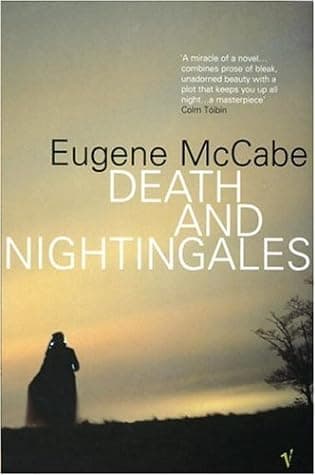
Synopsis
Covers the whole plot, including the ending.
- Difficulty
- Medium
- Pacing
- Moderate
- Mood
- Atmospheric, Suspenseful, Dark, Melancholy
- Read it if
- You enjoy atmospheric historical fiction with a gothic sensibility, focusing on psychological tension, betrayal, and a strong sense of place, exploring themes of freedom and entrapment.
- Skip it if
- You prefer fast-paced plots with clear-cut heroes and villains, or shy away from stories with bleak endings and moral ambiguity.
Death and Nightingales Plot Summary
Covers the whole plot, including the ending.
The Eve of Escape: Beth's Resolve
The story begins on the eve of Beth Winters' 25th birthday, May 19, 1883, in County Fermanagh, Ireland. Beth describes her life of servitude and emotional abuse under her Protestant stepfather, Billy Winters, a landowner and mill owner, after her Catholic mother's death. She has secretly planned to elope with Liam Ward, a Catholic man from the local village, on her birthday night. Her escape involves meeting Liam and a boat journey across the lough. Beth thinks about her past, her mother's tragic life, and her father's absence, all of which drive her desire for freedom from her home, Carrickdrin. She carefully prepares her few belongings and steels herself for the dangerous night, knowing her stepfather's temper.
Billy's Surveillance and Suspicion
Billy Winters, consumed by suspicion and a hatred for Catholics, watches Beth's preparations. He knows about her upcoming birthday and her inheritance from her biological father, money he controls. Billy's thoughts show his past: his affair with Beth's mother, Annie, while her husband was alive, and his marriage to Annie after her husband's death, which he arranged. He believes Beth has been meeting someone and wants to prevent her from leaving, seeing her as his property and a worker. He watches Beth closely, scrutinizing her every move, especially when she goes towards the lough or the village. His paranoia is clear, driven by a fear of losing control and guilt over past actions.
The Birthday Dinner and Growing Tension
On her birthday night, Beth and Billy share a tense dinner. Billy, pretending to be concerned, tries to talk to Beth, but his questions are loaded, looking for signs of her intentions. He subtly reveals he knows about her secret meetings, mentioning the paths she takes and people she might see. Beth, while appearing innocent, feels a growing dread as she realizes how much he watches her. Billy offers her a glass of drugged milk, supposedly to help her sleep, but Beth, expecting this, spills most of it. The dinner is a psychological battle, with Billy trying to dominate and Beth trying to hide her escape, all while fearing her plan might already be known.
Liam's Arrival and the Promise of Freedom
As the night goes on, Beth slips out of the house, going towards the meeting point by the lough. She feels terror and excitement, freedom almost within reach. Liam Ward arrives as planned; his presence is a sign of hope for Beth. He is charming and reassuring, confirming their plan to escape together to America. Beth feels a strong connection to Liam, believing he will save her. She tells him about her life under Billy's tyranny, and Liam listens. They discuss their escape, including the boat journey and the money Beth has. Despite the danger, Beth's resolve strengthens, convinced Liam is her only way out.
The Confession and the Poisoned Milk
By the lough, Beth tells Liam a shocking secret: her mother, Annie, poisoned her biological father, Frank, to be with Billy. This deeply bothers Liam, who struggles with the moral implications. Beth, driven by desperation and a desire to protect Liam, suggests a similar solution for Billy, offering the poisoned milk Billy had intended for her. She proposes they use it to incapacitate or kill Billy, ensuring their escape and protecting her inheritance. Liam, at first hesitant and repulsed, is persuaded by Beth's conviction and the money. Their pasts and the bleakness of their future without this action push them towards a terrible decision, blurring the lines between victim and perpetrator.
The Return to Carrickdrin
Beth and Liam return to Carrickdrin, the air thick with tension and their unspoken pact. Billy is still awake, seemingly unaware of their meeting or their conversation. Beth, with Liam's support, approaches Billy, pretending concern and offering him the poisoned milk, saying it will help him sleep. Billy, confident in his control and believing Beth is under his influence, accepts the drink. The scene has a chilling politeness, as Beth and Liam play their parts, each moment heavy with the coming act. The house, usually a place of oppression for Beth, now becomes the stage for a desperate and dangerous confrontation, with the roles of predator and prey seemingly reversed.
The Poisoning of Billy Winters
Beth, with Liam's help, gives the poisoned milk to Billy. He drinks it, believing it to be a harmless sedative. The poison quickly takes effect, and Billy begins to choke and convulse. A violent struggle follows as Billy realizes what is happening. He fights for his life, accusing Beth of betrayal, his strength surprising even in his weakened state. Beth and Liam must physically restrain him, a brutal act. The scene is chaotic and terrifying, as the reality of their actions hits them. The struggle is messy and desperate, far from the quick death they might have imagined, leaving them both traumatized and marked by their deed.
The Aftermath and Billy's Last Words
Billy Winters dies from the poison, his last breaths filled with accusations and a revelation. As he dies, he whispers a secret to Beth, a truth that shatters her understanding of her entire life: he is her biological father. This changes her relationship with him, her mother, and her own identity. The man she hated, the man she just killed, was her true father. This revelation sends Beth into profound shock and despair, turning her act of liberation into patricide. Liam, seeing this exchange, is also deeply affected, realizing the full weight of their actions and the depth of the lies that shaped Beth's life.
Liam's Betrayal and Beth's Despair
After Billy's death and his shocking revelation, Liam Ward's true character appears. Instead of comfort or support, he shows his mercenary intentions. He takes Beth's inheritance money, the sum meant for their escape and new life, and abandons her. He leaves her alone with the dead body of her father/stepfather, the weight of her actions, and the devastating truth of her parentage. Beth is left alone and betrayed, her dreams of freedom and a new life with Liam shattered. The man she believed would save her instead exploited her and left her to face the consequences of their crime by herself. Her despair is complete, as she realizes her naivety and the tragedy of her choices.
Facing the Future Alone
As dawn breaks over Carrickdrin, Beth Winters is in the house with Billy Winters' body and the wreckage of her life. The realization that Billy was her father, along with Liam's betrayal, leaves her devastated. She reflects on her mother's tragic life, her own desperate choices, and the cycle of violence and deceit that has affected her family. The freedom she wanted has come at an unbearable cost, leaving her isolated and burdened by an unspeakable crime. The story ends with Beth alone, facing the consequences of her actions, the Fermanagh landscape mirroring her inner desolation. Her future is uncertain, but she is changed by the events of her 25th birthday, forever marked by death and betrayal.
Death and Nightingales Characters
Beth Winters
Protagonist
A young woman seeking freedom from her oppressive stepfather and a tragic family legacy.
Beth Winters is the central character, a young Catholic woman living in 1883 Fermanagh. She is intelligent, observant, and deeply resentful of her life under her Protestant stepfather, Billy Winters. Beth is driven by a profound desire for freedom and a new life, having endured years of emotional abuse and servitude. She idealizes her absent biological father and romanticizes the possibility of escape with Liam Ward. Beth is initially portrayed as a victim, but her actions on her 25th birthday reveal a darker, more desperate side, capable of extreme measures to secure her perceived liberation. Her journey is one of shattering revelations and ultimate betrayal, leading to a profound re-evaluation of her identity and choices.
Relationships: Billy Winters (Stepfather/biological father, abuser, victim); Liam Ward (Lover, co-conspirator, betrayer); Annie Winters (mother) (Deceased mother, whose tragic life mirrors Beth's); Frank (biological father) (Deceased father, poisoned by Annie)
Billy Winters
Antagonist
Beth's cruel, controlling stepfather and mill owner, harboring dark secrets.
Billy Winters is Beth's Protestant stepfather, a wealthy landowner and mill owner in Fermanagh. He is portrayed as a cruel, manipulative, and deeply paranoid man, obsessed with control over Beth and his property. Billy is a bigot, frequently expressing contempt for Catholics. His past is steeped in darkness, including an affair with Beth's mother, Annie, and his likely involvement in the death of Beth's biological father, Frank. He sees Beth as his possession and is determined to prevent her from leaving or accessing her inheritance. His death at Beth's hands is complicated by his shocking dying confession, which reveals him to be Beth's biological father, adding a layer of tragic irony to their relationship.
Relationships: Beth Winters (Stepfather/biological father, abuser, victim); Annie Winters (mother) (Lover, wife, co-conspirator in Frank's death)
Liam Ward
Supporting
Beth's charming but opportunistic lover, who promises escape but delivers betrayal.
Liam Ward is a young Catholic man from the local village, charismatic and seemingly devoted to Beth. He represents Beth's hope for freedom and a new life in America, charming her with promises of escape and love. However, Liam's true motivations are revealed to be mercenary; he is primarily interested in Beth's inheritance money. He is easily swayed by Beth's desperate plan to poison Billy, showing a lack of moral compass. His ultimate betrayal of Beth, abandoning her after she commits patricide and stealing her money, exposes him as a selfish and opportunistic individual, leaving Beth utterly alone and devastated.
Relationships: Beth Winters (Lover, co-conspirator, betrayer)
Annie Winters (Beth's Mother)
Mentioned
Beth's deceased mother, whose tragic life and dark secrets cast a long shadow over Beth's own.
Annie Winters is Beth's deceased mother, whose life and choices profoundly impact Beth. She was a Catholic woman who had an affair with Billy Winters while married to Frank, Beth's biological father. Annie poisoned Frank to be with Billy, a secret Beth confesses to Liam. Her life was one of compromise and hidden truths, and her tragic end (implied to be suicide or a consequence of her choices) serves as a cautionary tale for Beth. Her actions set in motion the chain of events that lead to Beth's desperate situation, and her legacy of deceit and violence is inherited by her daughter.
Relationships: Beth Winters (Daughter); Billy Winters (Lover, husband, co-conspirator); Frank (biological father) (Husband, victim of poisoning)
Frank (Beth's Biological Father)
Mentioned
Beth's deceased biological father, poisoned by Annie, whose death is a key family secret.
Frank is Beth's biological father, whose death by poisoning at Annie's hands is a central, dark secret in the Winters family. His absence and the mystery surrounding his death contribute to Beth's longing for a true father figure and her idealized view of him. The revelation that Billy Winters was also her biological father, and that Frank was merely her mother's husband, adds a layer of complexity and tragedy to his character, as he was an innocent victim in Annie and Billy's scheme. His death is the original sin that ripples through the generations, shaping Beth's fate.
Relationships: Beth Winters (Daughter); Annie Winters (mother) (Wife, murderer)
Mary (The Maid)
Supporting
A loyal but fearful maid, a silent observer of the Winters household's dysfunction.
Mary is the long-serving maid in the Winters household. She is a quiet, observant woman who is privy to the oppressive atmosphere and the dynamics between Beth and Billy. While she cares for Beth, her fear of Billy prevents her from openly intervening or offering direct help. She represents the silent, complicit witnesses to abuse in a patriarchal and restrictive society. Her presence highlights Beth's isolation and the pervasive fear that Billy instills in those around him. She is a symbol of the constrained lives of women and servants in this era.
Relationships: Beth Winters (Young mistress, whom she quietly observes); Billy Winters (Master, whom she fears)
The Local Community
Mentioned
The villagers and local Protestants and Catholics, representing the societal backdrop and divisions.
The local community, though not a single character, plays a significant role as the societal backdrop of the novel. It is divided along religious lines, with the Protestant ascendancy (like Billy Winters) holding power and the Catholic community (like Beth and Liam) often marginalized. The community observes the Winters household from a distance, aware of Billy's reputation and the family's secrets, but largely powerless or unwilling to intervene. Their gossip and assumptions contribute to the claustrophobic atmosphere Beth experiences and highlight the rigid social structures of 19th-century Fermanagh. The sectarian tensions are subtly woven into the fabric of the story, influencing relationships and opportunities.
Death and Nightingales Themes
Identity and Self-Discovery
Beth's journey is a quest for identity, first defined by her desire to escape her stepfather and her idealized view of her biological father. The revelation that Billy is her true father at his death completely changes her understanding of herself, her parentage, and her place in the world. She grapples with her mother's choices and her own acts, forcing her to confront who she is outside of the stories she's been told or created. Her identity shifts from victim to perpetrator, from hopeful escapee to betrayed and isolated individual.
“I was a child, and now I am a woman. And I have killed my father. And I don’t know who I am.”
Betrayal and Deceit
Betrayal is a constant theme, happening on many levels. Beth's mother betrayed her first husband with Billy and then poisoned him. Billy betrays Beth's trust and manipulates her for years. Liam betrays Beth's love and trust by abandoning her and stealing her money. Beth even betrays her own moral compass by agreeing to the poisoning. The novel reveals layers of deceit, showing how secrets and lies within a family and community can lead to devastating consequences, leaving characters isolated and destroyed. Liam's abandonment is the ultimate betrayal for Beth, leaving her to face the aftermath alone.
“He had promised her the world, and now he had taken everything.”
Freedom vs. Oppression
Beth's main motivation is her desperate need for freedom from her stepfather, Billy. Her home, Carrickdrin, is shown as a prison, and her life as servitude. The beautiful but harsh Fermanagh landscape ironically reflects her trapped existence. Her escape plan with Liam is her perceived path to liberation, but the novel explores the reality that true freedom often comes at an unbearable cost, or is an illusion. Ultimately, Beth's act of rebellion, while freeing her from Billy's physical presence, leaves her psychologically imprisoned by her actions and the truths she uncovers.
“For twenty-five years I have been a prisoner in this house. Tonight, I will be free.”
The Cycle of Violence and Trauma
The novel shows how violence, both physical and psychological, and trauma are passed down through generations. Beth's mother poisoned her father, a secret Beth uses to justify poisoning Billy. Billy's abusive nature and control come from his own dark past and desires. Beth's act of patricide, though born of desperation, continues this cycle of violence within the family. The trauma of her upbringing and her mother's choices directly lead to Beth's tragic decisions, suggesting that escaping such a cycle is difficult, if not impossible, in a society steeped in historical grievances and personal wounds.
“The past was not dead. It was not even past.”
Sectarianism and Social Division
While not the main focus, the sectarian tensions between Protestants and Catholics in 19th-century Fermanagh subtly shape the story. Billy Winters' prejudice towards Catholics is clear in his thoughts and actions, and Beth's Catholic identity influences her desire to escape his Protestant household. Liam Ward, a Catholic, offers Beth a perceived escape to a different world. The social divisions contribute to the characters' motivations and the sense of isolation, reflecting Ireland's broader historical context. The religious difference between Beth and Billy highlights the cultural gap separating them and makes their relationship impossible.
“He hated the Papists with a passion that burned like a peat fire.”
Plot Devices & Literary Techniques
First-Person Narrative (Beth's Perspective)
Provides intimate access to Beth's thoughts, fears, and motivations.
The novel is primarily narrated from Beth Winters' first-person perspective, interspersed with sections from Billy Winters' viewpoint. Beth's narration is crucial for establishing her subjective experience of oppression, her desperate hope for freedom, and her internal struggle with her conscience. It allows the reader to deeply empathize with her plight and understand her radical actions, even as they unfold into tragedy. This intimate perspective makes the final betrayals and revelations all the more devastating, as we have been privy to her deepest desires and fears.
Dual Perspective (Beth and Billy)
Offers contrasting views and reveals hidden truths through shifting viewpoints.
The narrative alternates between Beth's first-person perspective and Billy Winters' third-person, limited perspective. This dual viewpoint is a powerful device. Beth's sections highlight her victimhood and yearning for escape, while Billy's sections reveal his paranoia, control, and the dark secrets of his past, including his role in Frank's death and his true relationship with Beth. This juxtaposition creates dramatic irony and suspense, as the reader often knows more than Beth, particularly about Billy's surveillance and intentions, until the final, shocking revelation that unites their narratives in a tragic way. It allows for a more comprehensive, albeit unsettling, understanding of the complex power dynamics.
Foreshadowing and Dramatic Irony
Hints at future events and reveals discrepancies between character knowledge and reality.
The novel employs significant foreshadowing, particularly through Billy's internal monologues, which hint at his dark past and his true relationship with Beth long before the final reveal. Beth's reflections on her mother's actions also foreshadow her own. Dramatic irony is present throughout, as the reader often understands Billy's sinister intentions (e.g., the poisoned milk) before Beth does, intensifying the tension. The most profound use is the irony of Beth's desperate act of killing her 'stepfather' only to discover he was her biological father, transforming an act of liberation into patricide, a twist that redefines the entire narrative.
Setting as a Character (Fermanagh Landscape)
The bleak, beautiful Fermanagh landscape mirrors the characters' internal states and the story's grim tone.
The Fermanagh landscape, with its loughs, hills, and isolated farmsteads, functions as more than just a backdrop; it is almost a character itself. Its beauty is often juxtaposed with the harshness and violence of the human drama unfolding within it. The lough, in particular, symbolizes both escape and danger, a path to freedom but also a place of secrets and potential death. The isolation of Carrickdrin mirrors Beth's emotional isolation and entrapment. The bleak, unforgiving nature of the land reflects the grim, fatalistic tone of the story and the characters' struggles against their circumstances, a silent witness to their despair and desperate acts.
The Poisoned Milk
A symbolic object representing manipulation, betrayal, and a cyclical pattern of violence.
The poisoned milk is a potent symbol in the novel. Initially, Billy offers it to Beth to sedate her, a tool of his control and manipulation. Beth, aware of his intent, then turns it against him, transforming it into an instrument of her perceived liberation. This act echoes her mother's use of poison to kill Beth's biological father, establishing a horrific cycle of violence and betrayal within the family. The milk, usually a symbol of nourishment and innocence, becomes corrupted, representing the dark, twisted nature of the relationships and the desperate measures taken for freedom or revenge. It is the literal and symbolic pivot point of the plot.
Death and Nightingales Quotes
“Sure, that's life for you, it's a dirty business, and no mistake.”
“The past is a foreign country; they do things differently there.”
“There's no good in looking back, none at all. What's done is done.”
“God forgive us all for what we do and what we leave undone.”
“The wind was a living thing, tearing at the thatch, howling round the corners of the house.”
“Love is a strange thing, it can make a fool of the wisest man.”
“Silence. The kind of silence that screams.”
“Some things are best left buried, deep down where they belong.”
“The world was a dark place, full of dark deeds.”
“Hope is a dangerous thing, a cruel mistress.”
“The air was thick with unspoken words, with fears and desires.”
“A man’s word, once given, is his bond.”
“There are some things you never get over, no matter how long you live.”
“The land itself seemed to breathe, a living, ancient thing.”
Quiz
10 questions on the plot and the characters. Each answer comes with a short explanation.
Question 1
On what specific occasion does Beth Winters plan her escape from her stepfather, Billy?
- The day after her twenty-fifth birthday
- During the annual harvest festival
- On her twenty-fifth birthday
- When her stepfather goes on a hunting trip
Show answer
C. On her twenty-fifth birthday Beth's plan to escape with Liam Ward is set to unfold on her twenty-fifth birthday, making the events of that single day crucial to the plot.
Question 2
What is the name of Beth's stepfather?
- Seamus
- Liam
- Billy
- Frank
Show answer
C. Billy Beth's stepfather, a central figure of her oppression, is named Billy. He is the man she desperately seeks to escape.
Question 3
Which character is described as 'roguish' and charms Beth Winters, playing a key role in her escape plan?
- Billy Winters
- Liam Ward
- Michael Slattery
- Father McGinn
Show answer
B. Liam Ward Liam Ward is the charming, roguish character with whom Beth plans to elope, hoping he will be her rescuer from her stepfather.
Question 4
What is the primary reason Beth Winters wants to escape her home?
- She dreams of a life in America
- To escape the oppressive control and abuse of her stepfather
- She is in love with a man her stepfather disapproves of
- She wants to inherit her mother's estate sooner
Show answer
B. To escape the oppressive control and abuse of her stepfather Beth's desperate desire for freedom stems from the long-standing oppression and abuse she suffers at the hands of her stepfather, Billy.
Question 5
The story is set in which specific year?
- 1893
- 1873
- 1903
- 1883
Show answer
D. 1883 The book is explicitly set in 1883, a detail that grounds its historical fiction aspect and influences the social context of the plot.
Question 6
The 'fearsome, unforgiving beauty' of which specific landscape forms the backdrop for Beth's story?
- The Scottish Highlands
- The Fermanagh landscape
- The Wicklow Mountains
- The Connemara coast
Show answer
B. The Fermanagh landscape The Fermanagh landscape is explicitly mentioned as the setting, its harsh beauty mirroring the difficult circumstances of Beth's life.
Question 7
What does Beth fear she is 'doomed to repeat' by trusting Liam Ward?
- Her father's financial ruin
- Her mother's tragic mistakes
- Her grandmother's lonely old age
- Her aunt's failed marriage
Show answer
B. Her mother's tragic mistakes A key theme is Beth's internal struggle with the fear of repeating the 'tragic mistakes of her family’s past,' particularly those of her mother, in her choices regarding men.
Question 8
How does the novel portray the relationship between Beth and her stepfather, Billy, leading up to her birthday?
- As one of mutual respect and affection
- As strained but generally peaceful
- As decades of pain and betrayal culminating in a deadly climax
- As a distant, formal arrangement
Show answer
C. As decades of pain and betrayal culminating in a deadly climax The description highlights that 'decades of pain and betrayal build to a devastating, deadly climax' specifically in the context of her relationship with her stepfather, which she seeks to escape.
Question 9
What is the central conflict that drives Beth's actions throughout the story?
- Her desire to reconcile with her estranged father
- Her struggle for autonomy and to escape a life of subjugation
- Her ambition to become a successful landowner
- Her quest to uncover a family secret
Show answer
B. Her struggle for autonomy and to escape a life of subjugation Beth is 'determined to decide her own destiny,' which directly relates to her struggle for autonomy against the oppressive forces in her life, primarily her stepfather.
Question 10
The title 'Death and Nightingales' suggests a juxtaposition of which two primary thematic elements?
- War and peace
- Violence/tragedy and beauty/hope
- Love and betrayal
- Past and future
Show answer
B. Violence/tragedy and beauty/hope The nightingale is often a symbol of beauty, nature, and sometimes hope or lament, while death represents the tragedy and violence that culminates in the story. This contrast is central to the novel's mood and themes.
Death and Nightingales FAQ
What is 'Death and Nightingales' about?
'Death and Nightingales' is a historical fiction novel set in 1883 Fermanagh, Ireland, focusing on Beth Winters's desperate attempt to escape her oppressive life. On her 25th birthday, Beth plans to flee her stepfather, Billy Winters, and her suffocating existence by eloping with the charming but enigmatic Liam Ward, leading to a night of escalating tension and ultimately, tragedy.
Why should I read 'Death and Nightingales'?
You should read 'Death and Nightingales' for its compelling, suspenseful narrative that unfolds over a single day, its richly atmospheric portrayal of 19th-century Fermanagh, and its deep exploration of themes like betrayal, freedom, and the lingering scars of sectarian conflict. The novel offers a profound look into the psyche of its characters, particularly Beth, as she grapples with her past and a perilous future.
What is the background/setting of 'Death and Nightingales'?
The story is set in rural Fermanagh, Ireland, in 1883, a landscape characterized by its wild beauty and underlying sectarian tensions between Protestants and Catholics. This historical backdrop, marked by unresolved conflicts and a rigid social structure, heavily influences the characters' lives and choices, particularly Beth's desire to escape the oppressive environment of her stepfather's estate, Carrigshane.
What are the most memorable quotes?
Memorable quotes often capture the raw emotion and setting, such as Beth's internal reflections on freedom or the stark descriptions of the Fermanagh landscape. Billy Winters's manipulative words to Beth also stand out, revealing his controlling nature and the insidious power dynamics at play. The novel's strength lies in its atmospheric prose and the characters' internal monologues.
What writing style does the author use?
Eugene McCabe employs a sparse yet poetic and deeply atmospheric writing style, utilizing vivid descriptions of the Irish landscape that mirror the characters' inner turmoil. The narrative is often told through multiple perspectives, primarily Beth's and Billy Winters's, creating a sense of dramatic irony and heightening the suspense as events unfold over a compressed timeline.
What minor details add significant meaning?
The recurring motif of the nightingales, which Beth associates with freedom and escape, takes on a poignant irony as her hopes are dashed. Also, the detailed descriptions of the family's Protestant estate versus the Catholic village subtly highlight the deep-seated sectarian divisions and the isolation Beth feels, trapped between two worlds.
What are some subtle foreshadowing moments?
Liam Ward's overly charming yet evasive demeanor subtly foreshadows his eventual betrayal, as does Beth's lingering unease despite her determination to trust him. Billy Winters's constant surveillance and veiled threats throughout the day also hint at his deep-seated knowledge and control over Beth's life, suggesting her escape plan is far from secret.
What unexpected character connections exist?
The most significant unexpected connection is the revelation of Billy Winters's true role in Beth's mother's death, which casts a sinister light on his 'paternal' care for Beth. Furthermore, Liam Ward's previous interactions with Billy, hinted at through their shared history in the local community, suggest a deeper, more manipulative connection between the two men than Beth initially realizes.
What are unspoken character motivations?
Beth's unspoken motivation is a desperate desire for agency and freedom, not just from Billy, but from the shadow of her mother's tragic life and the oppressive societal expectations. Billy Winters's unspoken motivation is a complex mix of possessiveness, guilt over his past actions, and a twisted form of love for Beth, desiring to keep her under his complete control.
What psychological complexities do characters exhibit?
Beth exhibits profound psychological complexities, oscillating between hope, fear, and a deep-seated trauma that influences her judgment and yearning for escape. Billy Winters, on the other hand, is a master manipulator, displaying psychopathic tendencies masked by a veneer of piety and concern, making him a chilling antagonist whose motives are rooted in control and past secrets.
What are the major emotional turning points?
A major emotional turning point is Beth's decision to finally commit to eloping with Liam, despite her lingering doubts, signifying her ultimate bid for freedom. The devastating climax in the boathouse, where the full extent of Liam's betrayal and Billy's manipulation is revealed, constitutes the most significant emotional and plot turning point, shattering Beth's hopes.
How do relationship dynamics evolve?
The relationship dynamics in the novel evolve from Beth's submissive obedience to Billy Winters to her defiant, albeit ultimately failed, attempt to break free. Her initial hopeful, trusting dynamic with Liam Ward quickly devolves into one of betrayal and disillusionment, revealing the true predatory nature of his intentions and the depth of the conspiracy against her.
Which parts remain ambiguous or open-ended?
While the immediate outcome of the climax is clear, the long-term psychological impact on Beth and the exact fate of certain characters after the devastating night are left somewhat open-ended. The novel focuses intensely on the events of one day, leaving the aftermath to the reader's imagination regarding the full consequences for the surviving characters.
What are controversial scenes or decisions?
The controversial decision lies in Beth's choice to trust Liam Ward despite numerous red flags, highlighting her desperation but also her naivety. The most controversial scene is the violent climax in the boathouse, where the full extent of the betrayal and the deadly outcome challenge the reader's expectations for Beth's future, leading to a brutal and tragic resolution.
'Death and Nightingales' ending explained: how it ends & what it means
The novel ends with Beth realizing Liam Ward's betrayal and the full extent of her stepfather Billy Winters's manipulation and control. In a desperate act, Beth shoots and kills Billy, effectively ending his tyrannical hold over her life, but also shattering her dreams of escape with Liam. The ending signifies a tragic liberation for Beth, achieved through violence, leaving her fate uncertain but free from her tormentor.
Similar books
- Wuthering Heights
Emily Brontë
3.9 (1.3M) average on GoodreadsHistorical FictionExplores intense, destructive relationships and a bleak, isolated setting.
- The Secret Scripture
Sebastian Barry
3.8 (17k) average on GoodreadsLiterary FictionFeatures a strong female protagonist in historical Ireland grappling with trauma and societal constraints.
- Rebecca
Daphne du Maurier
4.2 (450k) average on GoodreadsThrillerCreates a pervasive sense of dread and psychological suspense around a powerful, oppressive figure.
- The Old Man and the Sea
Ernest Hemingway
3.8 (831k) average on GoodreadsLiterary FictionA Cuban fisherman's long struggle with a giant marlin becomes a story of endurance and dignity, now retold for young adults with illustrations, phonetic guides, and writing prompts in Traditional Chinese.
- One Hundred Years of Solitude
Gabriel García Márquez
4.1 (753k) average on GoodreadsLiterary FictionThrough the multi-generational story of the Buendía family, a mythical town deals with the repeating patterns of time, love, and solitude, as the extraordinary mixes with the ordinary.
- The Goldfinch
Donna Tartt
3.9 (720k) average on GoodreadsLiterary FictionHaunted by a tragic explosion and clutching a stolen Dutch masterpiece, a young orphan navigates the opulent drawing rooms of New York and the gritty underbelly of the art world, desperately seeking connection and redemption amidst a life spiraling into crime and obsession.




Enjoyed the summary?
A summary gives you the shape of the book. The book itself has the detail, the examples and the voice.
Find Death and Nightingales on AmazonAs an Amazon Associate, BookBrief earns from qualifying purchases. How we're funded