

Synopsis
Covers the whole plot, including the ending.
- Difficulty
- Hard
- Pacing
- Variable
- Mood
- Philosophical, Reflective, Fragmented, Disorienting, Meditative
- Read it if
- You enjoy experimental, philosophical literary fiction that challenges traditional narrative structures, and you're fascinated by themes of travel, the human body, and the interconnectedness of seemingly unrelated stories.
- Skip it if
- You prefer linear plots, strong character arcs, and clear resolutions, or if you find fragmented narratives and philosophical digressions frustrating.
Flights Plot Summary
Covers the whole plot, including the ending.
The World in Your Hand
The book starts with the narrator's thoughts on airports, train stations, and the temporary feel of modern life. She describes the joy of moving, and the freedom travel offers. She compares this to the fixed nature of the past, suggesting that today's people are defined by constant movement. This section introduces the book's fragmented style, mixing personal observations with historical stories about maps, navigation, and the feeling of being a 'traveler.' The narrator is fascinated by the brief connections made while traveling and the unique view from a distance, noting the beauty and impermanence of the world seen from a train or plane.
Chopin's Heart
This historical story describes Ludwika Jędrzejewicz's difficult journey from Paris to Warsaw, carrying her dead brother Frédéric Chopin's heart in a jar of cognac. She does this secretly to fulfill his dying wish, dealing with border checks and the emotional weight of her task. The story highlights the secret nature of her act and the cultural importance of keeping a national treasure. The journey is tense, as Ludwika fears being caught and the heart being disrespected. This section explores national identity, keeping memories alive, and the physical remains of genius, showing the difference between life's briefness and art's lasting power.
The Airport of Vienna
The narrator gives a detailed account of the different types of travelers at an airport. She sorts them into categories: business travelers, tourists, families, and solo wanderers. She guesses their destinations, worries, and hidden stories, seeing the airport as a small example of global society. These observations are mixed with thoughts on airport design and psychology—places meant for transition, where time and identity often feel paused. The narrator finds a special interest in the anonymity and shared vulnerability of people in transit, highlighting the common human experience of moving and waiting.
Kunicki's Story: The Vanishing
Kunicki, a Polish man, is on vacation with his wife, Anna, and their young son, Adam, on a distant Croatian island. One morning, he wakes to find Anna and Adam gone from their rented house. Local authorities offer no help, and Kunicki's frantic search finds no clues. He becomes desperate and paranoid, questioning his own mind and what is real. The disappearance is sudden and unexplainable, leaving Kunicki alone and desperate in a foreign country. This section sets up a main mystery, exploring loss, memory, and the fragile nature of human connection when faced with the unknown, showing the psychological impact of an unexplained absence.
Kunicki's Story: The Return
After several days of agonizing searching, Anna and Adam suddenly reappear as mysteriously as they vanished. They are unharmed and give no clear reason for their absence, saying they were just 'out.' Kunicki is relieved but also deeply troubled and suspicious. Their casual manner and lack of memory about the time they were gone further unsettle him. He struggles to accept the joy of their return with the puzzling mystery of their disappearance, leading to a deep feeling of distance within his own family. This part explores the psychological effects of trauma and how hard it is to rebuild trust when a basic reality has been broken.
The Anatomist Philip Verheyen
This historical section focuses on Philip Verheyen, a 17th-century anatomist who had his own gangrenous leg amputated. After his death, he asked for his leg to be dug up and put back with his body. The story goes into Verheyen's careful work on human anatomy, his detailed drawings, and his deep understanding of the body's workings. The story shows the contradiction of a man so familiar with the physical form, yet separated from a part of himself. This section explores the body, dissection, the link between mind and body, and the philosophical meaning of having a whole body or a fragmented one, connecting the physical journey of a body part to the larger story of travel.
The Woman Who Poisons Her Lover
A woman, now living abroad, gets a letter from her dying high school boyfriend, asking her to return to Poland to help him end his life. She struggles with the moral and emotional weight of this request, remembering their past relationship and the harsh reality of his suffering. Her trip back is a kind of pilgrimage, a facing of a past she had left behind. The story explores the difficulties of love, compassion, and the right to choose one's own death, set against a sad reunion. This part looks at the limits of human connection and the tough choices illness and death force upon people.
The Russian Woman's Journey
This story introduces a Russian woman who lives a quiet, lonely life in a village. She dreams of traveling but never leaves her home. Instead, she finds great joy and a sense of freedom in studying maps and atlases, tracing routes and imagining herself in faraway places. Her 'travels' are only in her mind, yet deeply satisfying. She collects brochures and learns about different cultures, creating a whole world in her mind. This section explores the idea that travel can be an inner journey, a result of imagination and curiosity, challenging the usual definition of a 'traveler' and showing the mind's power to go beyond physical limits.
The Taxidermist's Daughter
The narrator tells of her childhood helping her father, a taxidermist. She describes the careful process of preserving animals, watching them change from living creatures to still displays. This early experience with death and preservation gives her a unique view of the body, its temporary nature, and the human desire to stop decay. The workshop becomes a place for deep thought, where the lines between life, death, and art blur. This part explores death, the artificiality of preservation, and the human need to control or understand the natural cycle of life and decay, connecting to the novel's interest in the body.
The Ferryman
This short piece features a ferryman who regularly carries people and cars across water. He watches his passengers, guessing about their lives and destinations, much like the narrator in an airport. He sees himself as a silent witness to countless individual journeys, a temporary keeper of their passage. His thoughts touch on the repeating nature of his work, the constant flow of people, and the small, personal dramas that happen on his ferry. This section acts as a metaphor for life's journey, with the ferryman as a guide through a transitional space, highlighting the common experience of moving from one place to another, both physically and in life.
The Drifting Islands
The narrator explores 'drifting islands'—pieces of land that break off and float freely—as a metaphor for the human condition and the fragmented nature of modern life. She describes historical accounts and scientific explanations of these events, linking them to the feeling of being unanchored, of always moving without a fixed point. These islands symbolize the temporary nature of identity, the impermanence of place, and the individual's journey through a fluid world. This section deepens the novel's exploration of movement and displacement, suggesting that stability is an illusion and that life itself is a continuous, unpredictable drift.
The Museum of the Body
The narrator describes her visits to various anatomical museums, admiring the preserved specimens, dissections, and medical oddities. She thinks about the ethical questions of displaying human remains and the scientific urge to classify and understand the body's inner workings. These museums become places for deep reflection on death, the fragility of life, and the lasting human fascination with what lies beneath the skin. This section reinforces the novel's main idea of the body as both a container for consciousness and a temporary physical object, highlighting the tension between the sacred and the scientific in understanding human existence.
The Last Ferry
Towards the end of the novel, the narrator shifts her focus from traveling to the inevitable end of all journeys. She thinks about arriving, settling down, and the possible sadness that can come with stopping movement. There is a subtle acknowledgment that while movement offers freedom, it also delays resolution. The idea of returning to a fixed point, or finding a final resting place, is explored with both longing and worry. This section brings the main ideas of motion, stillness, life, and death together, suggesting that even when still, the echoes of past journeys and the potential for future ones remain.
Flights Characters
The Narrator (Olga)
Protagonist/Observer
A philosophical traveler and keen observer of human movement and the body.
The unnamed narrator, often identifiable with the author, is a curious, introspective, and highly observant individual. She is a constant traveler, finding solace and understanding in airports, train stations, and the anonymity of transit. Her mind is a repository of historical anecdotes, scientific facts, and philosophical musings, particularly concerning the human body, its impermanence, and the concept of motion. She is driven by an insatiable curiosity about the world and the diverse ways humans experience life, death, and displacement. She connects seemingly disparate stories through her unique perspective.
Kunicki
Supporting
A Polish man whose family mysteriously vanishes and reappears during a vacation.
Kunicki is a seemingly ordinary man thrust into an extraordinary and terrifying situation. During a family vacation, his wife, Anna, and son, Adam, disappear without a trace, only to reappear days later with no explanation. This event profoundly shatters his sense of reality and trust. He is driven by a desperate search for answers and a struggle to reconcile the inexplicable, which pushes him to the brink of madness. His experience highlights the fragility of control and the psychological impact of the unknown, making him a poignant figure of modern anxiety and disorientation.
Relationships: Anna (wife, whose disappearance deeply traumatizes him); Adam (son, also disappears with Anna)
Anna
Supporting
Kunicki's wife, who vanishes and reappears mysteriously with her son.
Anna is Kunicki's wife and Adam's mother. Her character is largely defined by her mysterious disappearance and reappearance. When she returns, she offers no clear explanation for her absence, appearing strangely calm and unaffected, which only intensifies Kunicki's distress. Her enigmatic nature makes her a symbol of the inexplicable and the unsettling aspects of human behavior and memory. She embodies the idea that some events simply defy rational explanation, leaving those affected to grapple with an unresolvable mystery.
Relationships: Kunicki (husband, to whom she offers no explanation for her absence); Adam (son, disappears with her)
Ludwika Jędrzejewicz
Historical Figure/Supporting
Frédéric Chopin's sister, who secretly transports his heart.
Ludwika Jędrzejewicz is portrayed as a devoted sister and a woman of immense determination. Tasked with fulfilling her brother Frédéric Chopin's dying wish, she undertakes the perilous journey of smuggling his heart from Paris to Warsaw. Her character embodies loyalty, national pride, and the profound connection between family and legacy. Her quiet courage in the face of political instability and personal grief highlights the depth of her love for her brother and her commitment to preserving his memory and national significance. Her journey is both a physical and emotional pilgrimage.
Relationships: Frédéric Chopin (brother, whose dying wish she fulfills)
Frédéric Chopin
Historical Figure/Mentioned
The renowned composer whose heart is transported.
Frédéric Chopin, though deceased within the narrative, is a significant presence. His dying wish to have his heart returned to Poland drives Ludwika's journey and symbolizes the enduring connection between an artist and their homeland. He represents genius, national identity, and the vulnerability of the human body even in death. His heart, preserved in alcohol, becomes a powerful relic, embodying both his physical remains and his spiritual legacy, underscoring the novel's themes of preservation and the physical manifestation of memory and identity.
Relationships: Ludwika Jędrzejewicz (sister, entrusted with his heart)
Philip Verheyen
Historical Figure/Supporting
A 17th-century anatomist who amputated his own leg.
Philip Verheyen is a historical anatomist whose story illustrates the novel's fascination with the human body and its parts. His meticulous work in anatomy and his personal experience of amputation, followed by his request for his leg to be reunited with his body, highlight the complex relationship between identity, consciousness, and physical form. He represents the scientific pursuit of understanding the body, but also the deep human attachment to one's own physical integrity. His story explores the philosophical dimensions of embodiment, fragmentation, and the desire for wholeness, even beyond death.
The Woman Who Poisons Her Lover
Supporting
A woman who fulfills her terminally ill ex-lover's request for euthanasia.
This unnamed woman is faced with an agonizing moral and emotional dilemma. She travels back to Poland to assist her terminally ill high school sweetheart in ending his life. Her journey is a profound act of compassion, confronting her with her past and the stark realities of suffering and death. She embodies the complex interplay of love, responsibility, and the ethical boundaries of human relationships. Her character explores the profound courage and sacrifice involved in making such a difficult decision, highlighting the depths of human empathy and the desire to alleviate suffering.
Relationships: Terminally ill high school sweetheart (ex-lover, whom she helps to die)
The Russian Woman
Supporting
An isolated woman who travels the world through maps.
Living a quiet life in a remote Russian village, this woman embodies the idea of internal travel. Despite never leaving her home, she embarks on elaborate mental journeys through maps and atlases. She finds immense joy and a sense of liberation in tracing routes, studying geography, and imagining distant lands. Her character challenges the conventional definition of a 'traveler,' demonstrating that the human desire for exploration can be satisfied through imagination and intellectual engagement. She represents the power of the mind to transcend physical limitations and find freedom within one's own space.
The Taxidermist's Daughter
Supporting
A young girl who assists her taxidermist father, gaining a unique perspective on life and death.
This character, often implied to be the narrator in her youth, offers a unique lens through which to view the themes of the body, preservation, and mortality. Growing up in a taxidermy workshop, she is intimately familiar with the process of transforming dead animals into static forms. This experience shapes her understanding of life's impermanence and the human desire to control decay. She represents an early fascination with the mechanics of existence and the boundaries between the living and the inanimate, contributing to the novel's overarching exploration of the body as both a temporary vessel and a subject of scientific and artistic curiosity.
Relationships: Her father (taxidermist, who teaches her about preservation)
The Ferryman
Supporting
A modern ferryman who observes the transient lives of his passengers.
The ferryman serves as a symbolic figure, a Charon-like guide through the liminal spaces of modern travel. He transports countless individuals across water, silently observing their fleeting stories and destinations. His reflections on the constant flow of humanity and the brief, intimate encounters on his ferry echo the narrator's own observations in airports. He represents the silent witnesses to human journeys, highlighting the universal experience of transition and the shared vulnerability of being in motion. His character emphasizes the cyclical nature of travel and the persistent human need for movement and connection.
Flights Themes
The Body and Its Fragmentation
Tokarczuk carefully examines the human body, not as a whole, but as separate parts, organs, and systems, often subject to decay, dissection, and preservation. This theme appears in Ludwika Jędrzejewicz's trip with Chopin's heart, the story of anatomist Philip Verheyen and his amputated leg, and the narrator's visits to anatomical museums. The novel questions the body's wholeness, its link to identity, and the human desire to understand, control, or preserve it against the certainty of death. It also looks at the philosophical meaning of a body separated from its mind or broken down for science.
“What does a heart separated from a body remember? Does it remember anything at all? Or is it like a stone that remembers nothing?”
Travel, Movement, and Displacement
A main theme in 'Flights' is travel and the human state of being in motion. The narrator celebrates the freedom and anonymity of airports and train stations, seeing modern life as defined by constant movement. This theme is explored through various characters: Kunicki's difficult vacation, the Russian woman who travels through maps, and Ludwika's historical journeys. The novel suggests that displacement is not just physical but also mental, leading to a fragmented sense of self and place. It examines the appeal and anxiety of being unanchored, always moving between places and identities.
“I don't want to be rooted. I am a restless soul, a traveler, a voyager. I want to see the world, to feel the wind in my hair, to taste the salt on my tongue.”
The Nature of Identity and Belonging
With constant movement comes questions about where one truly belongs and what makes up identity. The characters in 'Flights' are often in in-between spaces, between cultures, homes, and states of being. Kunicki's story shows how easily one's sense of self and family can be broken by unexplained absence. Historical figures, like Chopin, want their physical remains returned to their homeland, highlighting the strong connection between identity and place. The novel suggests that identity changes, shaped by travel experiences and the shifting landscapes of the modern world, making belonging a complex and often hard-to-find idea.
“Where are you from? Where are you coming in from? Where are you going? we call to the traveler.”
Memory, Preservation, and Legacy
The novel often explores how humans try to preserve memories, both personal and shared, and how these efforts shape lasting legacies. Chopin's heart is a literal relic, a physical symbol of a national memory. The taxidermist's work shows a desire to stop decay and keep a semblance of life. Anatomical museums display the scientific preservation of the body. 'Flights' looks at how fragile memory is, what we choose to remember, and the various ways people and cultures try to immortalize what is temporary, questioning whether these acts of preservation are effective or ethical.
“We are like those tiny pieces of amber, in which the life of a mosquito or a gnat has been preserved.”
The Interconnectedness of Stories and Lives
Tokarczuk skillfully connects seemingly different stories, showing that all human experiences, regardless of time or place, are fundamentally linked. The novel's fragmented structure itself reflects this theme, as short stories, historical accounts, and modern tales shed light on each other. The narrator acts as the main connecting thread, drawing comparisons between a 17th-century anatomist and a modern traveler, or between a national hero's preserved heart and a personal family tragedy. This theme suggests that individual lives are part of a larger, complex human experience, where echoes and connections exist across vast distances and centuries.
“Everything is connected. There are no isolated islands, no separate stories. It's all one great, flowing river.”
Plot Devices & Literary Techniques
Fragmented Narrative Structure
The novel is composed of numerous short stories, essays, and meditations.
Instead of a linear plot, 'Flights' is a collection of vignettes, anecdotes, and philosophical reflections. This fragmented structure mirrors the themes of travel, displacement, and the transient nature of modern life. Each piece is a 'flight' or a 'stopover,' contributing to a larger mosaic without strictly adhering to a traditional narrative arc. This device allows Tokarczuk to explore a wide range of characters, historical periods, and philosophical ideas, creating a sense of interconnectedness while maintaining the novel's fluid and exploratory tone. It encourages the reader to make connections and ponder the relationships between seemingly disparate elements.
Metafiction/Self-Reflexivity
The narrator often comments on the act of storytelling and the nature of the novel itself.
The narrator frequently breaks the fourth wall, discussing her writing process, the challenges of creating a coherent narrative, and the philosophical implications of the stories she tells. This self-reflexivity highlights the artificiality of fiction while simultaneously inviting the reader to engage more deeply with the ideas presented. By drawing attention to the construction of the novel, Tokarczuk emphasizes the subjective nature of perception and the power of narrative to shape our understanding of the world, blurring the lines between author, narrator, and reader.
Interweaving of Historical and Contemporary Narratives
Stories from different historical periods are juxtaposed with modern experiences.
Tokarczuk seamlessly blends historical accounts (Chopin's heart, Philip Verheyen) with contemporary stories (Kunicki's vanishing family, the narrator's travel observations). This device creates a rich tapestry of human experience across time, demonstrating the enduring relevance of certain themes—like the body, travel, and identity—throughout history. It suggests that human concerns and fascinations are cyclical, and that past events illuminate present anxieties. This interweaving also contributes to the novel's fragmented yet cohesive feel, allowing for a broader, more universal exploration of its central ideas.
Symbolism of Anatomical Specimens
Preserved body parts and anatomical displays symbolize mortality, identity, and the desire for knowledge.
Throughout the novel, preserved body parts—Chopin's heart, Verheyen's leg, specimens in anatomical museums—serve as powerful symbols. They represent the fragility of life, the inevitability of death, and the human drive to understand and control the physical form. These specimens highlight the tension between the spiritual and the material, the transient and the preserved. They force contemplation on where identity resides—in the whole body, a single organ, or perhaps beyond the physical entirely—and serve as a constant reminder of the body's role in shaping human experience and legacy.
Flights Quotes
“I understood then that the world is a network of connections, and that these connections are made in our minds. It's not about what's there, but what we perceive.”
“What does it mean to be a traveler? It means to be a collector of fragments, a gatherer of stories, a witness to the unknown.”
“Each of us has a soul, and this soul is like a map, constantly being drawn and redrawn by our experiences.”
“The world is an endless labyrinth, and we are all just trying to find our way out, or further in.”
“We are condemned to movement, to constant change. Stagnation is death.”
“”
“”
“”
“To be lost is to be found, in a different way.”
“”
“”
“Time is not a line, but a series of moments, each one unique and unrepeatable.”
“What is memory but a collection of fragments, pieced together to create a story that may or may not be true?”
“”
Quiz
10 questions on the plot and the characters. Each answer comes with a short explanation.
Question 1
Which historical figure's heart is secretly transported back to Warsaw by his sister in one of the novel's narratives?
- Wolfgang Amadeus Mozart
- Frédéric Chopin
- Pyotr Ilyich Tchaikovsky
- Johann Sebastian Bach
Show answer
B. Frédéric Chopin One of the prominent narratives in 'Flights' involves the journey of Frédéric Chopin's heart, preserved in alcohol, being secretly brought back to Warsaw by his sister, Ludwika Jędrzejewicz, after his death in Paris.
Question 2
What is the primary mode of transportation that serves as a central theme and recurring motif throughout 'Flights'?
- Trains
- Ships
- Airplanes
- Automobiles
Show answer
C. Airplanes The title 'Flights' directly refers to air travel, and the novel frequently uses airports, planes, and the experience of flying as a setting and metaphor for modern existence, transit, and the human condition.
Question 3
Which of the following best describes the narrative structure of 'Flights'?
- A single, linear plot following one main character.
- A collection of unrelated short stories.
- Interweaving narratives, meditations, and character vignettes.
- A historical biography presented chronologically.
Show answer
C. Interweaving narratives, meditations, and character vignettes. 'Flights' is known for its non-linear, fragmented structure, which interweaves various narratives, philosophical meditations, historical anecdotes, and character sketches, all loosely connected by themes of travel, the body, and human transience.
Question 4
In one storyline, a woman returns to Poland with the intention of poisoning whom?
- Her estranged father
- Her terminally ill high school sweetheart
- A former business partner
- Her unfaithful husband
Show answer
B. Her terminally ill high school sweetheart The synopsis explicitly mentions a woman who 'must return to her native Poland in order to poison her terminally ill high school sweetheart,' highlighting a dark and complex act of mercy or control.
Question 5
What happens to the wife and child of a young man during a vacation, leading to his descent into madness?
- They are kidnapped and held for ransom.
- They mysteriously vanish and then just as suddenly reappear.
- They die in a tragic accident.
- They leave him for another family.
Show answer
B. They mysteriously vanish and then just as suddenly reappear. One of the central narratives follows a young man whose wife and child 'mysteriously vanish during a vacation and just as suddenly reappear,' driving him to madness and exploring themes of disappearance and presence.
Question 6
Which historical anatomical collection is featured, emphasizing the novel's interest in the human body and its preservation?
- The Mütter Museum's anatomical specimens
- The Vrolik Museum's pathological anatomy
- The collection of Frederik Ruysch's anatomical preparations
- The Hunterian Museum's anatomical displays
Show answer
C. The collection of Frederik Ruysch's anatomical preparations The novel includes detailed reflections on the anatomical preparations of Frederik Ruysch, an 17th-century Dutch anatomist, whose preserved specimens, including foetuses and body parts, are described with both scientific interest and artistic reverence, linking to the novel's broader exploration of the body, death, and preservation.
Question 7
The novel frequently shifts between different perspectives and time periods. What literary technique does this primarily exemplify?
- Stream of consciousness
- Omniscient narration
- Pastiche
- Fragmentation and polyphony
Show answer
D. Fragmentation and polyphony Tokarczuk employs fragmentation, presenting numerous distinct stories, essays, and character vignettes, often with varying narrative voices and temporal settings. This creates a polyphonic effect, where multiple voices and perspectives contribute to the overarching themes rather than a single linear narrative.
Question 8
What philosophical concept, central to the novel, explores the idea of human existence as constantly moving, without a fixed home or identity?
- Existentialism
- Nihilism
- Nomadism
- Solipsism
Show answer
C. Nomadism The novel deeply explores the concept of nomadism, not just in physical travel but as a state of being—a constant motion, a lack of fixed abode or identity, and a perpetual wandering through space and time, which is central to the 'traveler' identity the book investigates.
Question 9
Beyond the physical act of travel, 'Flights' also delves into the metaphorical journey of the human body after death. How is this theme prominently explored?
- Through detailed accounts of funeral rites in various cultures.
- By focusing on the preservation and dissection of human remains.
- By examining spiritual beliefs about the afterlife.
- Through stories of reincarnation and past lives.
Show answer
B. By focusing on the preservation and dissection of human remains. The novel dedicates significant attention to the journey of the body after death, particularly through its fascination with anatomical preservation, dissection, and the historical figures like Ruysch and his specimens, emphasizing the body's continued 'motion' and transformation even after life ceases.
Question 10
The narrator often reflects on maps, atlases, and the act of mapping. What is the implied significance of these geographical tools in the context of the novel's themes?
- They represent humanity's ultimate control over nature.
- They symbolize the futility of trying to impose order on chaos.
- They are attempts to capture and understand motion, yet inherently static.
- They serve as practical guides for the narrator's personal journeys.
Show answer
C. They are attempts to capture and understand motion, yet inherently static. Maps and atlases are recurring motifs that highlight the paradox of trying to represent movement and fluidity with static images. They are human attempts to categorize, understand, and contain the world, but in doing so, they often fail to capture the essence of constant change, motion, and the subjective experience of travel, which are central to the novel's themes.
Flights FAQ
What is the overarching theme connecting the disparate narratives in 'Flights'?
The central theme is the exploration of movement, travel, and the human body in various states of flux and decomposition. Tokarczuk uses the metaphor of 'flights' to examine physical journeys, the circulation of anatomical specimens, and philosophical wanderings through time and memory, ultimately questioning the nature of home and belonging.
Who is Kunicki, and what happens to his family during their island vacation?
Kunicki is a Polish man whose wife and young son mysteriously disappear during a vacation on an island, leaving him in a state of frantic despair. They reappear just as suddenly, but Kunicki is plagued by the unsettling suspicion that the returned wife is not truly his own, leading him into a profound psychological crisis and questioning of reality.
How does Chopin's heart feature in the novel, and what does its journey symbolize?
Chopin's preserved heart is secretly transported from Paris to Warsaw by his sister, Ludwika Jędrzejewiczowa, after his death. This narrative thread symbolizes the enduring connection between body and homeland, the desire to reclaim and preserve fragments of identity, and the macabre beauty of anatomical preservation.
What is the significance of the woman returning to Poland to poison her former lover?
This story, featuring the character Annushka and her terminally ill high school sweetheart, serves as a dark meditation on mercy, love, and the finality of life. It explores the moral complexities of euthanasia and the profound intimacy that can exist even in acts of ending, tying into the broader theme of the body's ultimate fate.
What role do anatomical museums and preserved specimens play in the book?
Anatomical museums and preserved bodies, like the famous plastinated 'visible man' in the airport, are recurring motifs. They highlight the human fascination with the body's inner workings, its fragility, and its potential for scientific study and artistic display, often juxtaposing life with death and permanence with decay.
Are there any subtle connections between the narrator and the characters like Kunicki or the woman who poisons her lover?
While not explicitly stated as direct encounters, the narrator often observes or reflects on scenarios that parallel the characters' experiences. The narrator's meditations on travel and identity echo Kunicki's disorientation, and the philosophical musings on life and death resonate with the ethical dilemmas faced by the woman poisoning her lover, suggesting a shared human condition.
What is the 'Psychopath's Island' mentioned by the narrator, and what does it represent?
The 'Psychopath's Island' is a fictional, metaphorical place conceived by the narrator where individuals who commit heinous crimes are sent, not for punishment, but for observation and study. It represents Tokarczuk's interest in the boundaries of human morality, the origins of evil, and the societal attempts to understand or contain deviance.
Is there a specific historical figure, other than Chopin, whose anatomical journey is detailed?
Yes, the narrative also delves into the story of Philip Verheyen, an 18th-century anatomist who reportedly had his own amputated leg preserved and kept nearby. This account further emphasizes the historical and personal fascination with the body, its parts, and the desire to understand or retain a physical self even after death.
How does Kunicki's psychological state evolve after his family's return, and what does this signify?
Kunicki descends into a profound state of paranoia and existential dread, convinced that the woman who returned is an impostor. This psychological breakdown signifies the fragility of identity and perception, the way trauma can shatter one's sense of reality, and the terrifying possibility that even the most intimate relationships can be undermined by doubt.
What psychological comfort or distress does constant travel provide for the narrator?
For the narrator, constant travel offers both a sense of freedom and a form of escape from the fixedness of identity and place. While it provides a stimulating detachment and opportunity for observation, it also hints at a potential rootlessness or inability to fully engage, suggesting a complex interplay of solace and unease.
How does the novel explore the concept of 'home' from a psychological perspective?
'Flights' deconstructs the traditional notion of 'home' as a stable, fixed point. Psychologically, home becomes less about a physical location and more about an internal state, a memory, or even the familiar discomfort of constant transit. Characters often feel alienated even in their supposed homes, or find belonging in unexpected, transient spaces.
What is the significance of the recurring images of maps and atlases in the novel?
Maps and atlases serve as metaphors for attempts to impose order and understanding on a chaotic world. Psychologically, they represent the human desire to orient oneself, to chart territory both physical and internal, and to find meaning in movement, even as the narratives themselves often defy linear mapping.
Is the narrator a consistent character throughout the novel, or are there multiple 'narrator' voices?
The narrator feels like a consistent, singular consciousness, despite the fragmented structure. While the voice shifts in tone and focus, it maintains a distinct philosophical and observational perspective, acting as a unifying thread that weaves together the disparate stories and meditations, reflecting a single mind grappling with these themes.
How does the novel challenge traditional notions of linear narrative and plot?
'Flights' eschews a conventional linear plot in favor of a mosaic structure, presenting a collection of interconnected fragments, essays, and stories. This challenges the reader to find connections and create meaning across disparate narratives, mirroring the fragmented nature of modern life and consciousness itself.
What is the ultimate message or conclusion that Tokarczuk offers about human existence in 'Flights'?
Tokarczuk offers no single, definitive conclusion, but rather invites readers to embrace the fluidity and impermanence of existence. The novel suggests that life is a continuous journey, a series of transitions and transformations, and that meaning can be found not in fixed points, but in the act of movement, observation, and the intricate connections between all things.
How does the novel's structure reflect its themes of travel and fragmentation?
The novel's non-linear, fragmented structure perfectly mirrors its themes. Short chapters, essays, and narratives are like snapshots from a journey, disconnected yet part of a larger whole, reflecting the experience of travel where one encounters diverse people and places without necessarily seeing their full stories unfold.
Is the ending of Kunicki's story ambiguous, and what does this ambiguity suggest?
Yes, the ending of Kunicki's story is highly ambiguous, leaving the reader to question whether his wife was truly replaced or if his madness consumed him. This ambiguity suggests the limits of human perception, the unreliability of memory, and the profound psychological impact of trauma, reinforcing the novel's theme that objective truth can be elusive.
What is the significance of the title 'Flights' beyond literal air travel?
The title 'Flights' extends beyond literal air travel to encompass various forms of movement: flights of imagination, philosophical flights of thought, the flight of time, the flight from responsibility, and even the flight of anatomical specimens across continents. It signifies the transient nature of existence and the constant state of flux in the human experience.
About the author
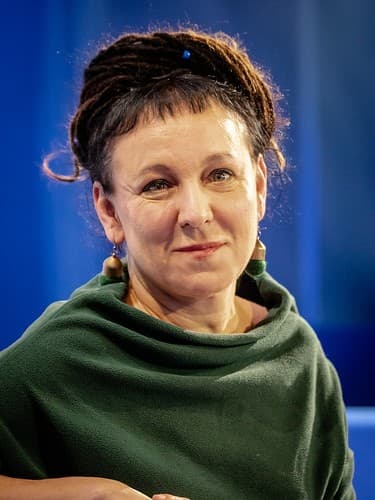
Olga Tokarczuk is a Polish author known for her contributions to contemporary literature. Her notable works include "Drive Your Plow Over the Bones of the Dead," a novel that explores themes of nature and morality, and "Flights," which delves into travel and the human experience. Tokarczuk was awarded the Nobel Prize in Literature in 2018 for her narrative imagination.
Similar books
- Austerlitz
W.G. Sebald
4.0 (14k) average on GoodreadsHistorical FictionExplores memory, travel, and history through a fragmented, contemplative style.
- Cloud Atlas
David Mitchell
4.0 (216k) average on GoodreadsLiterary FictionInterweaves multiple seemingly separate stories across different times and genres.
- The Old Man and the Sea
Ernest Hemingway
3.8 (831k) average on GoodreadsLiterary FictionA Cuban fisherman's long struggle with a giant marlin becomes a story of endurance and dignity, now retold for young adults with illustrations, phonetic guides, and writing prompts in Traditional Chinese.
- One Hundred Years of Solitude
Gabriel García Márquez
4.1 (753k) average on GoodreadsLiterary FictionThrough the multi-generational story of the Buendía family, a mythical town deals with the repeating patterns of time, love, and solitude, as the extraordinary mixes with the ordinary.
- The Goldfinch
Donna Tartt
3.9 (720k) average on GoodreadsLiterary FictionHaunted by a tragic explosion and clutching a stolen Dutch masterpiece, a young orphan navigates the opulent drawing rooms of New York and the gritty underbelly of the art world, desperately seeking connection and redemption amidst a life spiraling into crime and obsession.
- Little Fires Everywhere
Celeste Ng
4.1 (713k) average on GoodreadsLiterary FictionIn Shaker Heights, an artist and her daughter move in, and their free-spirited lives clash with a rule-bound matriarch, revealing hidden conflicts beneath a perfect surface.






Enjoyed the summary?
A summary gives you the shape of the book. The book itself has the detail, the examples and the voice.
Find Flights on AmazonAs an Amazon Associate, BookBrief earns from qualifying purchases. How we're funded