

Synopsis
Covers the whole plot, including the ending.
- Difficulty
- Hard
- Pacing
- Slow
- Mood
- Reflective, Profound, Melancholy, Intellectual
- Read it if
- You appreciate complex character studies, profound explorations of identity and race in America, and rich, lyrical prose reminiscent of jazz improvisation.
- Skip it if
- You prefer fast-paced plots with clear resolutions, or find narratives that frequently shift in time and perspective challenging.
Juneteenth Plot Summary
Covers the whole plot, including the ending.
The Senator's Deathbed Confession
The novel opens with the dying Senator Adam Sunraider, a prominent but controversial white politician, requesting the presence of Reverend A.Z. Hickman, an elderly Black minister. Sunraider, gravely wounded after an assassination attempt during a speech, is in a hospital, surrounded by his staff and concerned onlookers. He is wracked with guilt and a desperate need to confess his life story to Hickman, whom he calls 'Daddy' and recognizes from his childhood. The senator's request puzzles many, as his public persona is that of a race-baiting demagogue. Hickman, a man of spiritual authority, arrives, prepared to listen to the senator's sprawling, often disjointed narrative, which begins to reveal a shared, hidden past.
Bliss's Early Life and Adoption
Sunraider's confession transports the narrative back to his childhood as Bliss, a fair-skinned, ambiguously racial orphan. Reverend Hickman, then a charismatic and influential preacher, discovers Bliss as an infant after a devastating fire and takes him in. Bliss is raised within Hickman's all-Black religious community in a small Southern town, learning gospel music, the art of preaching, and the values of the church. He is a curious and intelligent child, deeply loved by Hickman and the women of the congregation. His upbringing is steeped in the cultural traditions of the African American South, and he shows talent for mimicry and performance, often imitating Hickman's sermons with uncanny accuracy.
The Young Preacher's Promise
As Bliss grows, he becomes a prodigy in the church. Under Hickman's guidance, he masters the cadences of preaching, the power of storytelling, and the ability to move a congregation. He is seen as the natural heir to Hickman's spiritual leadership, a 'chosen child' destined to carry on the ministry. His sermons, even as a youth, are powerful and captivating, blending the sacred with a nascent understanding of human experience. This period marks a deep bond between Bliss and Hickman, a father-son relationship built on mutual respect and affection, and a shared passion for the transformative power of the spoken word and music.
The Seeds of Doubt and Departure
Despite his success and acceptance within Hickman's community, Bliss begins to feel an underlying tension about his racial identity and his future. He is aware of his light skin and the ambiguities it presents in the segregated South. He also yearns for a different kind of knowledge and experience beyond the church. This internal conflict, coupled with a growing restlessness and a desire to explore the wider world, eventually leads him to decide to leave Hickman and the only home he has ever known. His departure is a profound break, leaving Hickman and the community with a sense of loss and unanswered questions.
The World Outside: Film and Reinvention
After leaving Hickman, Bliss embarks on a journey of self-discovery and reinvention. He sheds his past identity, including his name, and ventures into the burgeoning world of filmmaking. His ambiguous racial appearance allows him to move between different social spheres, adopting new personas. He finds success in creating propaganda films, often exploiting racial stereotypes, and becomes adept at manipulating perceptions. This period marks a moral shift, as he increasingly embraces a cynical view of identity and truth, using his early training in performance and rhetoric for secular, and often morally questionable, ends.
The Rise of Adam Sunraider
Through a series of calculated choices and opportunistic maneuvers, Bliss fully abandons his past as a 'black' preacher's son and emerges as Adam Sunraider, a powerful white politician. He builds a career on a platform that often uses divisive rhetoric, particularly on issues of race. This transformation is not merely superficial, it involves a deep psychological denial of his origins and the people who raised him. He actively suppresses his memories of Hickman and the Black community, constructing an entirely new public identity that is a stark contrast to his formative years. His success is built on this elaborate deception, an act of self-erasure.
The Juneteenth Speech
The novel circles back to the event that brings Sunraider and Hickman together: Sunraider's controversial Juneteenth speech. On a day commemorating the emancipation of enslaved people, Sunraider, a white senator, delivers a speech many perceive as deeply offensive and racially charged. His words ignite a furious reaction, culminating in an assassination attempt that leaves him critically wounded. This public spectacle and near-death experience trigger his desperate need to confess to Hickman, suggesting that the trauma has shattered the carefully constructed facade of his identity and forced him to confront the suppressed truths of his past.
Hickman's Enduring Faith and Memory
As Sunraider confesses, the narrative interweaves Hickman's perspective. The old preacher, though deeply hurt by Bliss's abandonment and subsequent transformation into Sunraider, has never truly given up on him. He reflects on his own life, his unwavering faith, and the impact Bliss had on him and his ministry. Hickman's memories provide a counterpoint to Sunraider's self-serving narrative, offering a more nuanced and compassionate view of Bliss's early promise and the circumstances of his upbringing. He sees beyond the senator's public persona, recognizing the lost boy he once loved and nurtured.
The Confession Unravels
Sunraider's confession is not linear but a sprawling, improvisational monologue, echoing the structure of a jazz performance. He jumps between past and present, truth and fabrication, attempting to make sense of his own complex identity. He recounts his experiences with women, his political machinations, and his internal struggles. His narrative is a desperate attempt to reconcile the disparate parts of himself: the Black preacher's son and the white senator, the innocent Bliss and the cynical Sunraider. Hickman patiently listens, occasionally interjecting with questions or affirmations, guiding Sunraider towards a deeper self-awareness.
Reconciliation and Unfinished Business
As Sunraider's confession unfolds, a fragile process of reconciliation begins between the dying senator and his spiritual father. Sunraider, stripped of his public identity by his imminent death, confronts the betrayal of his past. Hickman, in turn, offers a form of absolution and understanding, rooted in his deep love and spiritual wisdom. The novel grapples with the possibility of redemption, even for a life built on denial and deception. However, the exact nature of their reconciliation and Sunraider's ultimate fate remain ambiguous, leaving the reader to ponder the lasting impact of identity, race, and personal choice.
Principal Figures
Senator Adam Sunraider (Bliss)
Protagonist/Antagonist
A dying white senator who was raised as a Black preacher's son.
Adam Sunraider is a complex, contradictory figure. Publicly, he is a powerful, often demagogic white senator, known for his divisive rhetoric. Privately, he is Bliss, an orphan of ambiguous racial heritage raised by Reverend A.Z. Hickman in a Black community. His life is a monumental act of self-invention and denial, having shed his past to achieve political power. He is intelligent, charismatic, and manipulative, but also deeply tormented by his suppressed identity and the choices he has made. His dying confession is a desperate attempt to reconcile his fragmented self.
Relationships: Reverend A.Z. Hickman (Adoptive father, spiritual mentor, and later the recipient of his deathbed confession.); Various Women (Lovers and figures in his life who reflect aspects of his identity and desires.)
Reverend A.Z. Hickman
Supporting/Moral Compass
An elderly, wise Black preacher who adopted and raised Bliss.
Reverend A.Z. Hickman is the moral and spiritual anchor of the novel. He is a man of profound wisdom, unwavering faith, and deep compassion. As Bliss's adoptive father and mentor, he embodies the rich cultural and spiritual traditions of the African American South. His sermons are legendary, and his community reveres him. Despite Bliss's betrayal and transformation into Sunraider, Hickman maintains a steadfast love and concern for the lost boy. He serves as the patient, listening ear for Sunraider's confession, offering guidance and a pathway to potential redemption.
Relationships: Senator Adam Sunraider (Bliss) (Adoptive son, former prodigy, and the object of his enduring spiritual concern.)
Synergy
Supporting/Symbolic
A woman who represents the complex interplay of race, performance, and desire in Bliss's life.
Synergy is a recurring figure in Sunraider's fragmented memories, representing different aspects of his past and his struggle with identity. She appears in various guises, often associated with his early experiences with film and his exploration of sensuality and performance. She embodies the allure and danger of the secular world that drew Bliss away from his spiritual upbringing. Her presence often highlights the themes of racial ambiguity and the constructed nature of identity, mirroring Sunraider's own journey of reinvention and denial.
Relationships: Senator Adam Sunraider (Bliss) (A complex, often romantic or sensual relationship, tied to his self-discovery and reinvention.)
Brother Tarp
Mentioned/Symbolic
A character from Hickman's past, symbolizing resistance and the legacy of the Black experience.
Brother Tarp is primarily mentioned in Hickman's recollections, representing a figure of resistance and deep-seated wisdom within the Black community. He embodies the historical struggles and resilience of African Americans, and his stories and experiences contribute to the rich tapestry of Hickman's spiritual and cultural heritage. Tarp's presence, though not active in the present narrative, reinforces the depth of the community Bliss abandoned and the profound historical context of Hickman's ministry.
Relationships: Reverend A.Z. Hickman (Respected elder and fellow traveler in the struggle for dignity and faith.)
The Hospital Staff/Politicians
Supporting/Background
The contemporary figures surrounding Sunraider's deathbed, representing the external world.
This group includes doctors, nurses, political aides, and other officials present at Sunraider's hospital bedside. They represent the external, public world from which Sunraider has come, and their reactions to his bizarre request for Hickman highlight the profound disconnect between his public persona and his hidden past. They are confused, skeptical, and often dismissive of the spiritual drama unfolding, serving as a foil to the deeply personal and historical narrative shared between Sunraider and Hickman.
Relationships: Senator Adam Sunraider (Bliss) (Professional colleagues and caregivers, observing his final hours.)
Themes & Insights
Identity and Reinvention
The novel explores the fluidity and constructed nature of identity, especially in the American context of race. Bliss's transformation into Adam Sunraider is an act of self-reinvention, shedding his Black-identified past to become a white politician. This theme questions whether one can truly escape their origins or if suppressed identities inevitably resurface. Sunraider's deathbed confession is a desperate attempt to reconcile these disparate selves, highlighting the psychological toll of denying one's truth. The ambiguity of Bliss's racial heritage further underscores the idea that identity is often a performance, shaped by societal perceptions and personal choice.
“Tell me what happened while there's still time,”
Race and Performance
Ellison explores the performative aspects of race in America. Bliss, with his light skin, is able to 'pass' as white, allowing him to navigate and exploit racial boundaries. His early training as a preacher, a master of rhetoric and theatricality, ironically prepares him for his later career as a politician and filmmaker, where he manipulates public perception and often perpetuates racial stereotypes for his own gain. The novel suggests that racial identity is not merely biological but a social construct, a role one can adopt or discard, with personal and societal consequences. Sunraider's public life is a performance designed to deny his racial origins.
“I was a master of masks, a shape-shifter, a chameleon in a world of fixed colors.”
Betrayal and Redemption
At its heart, 'Juneteenth' is a story of betrayal — Bliss's abandonment of Hickman and his community, and his denial of his own past. This betrayal is not only personal but also cultural and spiritual, as he turns his back on the values and heritage he was raised with. The novel explores the possibility of redemption, as Sunraider, on his deathbed, seeks absolution from the man he wronged. Hickman, embodying Christian forgiveness and enduring love, offers a path towards reconciliation. This theme questions whether true redemption is possible for acts of such deep denial and whether one can ever fully atone for a life built on falsehoods.
“And behind it all lies a mystery: how did this chosen child become the man who would deny everything to achieve his goals?”
The Power of the Word and Music
Ellison, a master of language, emphasizes the power of both the spoken word and music. Reverend Hickman's sermons, filled with gospel rhythms and powerful rhetoric, shape Bliss's early life and instill in him an understanding of how to move and inspire people. This mastery of language and performance is later perverted by Sunraider in his political career and filmmaking, where words are used for manipulation and deception. The novel itself, with its jazz-like improvisational structure and lyrical prose, reflects this theme, showing how language can create, destroy, and ultimately reveal truth.
“Oh, that boy could preach! He had the Word in him, sure as I’m standing here.”
History and Memory
The novel grapples with how history is remembered, suppressed, and reinvented, both personally and collectively. Sunraider's entire life is an attempt to erase his personal history, while Hickman represents the enduring memory and historical consciousness of the Black community. The fragmented, non-linear narrative structure mirrors the way memory functions, often surfacing in disjointed flashes and impressions. The title 'Juneteenth' itself invokes a specific historical moment, highlighting the importance of remembering and acknowledging the past, even when individuals or society attempt to deny it. The story suggests that unacknowledged history can haunt the present.
“The past is never dead. It’s not even past.”
Plot Devices & Literary Techniques
The Deathbed Confession
A narrative framework where a dying character recounts their life story.
This device immediately establishes a sense of urgency and high stakes. Sunraider's confession is not merely a recounting of events but a desperate attempt at self-reckoning and potential absolution. It allows for a non-linear narrative, as memories surface in a fragmented, associative manner, mirroring the chaotic nature of the senator's mind. The presence of Hickman as the listener adds a layer of moral judgment and spiritual guidance, transforming the confession into a potential act of redemption and forcing the protagonist to confront his deepest truths.
Racial Ambiguity / Passing
The protagonist's ability to be perceived as either Black or white.
This is a central device that drives the entire plot and its thematic explorations. Bliss's light skin allows him to 'pass' as white, enabling his reinvention as Adam Sunraider. This device highlights the constructed nature of race and the social advantages and disadvantages associated with racial identity in America. It also creates profound internal conflict for the character, as he constantly navigates and exploits his ambiguous identity, leading to a life built on denial and self-deception. The ambiguity itself becomes a symbol of the fluid and often deceptive nature of American identity.
Jazz Improvisation (Narrative Structure)
A non-linear, associative narrative style mirroring the structure of jazz music.
The novel's narrative does not follow a strict chronological order but rather shifts between past and present, memory and reflection, much like a jazz musician improvises on a theme. Sunraider's confession is fragmented, full of digressions, repetitions, and sudden shifts in focus. This device reflects the internal chaos and complexity of the protagonist's mind, and it also allows Ellison to explore themes from multiple angles, creating a rich, multi-layered reading experience that echoes the improvisational, call-and-response traditions of African American oral culture and music.
The Double
The protagonist embodies two distinct, opposing identities.
Senator Adam Sunraider and the young Bliss represent a classic literary 'double.' They are two manifestations of the same individual, yet embody vastly different values, racial identities, and life paths. This device externalizes Sunraider's internal conflict and the profound psychological split caused by his denial of his past. The senator's journey is an attempt to reconcile these two opposing selves, highlighting the struggle between authenticity and performance, and the devastating consequences of suppressing one's true identity for societal gain.
Juneteenth Quotes
“The very idea of a Negro senator was a source of profound discomfort, a violation of the natural order of things.”
“History, Stephen decided, was not a straight line, but a series of interconnected circles, some expanding, some contracting, but all part of the same grand, bewildering design.”
“Every man, whether he knows it or not, is the sum of his ancestors.”
“The greatest tragedy of our time is not the bomb, but the silence between men.”
“Sometimes you have to be blind to see, and deaf to hear.”
“Memory is a tricky thing. It can be a blessing and a curse, a comfort and a torment.”
“To be truly free, one must first be free of the need to be understood.”
“The past is never dead. It's not even past.”
“A lie can travel halfway around the world while the truth is still putting on its shoes.”
“We are all trapped in the narratives we create for ourselves, and for others.”
“There are some things you can't learn from books, some things you just have to live.”
“The world is full of signs, if only we knew how to read them.”
“To deny a man his history is to deny him his humanity.”
“Silence is not always empty; sometimes it is full of unspeakable things.”
“The only way to overcome the past is to understand it, truly understand it, with all its ugliness and its beauty.”
Quiz
10 questions on the plot and the characters. Each answer comes with a short explanation.
Question 1
What is the relationship between Senator Adam Sunraider and the itinerate preacher he calls Daddy Hickman?
- They are biological father and son.
- Hickman adopted Sunraider, who was an orphan named Bliss.
- Hickman was Sunraider's political mentor.
- They were former army comrades.
Show answer
B. Hickman adopted Sunraider, who was an orphan named Bliss. The book description explicitly states that Sunraider, as a young man named Bliss, was an orphan taken in by Hickman and raised to be a preacher.
Question 2
What is Senator Adam Sunraider's dying demand to Daddy Hickman?
- To reveal the location of his hidden fortune.
- To tell him what happened while there's still time.
- To forgive him for his past transgressions.
- To deliver a final sermon at his funeral.
Show answer
B. To tell him what happened while there's still time. The opening line of the synopsis states, "Tell me what happened while there's still time, demands the dying Senator Adam Sunraider to the itinerate preacher whom he calls Daddy Hickman."
Question 3
What was Senator Adam Sunraider's original name when he was an orphan taken in by Daddy Hickman?
- Adam
- Bliss
- Juneteenth
- Oklahoma
Show answer
B. Bliss The synopsis clearly states, "As a young man, Sunraider was Bliss, an orphan taken in by Hickman and raised to be a preacher like himself."
Question 4
Which of the following experiences is NOT mentioned as part of young Bliss's history?
- Joys of young southern boyhood.
- Bucolic days as a filmmaker.
- Lovemaking in a field in the Oklahoma sun.
- Studying theology in a prestigious northern seminary.
Show answer
D. Studying theology in a prestigious northern seminary. The description lists "joys of young southern boyhood; bucolic days as a filmmaker, lovemaking in a field in the Oklahoma sun" as part of Bliss's history. There is no mention of a northern seminary.
Question 5
The central mystery of the novel revolves around:
- The true identity of Senator Adam Sunraider's biological parents.
- How Bliss, the chosen child, became the man who would deny everything to achieve his goals.
- The origins of Daddy Hickman's itinerate preaching ministry.
- The specific political policies Senator Sunraider championed.
Show answer
B. How Bliss, the chosen child, became the man who would deny everything to achieve his goals. The synopsis explicitly states, "And behind it all lies a mystery: how did this chosen child become the man who would deny everything to achieve his goals?"
Question 6
How does the novel's prose style relate to musical forms, according to the description?
- It is compared to classical orchestral compositions.
- It evokes the rhythms of jazz and gospel and ordinary speech.
- It features a rigid, metrical structure similar to traditional hymns.
- Its language is deliberately discordant and atonal.
Show answer
B. It evokes the rhythms of jazz and gospel and ordinary speech. The description notes, "Here is the master of American vernacular at the height of his powers, evoking the rhythms of jazz and gospel and ordinary speech."
Question 7
The novel is presented as a 'long-awaited second novel' from Ralph Ellison. What is his first bestselling novel mentioned in the description?
- Native Son
- Go Tell It on the Mountain
- Invisible Man
- Their Eyes Were Watching God
Show answer
C. Invisible Man The very first sentence of the description states, "From the author of bestselling Invisible Man--the classic novel of African-American experience--this long-awaited second novel..."
Question 8
The description characterizes Bliss's transformation into Senator Sunraider as a denial of 'everything to achieve his goals.' What does this suggest about Sunraider's character arc?
- He maintained his religious upbringing while pursuing political power.
- He abandoned his early identity, values, and possibly his connection to Hickman for ambition.
- His political career was a direct continuation of his preaching.
- He successfully integrated his past with his present without conflict.
Show answer
B. He abandoned his early identity, values, and possibly his connection to Hickman for ambition. The phrase "deny everything to achieve his goals" strongly implies a significant break or betrayal of his past identity and values, including his upbringing by Hickman, in favor of his political ambitions.
Question 9
The novel is described as 'an evocative tale of a prodigal of the twentieth century.' In the context of the biblical parable, what does 'prodigal' imply about Sunraider's journey?
- He was always faithful to his origins and never strayed.
- He squandered his inheritance and returned home repentant.
- He left his spiritual home and upbringing, possibly to pursue worldly ambitions, and is now confronting that past.
- He was a benevolent leader who always put others first.
Show answer
C. He left his spiritual home and upbringing, possibly to pursue worldly ambitions, and is now confronting that past. The term 'prodigal' (from the Parable of the Prodigal Son) refers to someone who leaves home and squanders their inheritance or opportunities, often returning later. In this context, it implies Bliss left his spiritual 'home' and the path Hickman set for him to pursue other goals, now facing the consequences.
Question 10
The review from Newsday states, 'With its publication, a giant world of literature has just grown twice as tall.' What literary significance does this statement imply for 'Juneteenth'?
- It is a physically very long book.
- It significantly expands and enriches the existing body of American literature, particularly given Ellison's stature.
- It is a sequel to 'Invisible Man,' literally doubling its narrative.
- It is a highly accessible book for new readers.
Show answer
B. It significantly expands and enriches the existing body of American literature, particularly given Ellison's stature. The hyperbolic statement 'a giant world of literature has just grown twice as tall' suggests that the novel is a monumental addition to literature, particularly from an author already considered a master, indicating its profound impact and contribution.
Juneteenth FAQ
What is the central premise of 'Juneteenth'?
The novel centers on the dying Senator Adam Sunraider, a white politician, who summons an African American preacher, Alonzo 'Daddy' Hickman, to his bedside. Sunraider, formerly known as Bliss, was raised by Hickman in a black community and trained to be a preacher, but he later disavowed his past and racial identity to pursue a political career.
Who are the main characters in 'Juneteenth'?
The two primary characters are Senator Adam Sunraider (formerly Bliss), a white politician who has renounced his past, and Alonzo 'Daddy' Hickman, the black preacher who raised Bliss and represents the spiritual and communal ties Bliss abandoned. Their dialogue forms the core of the narrative.
What is the significance of the title 'Juneteenth'?
Juneteenth refers to the holiday commemorating the emancipation of enslaved people in Texas on June 19, 1865. In the novel, it symbolizes themes of freedom, delayed recognition, and the complex, often unacknowledged, history and identity of African Americans, which Bliss/Sunraider attempts to escape.
What kind of relationship did Bliss have with Daddy Hickman in his youth?
Bliss was taken in by Daddy Hickman as an orphan and raised as his spiritual son within a vibrant African American community. Hickman nurtured Bliss's intellectual and oratorical talents, intending for him to become a great preacher, instilling in him a deep understanding of black culture and faith.
How does Sunraider's political career contrast with his early life as Bliss?
As Bliss, he was immersed in a black spiritual and cultural world, destined for the pulpit. As Senator Sunraider, he became a racial demagogue, known for his segregationist rhetoric, completely disavowing his upbringing and the identity Hickman fostered in him, representing a stark betrayal.
Are there any parallels between Bliss's story and Ellison's 'Invisible Man'?
Both novels explore themes of identity, performance, and the search for self within a racially charged American society. Bliss's chameleon-like ability to transform his identity and Sunraider's manipulation of public perception echo the Invisible Man's struggles with visibility and the roles society imposes on him.
What role does music, particularly jazz and gospel, play in the novel?
Music is central to the novel's structure and themes, reflecting Ellison's own deep appreciation for it. Jazz and gospel rhythms inform the narrative's language, structure, and emotional depth, serving as a cultural touchstone that Bliss abandons but Hickman embodies, representing authentic African American expression.
Is there a specific moment or event that triggered Bliss's transformation into Sunraider?
The novel suggests a gradual divergence rather than a single event, though Bliss's growing fascination with filmmaking and his desire to control narratives, coupled with a yearning for a different kind of power, contributed to his rejection of Hickman's world and his embrace of a new, self-created identity.
How does the 'prodigal son' motif manifest in the relationship between Sunraider and Hickman?
Sunraider is the prodigal son who abandons his spiritual father and community for worldly pursuits, only to return in his dying moments, seeking reconciliation and understanding. Hickman, like the father in the parable, welcomes him, embodying forgiveness and unwavering love despite the betrayal.
What psychological motivations drive Sunraider to deny his past and embrace a bigoted public persona?
Sunraider's denial stems from a profound psychological need for self-invention and control, perhaps fearing the constraints or expectations of his initial identity. His embrace of bigotry could be a calculated strategy for political power, a desperate attempt to assert a 'white' identity, or a manifestation of internalized self-hatred.
How does Bliss's early filmmaking ambition relate to his later political career?
Bliss's early interest in filmmaking reveals a desire to craft narratives and control perceptions, a skill that translates directly to his political career where he constructs his own public image and manipulates public opinion. Both roles involve performance and the creation of illusions, blurring the lines between reality and fabrication.
What is the psychological impact of Sunraider's 'passing' on his own identity?
Sunraider's 'passing' as solely white, and his subsequent denial of his black upbringing, creates a fractured and ultimately unsustainable identity. He lives a life built on a lie, leading to profound internal conflict and a sense of inauthenticity that haunts him, culminating in his deathbed confession.
How does the novel explore the concept of 'performance' in identity?
Both Bliss and Sunraider are master performers. Bliss's preaching was a form of performance, and Sunraider's political career is a grand theatrical act. The novel suggests that identity itself can be a performance, shaped by societal expectations and personal ambition, making the 'true' self elusive.
Is Sunraider's deathbed confession an act of genuine repentance or a final manipulation?
This is open to interpretation. While he seeks to understand 'what happened,' his desire for Daddy Hickman to 'tell him' suggests a longing for absolution and a reckoning with his past. However, the ambiguity allows for the possibility that even in death, Sunraider is seeking to control his narrative or find a final audience.
What commentary does 'Juneteenth' offer on race and identity in America?
The novel profoundly critiques the fluidity and constructed nature of racial identity in America, demonstrating how individuals can both embrace and deny their heritage. It highlights the deeply intertwined yet often unacknowledged connections between black and white American experience, and the destructive consequences of racial denial.
How does the fragmented, non-linear narrative structure contribute to the novel's themes?
The fragmented narrative, shifting between flashbacks, sermons, and the present dialogue, mirrors the fractured identity of Sunraider and the complex, often disjointed nature of memory and history. It forces the reader to piece together the truth, reflecting the characters' own struggles to understand their pasts.
What is the ultimate message or lesson Ellison conveys through the story of Bliss/Sunraider?
Ellison seems to suggest that denying one's origins and the interconnectedness of human experience, particularly across racial lines, leads to a profound spiritual emptiness and a loss of self. The novel champions the enduring power of community, love, and the truth of history, even when suppressed.
Does the novel offer any hope for reconciliation or redemption?
The very act of Sunraider summoning Hickman and their extended conversation implies a possibility of reconciliation, even if only in extremis. Hickman's willingness to engage and his enduring love for Bliss offer a powerful counterpoint to Sunraider's betrayals, suggesting that redemption, though complex, is always within reach.
About the author
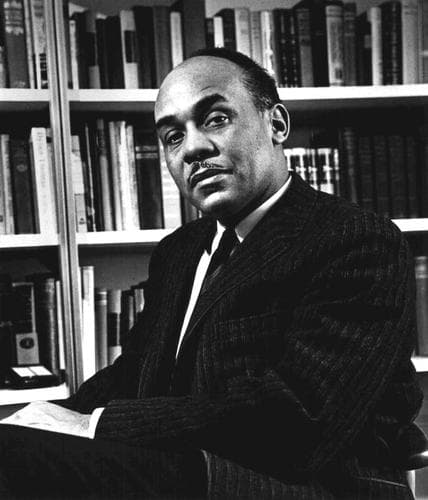
Ralph Ellison was an American novelist and essayist best known for his exploration of African American identity and social issues. His notable works include "Invisible Man," which addresses themes of race and individuality, and "Juneteenth," a posthumously published novel that continues his examination of the African American experience.
Similar books
- Invisible Man
Ralph Ellison
3.9 (157k) average on GoodreadsLiterary FictionExplores similar themes of identity, race, and the search for self in America with a distinctive narrative voice.
- Beloved
Toni Morrison
3.9 (325k) average on GoodreadsLiterary FictionA deep dive into the psychological impact of history and memory, with rich, challenging prose.
- Go Tell it on the Mountain
James Baldwin
4.0 (51k) average on GoodreadsLiterary FictionBoth novels explore the complex interplay of faith, family, and identity within the African American experience. Baldwin's novel focuses on the spiritual awakening and struggles within a Harlem Pentecostal church, emphasizing generational conflict and the weight of sin and redemption. Juneteenth, while also deeply invested in religious themes and the black church, broadens its scope to include the political sphere and the national implications of racial deception. Ellison's novel uses the church as a foundation from which one character deviates drastically into political performance, whereas Baldwin's narrative largely remains within the spiritual and familial confines of the church community.
- The Old Man and the Sea
Ernest Hemingway
3.8 (831k) average on GoodreadsLiterary FictionA Cuban fisherman's long struggle with a giant marlin becomes a story of endurance and dignity, now retold for young adults with illustrations, phonetic guides, and writing prompts in Traditional Chinese.
- One Hundred Years of Solitude
Gabriel García Márquez
4.1 (753k) average on GoodreadsLiterary FictionThrough the multi-generational story of the Buendía family, a mythical town deals with the repeating patterns of time, love, and solitude, as the extraordinary mixes with the ordinary.
- The Goldfinch
Donna Tartt
3.9 (720k) average on GoodreadsLiterary FictionHaunted by a tragic explosion and clutching a stolen Dutch masterpiece, a young orphan navigates the opulent drawing rooms of New York and the gritty underbelly of the art world, desperately seeking connection and redemption amidst a life spiraling into crime and obsession.






Enjoyed the summary?
A summary gives you the shape of the book. The book itself has the detail, the examples and the voice.
Find Juneteenth on AmazonAs an Amazon Associate, BookBrief earns from qualifying purchases. How we're funded