
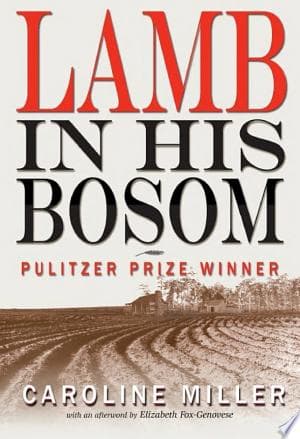
Synopsis
Covers the whole plot, including the ending.
- Difficulty
- Medium
- Pacing
- Slow
- Mood
- Atmospheric, Resilient, Melancholy, Authentic, Gritty
- Read it if
- You appreciate lyrical prose and want an unflinching, authentic portrayal of a woman's struggle and resilience in the face of extreme hardship in antebellum rural South Georgia. Ideal for readers interested in women's history, Southern history, and the daily lives of impoverished settlers.
- Skip it if
- You prefer fast-paced plots, lighthearted stories, or find detailed descriptions of hardship and loss too emotionally taxing. Readers looking for a modern narrative style might also find it slow.
Lamb in His Bosom Plot Summary
Covers the whole plot, including the ending.
A Hardscrabble Courtship and Marriage
The novel introduces Cean Carver, a young woman living with her family in the isolated Wiregrass region of Georgia in the decades before the Civil War. Life is a constant struggle against the elements and poverty. Cean meets Lonzo Smith, a hardworking and kind young man, and they begin a courtship. Despite their harsh existence, they fall deeply in love. They marry and, like many of their neighbors, build a home in the dense pine forests. Their early years involve clearing land, building a cabin, and planting crops, all while facing wild animals, disease, and the seasons. Their love and determination help them in this challenging environment.
The Joys and Sorrows of Early Motherhood
Soon after marriage, Cean becomes pregnant and gives birth to her first child, a son named John. The baby brings joy and purpose to Cean and Lonzo, strengthening their family. However, the wilderness is unforgiving, and infant mortality is common. Sadly, little John gets sick and dies young, causing Cean deep grief. This loss is an early lesson in life's fragility and the constant presence of death. Despite her sorrow, Cean's resilience shows as she and Lonzo continue to work their land and hope for more children.
A Growing Family and Constant Hardship
Over the years, Cean and Lonzo have more children, including Jim, Luke, and others, eventually having fourteen in total. Life remains a cycle of constant work: planting, harvesting, tending livestock, and preparing food. They face illness, accidents, and animal attacks. Cean, with her growing family, becomes skilled at managing her household, nursing her children through fevers, and making do with little. Lonzo works tirelessly to provide for his family, often hunting and trapping to add to their farm yield. Their community is small and close-knit, relying on each other for help during sickness, childbirth, or barn-raisings, showing frontier self-sufficiency and mutual aid.
The Panther Attack and Enduring Scars
A harrowing incident that affects Cean is a panther attack. While she is in the woods, a wild panther ambushes her. She fights for her life, suffering severe injuries. She survives, but the experience leaves her with physical scars and a deep fear of the wild. This event shows the constant danger and uncertainty of their lives, where humans are vulnerable to nature's power. It also shows Cean's strength and will to survive, qualities that will help her throughout her difficult life.
The Loss of Lonzo and Widowhood
Tragedy strikes again when Lonzo, Cean's husband and partner, gets sick. Despite Cean's care and the limited medical knowledge available, he does not recover. Lonzo's death leaves Cean a widow with a large family to support. This loss is devastating, emotionally and practically, as Lonzo was the main provider and a strong family member. Cean must now handle the farm, raise her children, and make all decisions for their survival. Her resilience is tested again as she deals with widowhood in a society where women's roles were often tied to their husbands.
A New Chapter and the Snakebite
After Lonzo's death, Cean decides to move her family to a new location, seeking better land or a fresh start away from her loss. This move shows her strength and determination to provide for her children. During this time, Cean suffers a venomous snakebite, a common and often deadly danger. The bite is severe, and her life is at risk. Through sheer will and the need to survive for her children, Cean fights off the poison and recovers, though slowly. This incident further shows her as a woman of great strength, able to endure almost anything.
Children Growing and Moving On
As years pass, Cean watches her children grow into adults. They too face frontier challenges, learning survival skills and finding their own places. Her sons, like Jim and Luke, take on more responsibility, helping with farm work and eventually marrying and starting their own families. Her daughters also find partners and establish their own homes. While Cean finds comfort in seeing her children thrive, their departures mean a changing dynamic in her household, often leaving her with fewer helpers and a growing sense of solitude as her family spreads out.
The Civil War Looms and Its Impact
The national tensions leading to the Civil War eventually reach the remote Wiregrass region. Though far from political centers, the war directly affects Cean's family. Her sons, now young men, are called to serve in the Confederate army. This time is filled with anxiety for Cean, as she worries about her children's safety. The war brings scarcity, hardship, and fear of loss. Letters from the front are rare, and news of battles is often delayed and devastating. The war adds another layer of suffering to the already difficult lives of these settlers, changing their community forever.
Further Losses and Enduring Grief
Throughout her life, Cean experiences the heartbreaking reality of losing multiple children. Whether from illness, accident, or war, each death leaves a mark on her soul. The novel shows the cumulative effect of these losses, portraying Cean as a woman who carries a heavy burden of grief. Despite the constant sorrow, she never fully gives in to despair, always finding strength to continue living, working, and caring for those who remain. Her ability to endure such profound and repeated loss is a central theme, showing her deep resilience and the human capacity to carry on in the face of great suffering.
The Fire and Renewed Spirit
In a cruel twist, Cean's home, the cabin she and Lonzo built and where she raised her children, is destroyed by fire. This loss is not just a physical dwelling but a repository of memories and a symbol of her life's work. The fire forces her to start over again, but by this point, Cean is a woman shaped by hardship. With help from her surviving children and neighbors, she begins the hard task of rebuilding. This act of reconstruction, even in her later years, signifies her strong spirit and her refusal to be defeated by life's challenges. She continues to live, embodying the strength of the frontier woman.
Reflections and Legacy
As Cean reaches old age, she often reflects on her long and hard life. She remembers Lonzo, her lost children, and the many struggles she faced. Despite the pain and loss, there is a quiet satisfaction in having survived and raised a family in such a harsh environment. She sees her legacy in her surviving children and grandchildren, who continue to live on the land. Her life, though marked by tragedy, also shows human endurance, the power of love, and the spirit of those who made a life in the American wilderness. The novel ends with a sense of Cean's lasting presence and the cycles of life and death in the Wiregrass.
Lamb in His Bosom Characters
Cean Carver Smith
Protagonist
A resilient frontier woman who endures immense hardship and loss in pre-Civil War Georgia.
Cean is the central figure of the novel, a strong-willed and deeply loving woman who embodies the spirit of the early American frontier. Born into poverty in the Wiregrass region of Georgia, she marries Lonzo Smith and dedicates her life to building a home and raising a large family. Her character is defined by her incredible resilience in the face of relentless hardship, including the deaths of multiple children, a panther attack, a venomous snakebite, and the loss of her husband and home. She is practical, hardworking, and deeply connected to the land, finding strength in her faith and her unwavering commitment to her family.
Relationships: Lonzo Smith (Devoted husband, partner in life and labor); John Smith (Firstborn son, tragically lost in infancy); Jim Smith (Son, grows up and helps on the farm); Luke Smith (Son, grows up and helps on the farm); Her children (Mother to fourteen, experiencing joy and profound grief through them)
Lonzo Smith
Supporting
Cean's loving and hardworking husband, a devoted family man who helps establish their home.
Lonzo is Cean's husband, a kind, strong, and diligent man who shares her vision of building a life in the wilderness. He is a skilled hunter, farmer, and builder, working tirelessly to provide for his growing family. Lonzo represents the ideal frontier husband, a partner who shares the burdens and joys of their arduous existence. His death early in Cean's widowhood is a pivotal moment, leaving her to face the majority of her struggles alone. His memory and the foundation he helped build remain a source of strength and inspiration for Cean throughout her life.
Relationships: Cean Carver Smith (Devoted husband); His children (Loving father)
Jim Smith
Supporting
Cean and Lonzo's son, who grows up to help his mother and represents the next generation.
Jim is one of Cean and Lonzo's many children, one of the sons who survives into adulthood and plays a role in helping his mother after his father's death. He embodies the continuation of the frontier spirit, learning the skills of farming and survival from his parents. His presence represents the enduring family line and the cycle of life that continues despite immense loss. He helps Cean with the farm work and eventually establishes his own family, mirroring the path his parents took.
Relationships: Cean Carver Smith (Son); Lonzo Smith (Son)
Luke Smith
Supporting
Another of Cean and Lonzo's sons, who contributes to the family's survival.
Luke is another of Cean and Lonzo's sons, growing up alongside Jim and the other siblings. Like Jim, he represents the younger generation tasked with continuing the difficult work of carving out a life in the Wiregrass. His character, while not as deeply explored as Cean's, serves to illustrate the sheer number of children Cean bore and the collective effort required for a family's survival in such an environment. He contributes to the family farm and eventually establishes his own household, reflecting the common trajectory for young men in that era.
Relationships: Cean Carver Smith (Son); Lonzo Smith (Son)
John Smith
Mentioned
Cean and Lonzo's first child, whose early death profoundly impacts Cean.
John is Cean and Lonzo's firstborn son. His birth brings immense joy and hope to the young couple. However, his subsequent death from illness as an infant is Cean's first profound experience with the harsh realities of mortality in the wilderness. His loss is a defining moment for Cean, initiating her into a lifetime of grief for lost children and hardening her resolve to protect her future offspring. Though he appears briefly, his impact on Cean's character and the novel's thematic exploration of loss is significant.
Relationships: Cean Carver Smith (Firstborn son); Lonzo Smith (Firstborn son)
Neighbors and Community
Supporting
The collective group of settlers who provide mutual support in the isolated Wiregrass.
While not a single character, the collective community of neighbors plays a vital supporting role. In the isolated Wiregrass, families like the Carvers and Smiths rely heavily on each other for assistance during births, illnesses, deaths, and major tasks like barn-raisings or house-building. They share resources, labor, and emotional support, forming a close-knit, self-reliant society. This community underscores the theme of communal strength and the necessity of cooperation for survival in a challenging environment. Their presence highlights the social fabric of frontier life.
Relationships: Cean Carver Smith (Reciprocal support and friendship); Lonzo Smith (Reciprocal support and friendship)
Lamb in His Bosom Themes
Endurance and Resilience
This is the main theme, shown by Cean's ability to withstand constant hardship: the deaths of five children, her husband's passing, a panther attack, a snakebite, and her home burning down. Her continuous work, her refusal to despair, and her commitment to survival and raising her family show the human spirit's capacity to endure great adversity. The novel celebrates not just survival, but the quiet strength found in continuing on, day after day, year after year.
“She took life as it came, and if it was hard, why, she was hard too, and could stand it.”
Man vs. Nature
The novel shows the constant struggle between early settlers and the wild Wiregrass region. Nature is both a source of food and a hostile force. The characters deal with harsh weather, poor soil, wild animals (like the panther), snakes, and diseases that claim many lives, especially children. Their lives are dictated by the seasons and the land, showing humanity's vulnerability and dependence on nature, even as they try to tame it.
“The earth was a hard task-mistress, but she was a good provider for those who worked her patiently.”
Grief and Loss
A constant theme in the novel is the repeated experience of grief. Cean loses her first child, then more of her fourteen children to illness, accidents, and war. Her beloved husband, Lonzo, also dies, adding to her sorrow. The novel explores how people cope with such frequent loss, showing grief not as a single event but as a continuous, heavy burden that shapes Cean's character. Yet, despite the sorrow, the characters find ways to carry on, showing the human capacity to live with loss.
“Each child had been a separate person, and each death a separate grief, but all together they made a river of tears that ran through her life.”
Family and Community
In the isolated Wiregrass, family is the basic unit of survival, and the community provides support. Cean's dedication to her husband and children drives her actions. The novel shows how families and neighbors depend on each other for labor, help during crises, and social connection. This theme shows the importance of human connection and collective effort in overcoming frontier challenges, illustrating how shared burdens strengthen bonds.
“A neighbor's trouble was every man's trouble in the Wiregrass, and a helping hand was never withheld.”
The Cycle of Life and Death
The novel presents life and death as an inescapable, intertwined cycle, especially in the frontier. Births are celebrated, but deaths are a constant reality. Cean's journey through fourteen pregnancies and multiple burials shows this relentless cycle. The land itself has seasons of planting, growth, harvest, and dormancy, mirroring human experience. This theme shows the natural order of existence, life's fragility, and how new life continually emerges to replace what is lost.
“Life was a thing of the earth, born of the earth, and to the earth it must return.”
Plot Devices & Literary Techniques
Episodic Narrative Structure
A series of distinct, yet interconnected, vignettes chronicling Cean's life.
The novel employs an episodic structure, presenting Cean's life through a series of significant events and periods rather than a tightly linear, cause-and-effect plot. Each chapter or section often focuses on a particular hardship (a birth, a death, an attack, a move) or a phase of her life. This structure effectively conveys the relentless, cyclical nature of frontier existence, where life is a succession of challenges and small victories, without a single overarching dramatic climax. It allows the reader to witness the cumulative effect of Cean's experiences over decades.
Naturalistic Detail and Setting as Character
Vivid descriptions of the Wiregrass region that shape the characters' lives.
Caroline Miller uses rich, naturalistic detail to bring the Wiregrass region of Georgia to life. The physical environment—the pine forests, sandy soil, swamps, and wildlife—is not merely a backdrop but an active force that dictates the characters' struggles and defines their existence. The land itself acts almost as a character, a formidable antagonist and a source of sustenance. Descriptions of weather, flora, and fauna are interwoven with the plot, emphasizing the constant interaction between humans and their environment and highlighting the raw, untamed nature of their world.
Foreshadowing through Natural Cycles
The changing seasons and animal behavior subtly hint at impending hardships or changes.
The novel often uses the natural world to subtly foreshadow events. The harshness of winter might hint at coming struggles, or the abundance of a harvest might precede a period of relative ease. The behavior of animals, such as the lurking panther, directly prefigures danger. This device connects the human experience directly to the rhythms of nature, reinforcing the theme of man's vulnerability to the environment. It creates a sense of inevitability and a constant awareness of the precariousness of life in the wilderness.
Symbolism of the 'Lamb in His Bosom'
The title's biblical allusion symbolizes innocence, vulnerability, and divine comfort amidst loss.
The title itself, drawn from Isaiah 40:11 ("He shall feed his flock like a shepherd: he shall gather the lambs with his arm, and carry them in his bosom"), serves as a central symbol. It represents the profound vulnerability of Cean's children, especially those lost to early death, and Cean's own maternal instinct to protect them. It also alludes to a spiritual comfort or divine providence, suggesting that even in the face of unimaginable loss, there is a hope for solace and care, akin to a shepherd tending his flock. This biblical reference adds a layer of spiritual depth to the narrative of suffering and endurance.
Lamb in His Bosom Quotes
“It was a wild, free life, with little of comfort, and much of hardship, but with a certain grandeur about it that made it seem worth the living.”
“She had learned to endure, and that was a great thing for a woman to learn.”
“Love was a queer thing, she thought, coming when you least expected it, and often when you least wanted it.”
“The wilderness was a hard master, but it taught many good lessons.”
“A woman's place was where she could do the most good.”
“There was a time for sorrow, and a time for joy, and a time for simply enduring.”
“The past was like a dream, sometimes sweet, sometimes bitter, but always fading.”
“It took courage to live, and more courage to live well.”
“The wind sang old songs through the pines, songs of hardship and hope, of love and loss.”
“Grief was a lonely road, and one had to walk it alone.”
“Every day brought its own measure of trouble, and its own measure of blessing.”
“There was a stillness in the woods that made a body feel small and yet strong.”
“She had known sorrow, but she had known joy too, and the joy was real.”
“The world was always changing, and a body had to change with it, or be left behind.”
Quiz
10 questions on the plot and the characters. Each answer comes with a short explanation.
Question 1
What is the primary setting of 'Lamb in His Bosom'?
- Urban Atlanta during Reconstruction
- Rural, impoverished antebellum Georgia
- A bustling plantation in coastal South Carolina
- A frontier settlement in the newly opened Western territories
Show answer
B. Rural, impoverished antebellum Georgia The novel is explicitly set in rural, impoverished antebellum Georgia, detailing the harsh life of settlers before the Civil War.
Question 2
What significant personal loss does Cean experience by the age of forty-three, according to the description?
- She loses her entire farm to a flood.
- She buries five of her fourteen children and her husband.
- She is abandoned by her husband and all her children.
- She loses her inheritance due to economic collapse.
Show answer
B. She buries five of her fourteen children and her husband. The book description states that by forty-three, Cean has borne fourteen children, but buried five of them and her husband, highlighting her immense personal losses.
Question 3
Which of the following natural dangers does Cean NOT specifically survive, according to the synopsis?
- A venomous snakebite
- A ferocious panther attack
- A deadly house fire
- A devastating earthquake
Show answer
D. A devastating earthquake The synopsis mentions survival from a venomous snakebite, a ferocious panther attack, and a deadly house fire, but does not list a devastating earthquake.
Question 4
What is described as the 'only wealth' of Cean and Lonzo in their early married life?
- A small inheritance from their parents
- Their hands, their obstinacy, and their love
- Several acres of fertile land and livestock
- Their strong community ties and neighbors' generosity
Show answer
B. Their hands, their obstinacy, and their love The book description explicitly states that the couple's 'only wealth is their hands, their obstinacy, and their love,' emphasizing their reliance on their own labor and spirit.
Question 5
What historical event does Cean survive, alongside her personal struggles?
- The War of 1812
- The American Civil War
- The Great Depression
- The Mexican-American War
Show answer
B. The American Civil War The summary clearly states that Cean 'survived a civil war,' placing her story within the context of this major historical event.
Question 6
How does the novel portray the relationship between the characters and nature in their antebellum Georgia setting?
- Nature is a benevolent force, providing abundant resources easily.
- Nature is hostile, dictating law and requiring hard work for survival.
- Nature is largely irrelevant to their daily struggles, which are mostly social.
- Nature is a source of spiritual enlightenment and peace.
Show answer
B. Nature is hostile, dictating law and requiring hard work for survival. The description highlights that they live 'in a land where nature is hostile, the seasons dictate the law, and the days are punctuated by the hard work of the land,' emphasizing nature's challenging role.
Question 7
What does the phrase 'Neither life nor the din of history has spared her' suggest about Cean's journey?
- She was an influential figure who shaped historical events.
- She lived a sheltered life, untouched by major events.
- She faced relentless personal hardships and was impacted by broader historical turmoil.
- She purposefully avoided all conflict and strife.
Show answer
C. She faced relentless personal hardships and was impacted by broader historical turmoil. This phrase signifies that Cean endured both intense personal suffering ('life') and the upheavals of major historical events ('din of history'), indicating a life of relentless struggle.
Question 8
Why is 'Lamb in His Bosom' considered a 'thought-provoking addition' to specific fields of study?
- It offers new insights into early American industrialization.
- It explores the struggle and survival of impoverished settlers in pre-Civil War South Georgia.
- It provides a detailed account of the lives of wealthy plantation owners.
- It critiques the political systems of post-Civil War Reconstruction.
Show answer
B. It explores the struggle and survival of impoverished settlers in pre-Civil War South Georgia. The synopsis states it's a thought-provoking addition to American, Civil War, and Women's History studies because it 'explores the struggle and survival of impoverished settlers in pre-Civil War South Georgia.'
Question 9
What does the description imply about the daily lives of Cean and Lonzo in their early marriage?
- They spent most of their time socializing and attending community events.
- Their days were primarily defined by hard work on the land.
- They were constantly planning their escape to a more prosperous region.
- Their main concern was navigating complex local politics.
Show answer
B. Their days were primarily defined by hard work on the land. The text states their days 'are punctuated by the hard work of the land,' indicating that physical labor was a central and defining aspect of their lives.
Question 10
The title 'Lamb in His Bosom' is not directly explained, but based on the overall themes of the book, what could it most likely symbolize?
- The political leaders who guided the South during the Civil War.
- The vulnerable children Cean bore and tragically lost, held close to her heart.
- The literal livestock that provided their meager sustenance.
- The religious figures who offered solace to the community.
Show answer
B. The vulnerable children Cean bore and tragically lost, held close to her heart. Given Cean's immense loss of five children and the emphasis on her struggle, 'lamb in his bosom' (often referring to a cherished, vulnerable being) most likely symbolizes her lost children, held in memory and love, representing the profound personal tragedies endured.
Lamb in His Bosom FAQ
What is 'Lamb in His Bosom' about?
'Lamb in His Bosom' follows the arduous life of Cean Carver, a young newlywed in antebellum rural Georgia. The novel chronicles her relentless struggle against poverty, a harsh natural environment, and personal tragedies, including the loss of children and her husband, Lonzo. It paints a vivid picture of survival and resilience in a time dictated by the land and the burgeoning shadow of the Civil War.
Why should I read 'Lamb in His Bosom'?
You should read 'Lamb in His Bosom' for its powerful depiction of human endurance and the unvarnished realities of pioneer life in the pre-Civil War South. Caroline Miller's lyrical prose brings to life the struggles of impoverished settlers, offering a unique perspective on American, Civil War, and Women's History studies through the eyes of a resilient woman, Cean Carver.
What is the background/setting of 'Lamb in His Bosom'?
The novel is set in the wild, impoverished rural Georgia backcountry during the two decades leading up to the Civil War. It vividly portrays a land where nature is often hostile, dictating daily life through its seasons, and where settlers like Cean and Lonzo Carver rely solely on their labor and determination to survive, isolated from the conveniences of more developed areas.
What writing style does the author use?
Caroline Miller employs a lyrical and evocative writing style, rich in naturalistic detail and regional dialect, to immerse the reader in the harsh yet beautiful landscape of rural Georgia. Her prose is direct and unadorned, reflecting the simple yet profound lives of her characters, particularly Cean, and highlighting the raw beauty and brutality of their existence.
What minor details add significant meaning?
The constant presence of the 'lamb in his bosom' motif, drawn from a biblical parable, subtly underscores the themes of sacrifice, protection, and the deep, often painful, love Cean holds for her children. Details like the specific types of crops, the methods of hunting, and the construction of their rudimentary cabin emphasize the Carvers' profound connection to and dependence on the land.
What are some subtle foreshadowing moments?
The recurring descriptions of the unforgiving wilderness and the unpredictable nature of wild animals, such as the panther that eventually attacks Cean, subtly foreshadow the constant threats to life and limb faced by the settlers. Similarly, the early mentions of skirmishes or distant political rumblings hint at the larger historical upheaval of the Civil War that will eventually impact Cean's life.
What unexpected character connections exist?
While the novel primarily focuses on Cean's immediate family, the interconnectedness of the isolated settler community is revealed through shared hardships and communal support, such as neighbors helping rebuild after the house fire. These connections, though sometimes strained by jealousy or gossip, form a vital, if unstated, network of survival in their harsh environment.
What are unspoken character motivations?
Cean's unspoken motivation is often a fierce, almost instinctual drive for survival and the protection of her children, even in the face of overwhelming loss. Lonzo's relentless hard work and desire to clear more land are fueled by a deep-seated hope for a better future and a legacy for his burgeoning family, even if he rarely articulates these aspirations directly.
What psychological complexities do characters exhibit?
Cean exhibits profound psychological resilience, demonstrating a capacity to absorb immense grief and tragedy without succumbing to despair, instead finding a quiet strength to continue. Her practical, almost stoic acceptance of death and hardship, while appearing simple, masks a deep well of emotional fortitude and an unwavering commitment to life's continuation.
What are the major emotional turning points?
Major emotional turning points include the death of several of Cean and Lonzo's children, particularly the first few, which force Cean to confront the fragility of life and the inevitability of loss. Lonzo's death is another pivotal moment, shifting Cean from a partner in survival to the sole matriarch responsible for her remaining family, demanding an even greater degree of self-reliance.
How do relationship dynamics evolve?
The relationship between Cean and Lonzo evolves from youthful, passionate love into a deep partnership forged by shared labor and mutual endurance against incredible odds. After Lonzo's death, Cean's relationships with her surviving children transform; she becomes not just a mother but a guiding force, teaching them the skills and resilience needed to navigate their harsh world, with her older children stepping up to assist.
Which parts remain ambiguous or open-ended?
The novel leaves the long-term future of Cean's surviving children somewhat open-ended, focusing more on their immediate survival and the lessons learned from their mother. While the Civil War's impact is felt, the specific personal outcomes for all family members in the post-war era are not fully detailed, emphasizing the cyclical nature of life and struggle rather than a definitive resolution.
What are controversial scenes or decisions?
The stark realism in depicting child mortality and the pragmatic, almost detached way Cean and the community cope with these frequent losses could be seen as controversial. Her decisions, driven by necessity rather than sentimentality, such as quickly moving on from grief to ensure the survival of others, highlight a harsh reality that might challenge modern sensibilities.
'Lamb in His Bosom' ending explained: how it ends & what it means
The novel ends with Cean, now an older woman, having survived numerous personal tragedies, including the deaths of five of her fourteen children and her husband, Lonzo, as well as a civil war, a panther attack, and a house fire. The ending signifies her profound resilience and the enduring human spirit in the face of relentless adversity. It's not a triumphant ending in the traditional sense, but a powerful testament to survival, the cyclical nature of life, and the quiet dignity of a life lived fully amidst hardship, emphasizing that the struggle itself is a form of victory.
About the author

Caroline Miller may refer to:Caroline Pafford Miller (1903–1992), American novelist Caroline Adams Miller, American non-fiction author and life coach Caroline Miller (character), from Malcolm in the Middle Caroline Miller (politician), American politician and writer Caroline Miller (planner), New Zealand historian and planning professor Caroline Miller (soccer), American soccer player
Similar books
- The Yearling
Marjorie Kinnan Rawlings
4.0 (26k) average on GoodreadsChildren'sExplores themes of survival, nature's harshness, and family life in rural Florida, with a strong sense of place and regional dialect.
- A Tree Grows in Brooklyn
Betty Smith
4.3 (388k) average on GoodreadsHistorical FictionFocuses on a young girl's coming-of-age amidst poverty and hardship, emphasizing resilience and the importance of family.
- Cold Mountain
Charles Frazier
3.9 (221k) average on GoodreadsLiterary FictionA historical novel set during the Civil War era in the South, depicting the struggles of individuals against a harsh landscape and societal upheaval.
- The Grapes of Wrath
John Steinbeck
4.0 (750k) average on GoodreadsHistorical FictionWhile both explore themes of hardship and survival, Miller's novel is intensely localized to 19th-century Appalachian self-sufficiency, whereas Steinbeck's focuses on 20th-century economic displacement and migration on a national scale. Miller's scope is narrower and more ethnographically precise to a specific regional culture.
- The Old Man and the Sea
Ernest Hemingway
3.8 (831k) average on GoodreadsLiterary FictionA Cuban fisherman's long struggle with a giant marlin becomes a story of endurance and dignity, now retold for young adults with illustrations, phonetic guides, and writing prompts in Traditional Chinese.
- One Hundred Years of Solitude
Gabriel García Márquez
4.1 (753k) average on GoodreadsLiterary FictionThrough the multi-generational story of the Buendía family, a mythical town deals with the repeating patterns of time, love, and solitude, as the extraordinary mixes with the ordinary.





Enjoyed the summary?
A summary gives you the shape of the book. The book itself has the detail, the examples and the voice.
Find Lamb in His Bosom on AmazonAs an Amazon Associate, BookBrief earns from qualifying purchases. How we're funded