

Synopsis
Covers the whole plot, including the ending.
- Difficulty
- Hard
- Read it if
- You are fascinated by existentialist philosophy applied to complex human relationships, enjoy deep psychological introspection, and are prepared for a challenging exploration of identity, freedom, and the 'Other'.
- Skip it if
- You prefer plot-driven narratives over philosophical exploration, dislike morally ambiguous characters, or are seeking a light, optimistic read.
She Came to Stay Quotes
“One is not born, but rather becomes, a woman.”
“To be free is to be condemned to be free.”
“Hell is other people.”
“She was a woman of ideas, but also a woman of flesh and blood.”
“The other's gaze alienates me from myself.”
“There are no ready-made values, one must invent them.”
“Each man makes his own hell.”
“Love is not a tranquil haven, but a stormy sea.”
“She had wanted to live her life as an adventure, but it was turning into a tragedy.”
“The present is opaque; the future is an open book.”
“One is always alone, even in the midst of others.”
“To exist is to choose oneself.”
“She felt a terrible freedom, a freedom that crushed her.”
“The other is necessary for my own consciousness.”
“Every choice is a leap into the unknown.”
Quiz
10 questions on the plot and the characters. Each answer comes with a short explanation.
Question 1
Which of the following best describes Françoise's initial view of Xavière's presence in her life?
- A threat to her artistic freedom.
- A refreshing and stimulating new friendship.
- An obligation imposed by Pierre.
- An opportunity to mentor a younger woman.
Show answer
B. A refreshing and stimulating new friendship. Françoise initially finds Xavière's youthful exuberance and unconventional nature to be a stimulating and refreshing change from her routine, viewing her as an interesting new presence rather than an immediate threat.
Question 2
What is the central philosophical conflict that emerges between Françoise and Xavière, particularly regarding their individual existences?
- Françoise's commitment to social justice versus Xavière's political apathy.
- Françoise's belief in rationalism versus Xavière's embrace of mysticism.
- Françoise's established, willed identity versus Xavière's fluid, unselfconscious being.
- Françoise's artistic discipline versus Xavière's bohemian lifestyle.
Show answer
C. Françoise's established, willed identity versus Xavière's fluid, unselfconscious being. The core conflict lies in Françoise's carefully constructed identity, built on choice and intention, clashing with Xavière's seemingly effortless and unreflective existence, which appears to simply 'be' without the same existential struggle.
Question 3
How does Pierre's relationship with Xavière evolve throughout the novel, and what does it primarily represent for Françoise?
- It remains purely platonic and represents a shared intellectual interest.
- It deepens into a passionate affair, representing Françoise's fear of abandonment.
- It becomes a professional collaboration, symbolizing Françoise's artistic jealousy.
- It is a brief flirtation, signifying Xavière's manipulative nature.
Show answer
B. It deepens into a passionate affair, representing Françoise's fear of abandonment. Pierre's growing intimacy with Xavière, culminating in an affair, is a central catalyst for Françoise's emotional turmoil and existential crisis, representing the direct threat to her established relationship and her place in Pierre's life.
Question 4
The novel explores the Sartrean concept of 'the Other.' How does Xavière embody 'the Other' for Françoise in a way that is particularly destructive?
- Xavière represents the judgmental gaze of society, forcing Françoise to conform.
- Xavière's existence, perceived as unmediated and 'pure,' reflects Françoise's own consciousness back to her as artificial and inauthentic.
- Xavière symbolizes the past that Françoise wishes to escape but cannot.
- Xavière's indifference to Françoise's intellectual pursuits makes Françoise question their value.
Show answer
B. Xavière's existence, perceived as unmediated and 'pure,' reflects Françoise's own consciousness back to her as artificial and inauthentic. Xavière becomes the 'Other' through whom Françoise perceives herself, and this perception is devastating because Xavière's unselfconscious being makes Françoise's own carefully constructed, self-aware identity feel inauthentic and contingent, threatening its very foundation.
Question 5
What is the significance of the recurring motif of the mirror or reflection in the novel?
- It symbolizes the superficiality of Parisian society.
- It highlights Françoise's narcissism and self-obsession.
- It represents Françoise's struggle to define her self-image independently of Xavière's presence and gaze.
- It foreshadows Xavière's eventual betrayal of Françoise.
Show answer
C. It represents Françoise's struggle to define her self-image independently of Xavière's presence and gaze. Mirrors frequently appear when Françoise is contemplating her identity in relation to Xavière, symbolizing her desperate attempts to see herself, to grasp her own existence, which feels increasingly fragmented and threatened by the 'reflection' provided by Xavière's being.
Question 6
Françoise believes that Xavière 'lives without a past, without a future.' What philosophical implication does this observation carry for Françoise's own existence?
- It makes Françoise question the validity of historical analysis.
- It highlights Xavière's lack of ambition, contrasting with Françoise's career goals.
- It emphasizes Xavière's seemingly unburdened, 'in-itself' existence, making Françoise's own project of self-creation feel artificial and heavy.
- It suggests Xavière's spiritual enlightenment, which Françoise envies.
Show answer
C. It emphasizes Xavière's seemingly unburdened, 'in-itself' existence, making Françoise's own project of self-creation feel artificial and heavy. This observation underscores Xavière's perceived 'facticity' or 'in-itself' quality, which, for Françoise, contrasts sharply with her own 'for-itself' existence, burdened by choices, projects, and the weight of past and future, making her feel less 'real' than Xavière.
Question 7
The novel's title, 'She Came to Stay,' carries a double meaning. What is the most profound philosophical interpretation of 'staying' in the context of the narrative's resolution?
- Xavière literally remains in Paris, despite Françoise's wishes.
- Xavière's influence and the existential crisis she provoked permanently alter Françoise's perception of herself and her world.
- The memory of the affair stays with Pierre, causing lasting guilt.
- Françoise realizes she cannot escape her own past actions.
Show answer
B. Xavière's influence and the existential crisis she provoked permanently alter Françoise's perception of herself and her world. Beyond the literal presence, 'She Came to Stay' signifies that Xavière, as an 'Other' and a catalyst for Françoise's existential crisis, has permanently inscribed herself into Françoise's consciousness, irrevocably changing her subjective reality and forcing a confrontation with her own being.
Question 8
What is the primary motivation behind Françoise's dramatic final act towards Xavière?
- To protect Pierre from Xavière's manipulative influence.
- To escape the suffocating gaze of the Other and reclaim her own distinct existence.
- To prevent Xavière from revealing a secret about Françoise's past.
- To punish Xavière for her perceived betrayal and insincerity.
Show answer
B. To escape the suffocating gaze of the Other and reclaim her own distinct existence. Françoise's ultimate act is a desperate, violent assertion of her own subjective freedom and a rejection of Xavière's consuming presence, which had threatened to annihilate Françoise's sense of self by making her feel like a mere object in Xavière's world.
Question 9
Which emotion does Françoise initially feel most strongly towards Xavière, before it devolves into resentment and fear?
- Pity.
- Admiration.
- Indifference.
- Suspicion.
Show answer
B. Admiration. Initially, Françoise is drawn to Xavière's youthful vitality, authenticity, and seemingly unburdened existence, expressing a form of admiration before these qualities begin to undermine her own sense of self.
Question 10
The novel is often seen as an exploration of the limits of existentialist freedom. How does Françoise's journey exemplify this theme?
- She finds ultimate freedom in rejecting all social norms.
- She discovers that true freedom lies in accepting her circumstances.
- Her struggle demonstrates that one's freedom is always constrained and threatened by the existence and gaze of others.
- She realizes that freedom is an illusion and that fate dictates her choices.
Show answer
C. Her struggle demonstrates that one's freedom is always constrained and threatened by the existence and gaze of others. Françoise's experience with Xavière is a profound illustration of how the freedom of the 'Other' can impinge upon and even threaten one's own freedom, creating a constant struggle for self-definition and recognition in a world shared with other conscious beings.
She Came to Stay FAQ
What is the central theme of Simone de Beauvoir's 'She Came to Stay'?
The novel explores themes of identity, freedom, and the destructive nature of relationships, particularly through the lens of a couple whose lives are disrupted by the arrival of a younger woman. It delves into the complexities of desire, jealousy, and the struggle for self-definition when confronted with the 'other'.
Is 'She Came to Stay' a fictionalized account of real events?
Yes, it is widely considered a roman à clef, a fictionalized account inspired by real-life events involving Simone de Beauvoir, Jean-Paul Sartre, and Olga Kosakiewicz. De Beauvoir used the novel to process and retaliate against the emotional turmoil caused by this ménage à trois.
What philosophical concepts are explored in 'She Came to Stay'?
The book deeply engages with existentialist philosophy, particularly ideas around freedom, responsibility, the gaze of the other, and the fluid nature of the self. Characters grapple with their choices and the impact of others on their subjective reality.
Does the love triangle in 'She Came to Stay' work out for the characters?
The novel portrays the love triangle as a source of intense psychological conflict and ultimately, destruction for its characters. It highlights the impossibility of maintaining genuine freedom and individual identity within such a deeply entangled and unequal dynamic.
How does 'She Came to Stay' differ from other existentialist novels of its time?
'She Came to Stay' offers a uniquely personal and emotionally charged exploration of existential themes, often focusing on the female perspective and the specific dynamics of a complex, intellectually driven relationship. While sharing thematic ground with works by Sartre or Camus, its narrative is deeply rooted in de Beauvoir's lived experience and psychological insight.
What is the significance of the title 'She Came to Stay'?
The title refers to the persistent and ultimately destructive presence of Xavière, the young woman who intrudes upon the lives of Françoise and Pierre. It also metaphorically suggests how certain experiences or people can permanently alter one's existence and sense of self, leaving an indelible mark.
Is 'She Came to Stay' suitable for readers new to philosophy?
While deeply philosophical, the novel is also a compelling psychological drama with a strong narrative. Readers new to philosophy might find it an accessible entry point as the abstract ideas are embodied and explored through the characters' experiences and relationships.
Does the book offer a feminist perspective on relationships?
While not explicitly a feminist text in the way her later work 'The Second Sex' is, 'She Came to Stay' implicitly critiques traditional relationship dynamics and explores the vulnerabilities and struggles of a woman (Françoise) attempting to maintain her intellectual and personal autonomy within a patriarchal context, even if subtly.
About the author
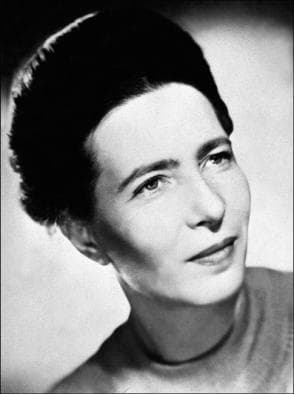
Simone Lucie Ernestine Marie Bertrand de Beauvoir was a French existentialist philosopher, writer, social theorist, and feminist activist. Though she did not consider herself a philosopher, nor was she considered one at the time of her death, she had a significant influence on both feminist existentialism and feminist theory.
Similar books
- Nausea
Jean-Paul Sartre
3.9 (86k) average on GoodreadsPhilosophyExplores existential angst and the nature of being through philosophical fiction.
- The Stranger
Albert Camus
4.1 (3k) average on GoodreadsFantasyExamines existential alienation and the absurdity of life through a detached protagonist.
- Mrs Dalloway
Virginia Woolf
3.8 (361k) average on GoodreadsFictionBoth novels delve into the inner lives of their characters, but Woolf's Mrs Dalloway employs a stream-of-consciousness style rich in sensory detail and emotional nuance, exploring themes of memory, time, and societal roles through a more poetic lens. Beauvoir's She Came to Stay is more direct and analytical, using a psychological drama to explicitly demonstrate philosophical concepts of freedom, identity, and the destructive power of interpersonal dynamics.
- Brave New World
Aldous Huxley
4.0 (1.4M) average on GoodreadsFantasyIn a future where happiness comes from chemicals and individuality is gone, one man's desire for real experience threatens the calm, controlled society.
- Life of Pi
Yann Martel
3.9 (1.3M) average on GoodreadsFantasyStranded in the vast Pacific, a young Indian boy forms an unlikely bond with a Bengal tiger, questioning belief and survival.
- The Picture of Dorian Gray
Oscar Wilde
4.1 (966k) average on GoodreadsFantasyA beautiful young man's soul decays within a cursed portrait, mirroring the grotesque cost of his hedonistic pursuit of eternal youth and illicit pleasure.






Enjoyed the summary?
A summary gives you the shape of the book. The book itself has the detail, the examples and the voice.
Find She Came to Stay on AmazonAs an Amazon Associate, BookBrief earns from qualifying purchases. How we're funded