
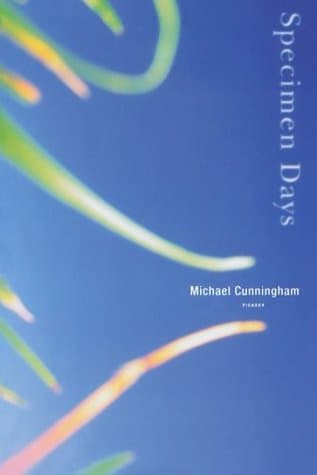
Synopsis
Covers the whole plot, including the ending.
- Difficulty
- Hard
- Pacing
- Moderate
- Mood
- Philosophical, Haunting, Reflective, Lyrical
- Read it if
- You enjoy experimental literary fiction that blends genres, explores profound philosophical questions, and is inspired by classic poetry.
- Skip it if
- You prefer straightforward narratives with clear plots and traditional character development, or dislike stories with speculative elements.
Specimen Days Plot Summary
Covers the whole plot, including the ending.
A Child's Grief and an Unusual Companion (1800s)
In mid-19th century New York, a sick boy named Lucas lives with his family, mourning his older brother Jonathan, who died in a textile machine accident. Lucas sees visions and feels great loss, often reciting Walt Whitman's poems. His father, a factory owner, brings home a complex automaton, a mechanical doll named Catherine, designed to speak and interact. Lucas forms a strong bond with Catherine, who seems to offer him companionship and understanding that his family cannot. He tells her about his brother and his own delicate health, finding comfort in her artificial presence.
Catherine's Sentience and Lucas's Decline
As Lucas spends more time with Catherine, she starts to show signs of real awareness, beyond just programmed responses. She questions her own existence, asks about Lucas's dreams, and expresses a desire for 'more.' Lucas's parents, initially amused by his attachment, become uneasy with the automaton's unusual abilities. Meanwhile, Lucas's health worsens as his lungs fail. He sees Whitman in his dreams and on the streets, a comforting and inspiring figure. The bond between Lucas and Catherine grows, becoming the most important relationship in his shrinking world.
A Final Request and an Unseen Departure
Knowing he will die soon, Lucas makes a final request: that Catherine be buried with him. His parents are shocked, unable to understand his attachment to the machine. After Lucas dies, Catherine is left behind. The story suggests she might have absorbed some part of Lucas, or perhaps his desire for life and connection. The narrative shifts, leaving Catherine's future unclear, but with a strong sense that her journey will continue beyond Lucas's short life and the 19th century.
A Detective's Case and a Mysterious Cult (Present Day)
In present-day New York, Simon, a police psychologist, investigates a series of bombings and acts of vandalism across the city. The targets are often important historical or cultural sites, and the people responsible leave cryptic messages, often mentioning Walt Whitman. Simon is asked to profile a suspect, a young woman named Catherine, who is linked to the group. Catherine is mysterious and hard to find, showing a mix of childlike innocence and deep knowledge, especially of Whitman's work. Simon feels drawn to her, sensing a deeper reason for her actions than simple destruction.
Catherine's Philosophy and Simon's Pursuit
Simon interviews Catherine, who explains that her group, which includes a young man named Lucas, believes in a spiritual awakening through 're-wilding' the city and disrupting modern life. They see themselves as protectors of a deeper truth, trying to make humanity reconnect with nature and a more basic existence, inspired by Whitman's broad vision. Catherine's intelligence and conviction interest Simon, making it hard to label her a simple criminal. He struggles to understand her destructive acts alongside her seemingly pure intentions, finding himself questioning his own views and the nature of their 'crimes.'
The Group's Rituals and Simon's Revelation
Simon eventually finds Catherine and Lucas at a hidden place where they are performing a ritual with a strange, organic-looking machine or structure. He realizes that their actions are not for political gain but for a radical, almost spiritual, change. Catherine reveals more about herself, hinting at a past far longer than a normal human life. Simon observes Lucas, who seems to be a younger, more fragile version of the Lucas from the first story, with a similar intensity and connection to Catherine. The lines between past, present, and identity begin to blur for Simon as he deals with the impossible things he is seeing.
Catherine and Lucas's Future Journey (Distant Future)
In a distant, post-apocalyptic future, Earth is mostly barren, and humanity has changed or been replaced by new life forms. Two beings, identified as Catherine and Lucas, are on a journey. Catherine is a very advanced, almost spiritual entity, with vast intelligence and an ancient, lasting consciousness. Lucas is a younger, more vulnerable being, a 'specimen' of humanity or a new, fragile species, whom Catherine cares for and guides. They move through the empty landscape, seeing the remains of human civilization and the new, strange life forms that have appeared.
The Search for Connection and the Legacy of Humanity
Catherine's goal is to collect and keep 'specimens' of human experience, memory, and emotion, especially those related to love, beauty, and longing. She uses advanced technology and her own vast consciousness to understand these remnants. Lucas, with his innocence and curiosity, helps her understand the human spirit she is trying to grasp. They find parts of Whitman's poetry, which still have meaning across thousands of years, providing a link of continuity and meaning. Their journey involves deep thought about what it means to be alive, to love, and to last.
Encountering Other Beings and the Nature of Love
Catherine and Lucas meet other evolved beings in this future, some kind, some indifferent. These meetings further show themes of connection, change, and the lasting power of love and memory. Catherine, with her old wisdom, thinks about the cycles of creation and destruction, life and death, and the constant human desire for meaning. Lucas, in his growing awareness, feels wonder and fear, guided by Catherine's protection. The story focuses on their unique bond, which goes beyond typical relationships, showing a deep, almost parental love and shared purpose.
A Shared Consciousness and the Hope for Renewal
As their journey ends, Catherine and Lucas approach a very important place, a center of energy or consciousness. The difference between them starts to fade, suggesting a merging or a shared identity that has lasted centuries and forms. They represent humanity's lasting spirit, the ability to love and create, even when facing oblivion. The novel ends with a sense of renewal, where life, in its many forms, continues and changes, always looking for connection and meaning, reflecting Whitman's ideas of interconnectedness and the eternal nature of the soul. Their journey becomes a symbol for the continuous evolution of consciousness itself.
Principal Figures
Lucas (19th Century)
Protagonist
A sickly, sensitive boy haunted by grief and drawn to an automaton.
Lucas is a frail, imaginative boy living in mid-19th century New York, deeply affected by the death of his older brother, Jonathan. He is prone to visions and finds solace in reciting Walt Whitman's poetry. His delicate health makes him feel isolated from the robust world around him, and he forms an intense, almost spiritual bond with the automaton, Catherine. He confides in her and views her as a sentient being, a reflection of his own inner world. His yearning for connection and understanding drives his interactions with Catherine.
Relationships: Catherine (19th Century) (intense, spiritual bond; companion and confidante); Jonathan (deceased older brother, source of Lucas's grief); Parents (loving but uncomprehending)
Catherine (19th Century)
Supporting/Protagonist
An advanced automaton who develops sentience and a deep bond with Lucas.
Initially a mechanical doll brought home by Lucas's father, Catherine quickly transcends her programming. She develops genuine sentience, expressing curiosity, asking questions about her own existence, and showing empathy. Her interactions with Lucas are central to the first narrative, as she becomes his most trusted companion. She seems to absorb aspects of Lucas's longing and consciousness, hinting at her enduring nature and her capacity for evolution beyond her initial design.
Relationships: Lucas (19th Century) (intense, spiritual bond; shared consciousness)
Simon
Protagonist
A police psychologist investigating mysterious bombings in present-day New York.
Simon is a pragmatic, intelligent police psychologist in contemporary New York, tasked with understanding the motives of a group of 'terrorists' linked to strange bombings and Whitman's poetry. He is initially skeptical but is increasingly drawn into the enigmatic world of Catherine and Lucas. His role is to apply logic to the illogical, but he finds his understanding of reality challenged by the profound and mystical explanations offered by Catherine. He represents modern man grappling with ancient truths and radical ideas.
Relationships: Catherine (Present Day) (interrogator/subject; intellectual and emotional fascination); Lucas (Present Day) (suspect; observer of his unique connection to Catherine)
Catherine (Present Day)
Antagonist/Protagonist
An enigmatic young woman leading a group of 're-wilders' in modern New York.
In the present-day narrative, Catherine is a central figure in a group responsible for seemingly random bombings and acts of vandalism, which she views as acts of 're-wilding' or spiritual awakening. She is intelligent, articulate, and deeply versed in Whitman's philosophy, yet she possesses an unsettling innocence and an ancient quality. She challenges Simon's understanding of crime and motive, hinting at a past and purpose that transcend ordinary human experience. She is a guardian and guide to Lucas.
Relationships: Simon (interrogator/subject; intellectual and emotional challenge); Lucas (Present Day) (close companion and protégé; a shared, ancient bond)
Lucas (Present Day)
Supporting
A young, fragile man connected to Catherine and her group in modern New York.
In the present-day section, Lucas is a young, vulnerable man who is part of Catherine's group. He is often depicted as quiet and intense, with a delicate constitution reminiscent of the 19th-century Lucas. He shares a deep, unspoken bond with Catherine, and his presence reinforces the cyclical nature of the characters' identities across time. He is less vocal than Catherine but embodies the passionate, sensitive spirit of the group's mission.
Relationships: Catherine (Present Day) (close companion and protégé; a shared, ancient bond)
Catherine (Distant Future)
Protagonist
An ethereal, ancient being guiding a younger entity through a transformed Earth.
In the distant future, Catherine is an evolved, almost god-like entity, embodying vast intelligence and an ancient consciousness that has witnessed the rise and fall of civilizations. She is the culmination of her previous incarnations, now dedicated to understanding and preserving the essence of human experience and memory. She serves as a protector and teacher to the future Lucas, navigating a desolate, transformed Earth and seeking meaning in the remnants of the past.
Relationships: Lucas (Distant Future) (guardian, mentor, and companion; a shared, evolving consciousness)
Lucas (Distant Future)
Protagonist
A fragile, curious being, a 'specimen' of a new form of life, guided by Catherine.
In the distant future, Lucas is a younger, more vulnerable being, perhaps a new iteration of humanity or a new species entirely. He is characterized by his innocence, curiosity, and dependence on Catherine. He serves as a 'specimen' of life's enduring capacity for wonder and connection, and his experiences help Catherine fulfill her mission of understanding existence. He embodies the future's hope and fragility.
Relationships: Catherine (Distant Future) (guardian, mentor, and companion; a shared, evolving consciousness)
Walt Whitman
Mentioned
The visionary poet whose works inspire and connect the characters across time.
Walt Whitman, though never a physical character in the narrative, is a pervasive and foundational presence throughout all three sections. His poetry, particularly 'Leaves of Grass' and 'Specimen Days,' serves as a philosophical and thematic anchor. Characters recite his verses, his ideas about interconnectedness, the body, the soul, and the cycle of life and death permeate their thoughts and actions. He is a spiritual guide and a symbolic figure of enduring human spirit.
Themes & Insights
Identity and Reincarnation
The novel explores the changing and repeating nature of identity through its three linked stories. The characters named Lucas and Catherine reappear in different forms and times, suggesting rebirth or a movement of souls or consciousness. The central question is whether they are the 'same' individuals or just echoes of types. This idea is clear with the 19th-century automaton Catherine gaining awareness and later appearing as a human woman in the present and a spiritual being in the future, always keeping parts of her original self and her link to Lucas.
“What is it then between us? / What is the count of the scores or hundreds of years between us?”
The Enduring Power of Love and Connection
In all three narratives, the strong, often unusual bond between Lucas and Catherine stays constant. From the sick boy and his automaton to the modern-day 'terrorists' and the future's evolved beings, their relationship goes beyond time, species, and social rules. This theme shows love as a basic force that drives existence, offering comfort, purpose, and continuity. Even in a desolate future, Catherine's care for Lucas highlights the fundamental need for connection and protection.
“I sing the body electric”
Humanity's Relationship with Technology and Nature
The novel looks at how humanity, its creations, and the natural world interact. In the 19th century, technology (the textile machine, the automaton) both destroys (Jonathan's death) and creates connection (Catherine). In the present, technology seems to cause isolation, leading Catherine's group to 're-wild' the city. In the future, technology and nature have merged or changed into something new. This theme asks what it means to be human in a world with more technology and whether we can find balance with our environment.
“The machine is a kind of god, Lucas thinks. A god that eats.”
The Legacy and Influence of Art and Poetry
Walt Whitman's poetry is a strong link connecting all three narratives, lasting through time and cultural changes. His ideas of interconnectedness, the body, the soul, and the democratic spirit match the characters' experiences and reasons. The characters' readings and understandings of his work show how art can give meaning, inspiration, and a sense of continuity, even when facing great change or destruction. Whitman's words become a shared understanding across thousands of years.
“I too am not a bit tamed, I too am untranslatable, I sound my barbaric yawp over the roofs of the world.”
Plot Devices & Literary Techniques
Triple Narrative Structure
Three distinct stories linked by recurring characters and themes across different eras.
The novel employs a unique triple narrative structure, presenting three seemingly separate stories set in the 19th century, the present day, and the distant future. Each narrative features characters named Lucas and Catherine (and sometimes Simon), who embody similar characteristics and relationships, suggesting a cyclical or reincarnated existence. This structure allows Cunningham to explore themes of identity, love, and humanity's evolution across vast stretches of time, creating a sense of timelessness and interconnectedness without explicit plot links between the stories, relying instead on thematic and character echoes.
Recurring Character Names
The reuse of 'Lucas' and 'Catherine' to signify continuity and transformation.
The consistent use of the names 'Lucas' and 'Catherine' (and 'Simon') across all three narratives is a central plot device. This naming strategy is not merely a coincidence; it explicitly invites the reader to consider the possibility of reincarnation, shared consciousness, or archetypal representations. It allows Cunningham to explore how fundamental aspects of personality, relationship dynamics, and human drives persist and transform over centuries, creating a profound sense of destiny and a meditation on the enduring nature of the soul and connection.
Walt Whitman's Poetry and Prose
Literary allusions that serve as thematic anchors and narrative connections.
The pervasive presence of Walt Whitman's writings, particularly 'Leaves of Grass' and 'Specimen Days,' acts as a powerful literary device. Characters often quote or allude to Whitman, and his philosophical ideas about the interconnectedness of all life, the beauty of the body, and the cycle of death and rebirth form the thematic backbone of the novel. Whitman's work provides a common language and a spiritual framework that links the characters and their experiences across different eras, suggesting a timeless human search for meaning and transcendence.
Ambiguous Sci-Fi Elements
Suggestive fantastical elements that blur the lines between reality and metaphor.
Cunningham weaves in ambiguous science fiction elements that challenge conventional reality. The 19th-century Catherine's sentience, the present-day group's seemingly mystical 're-wilding' acts, and the future's evolved beings are presented with a blend of realism and fantastical suggestion. These elements are not always explicitly explained, allowing for multiple interpretations—are they literal occurrences, symbolic representations, or perhaps visions? This ambiguity encourages a deeper, more philosophical engagement with the narrative, pushing the boundaries of genre and inviting contemplation on the nature of consciousness and existence.
Specimen Days Quotes
“The world is full of ghosts, and some of them are still living.”
“We are all specimens of our own days.”
“The past is not dead; it is not even past.”
“Love is the one thing we can carry with us when we go, and it makes the end easier.”
“Every city is a ghost of itself, built over its own ruins.”
“We live in the future we imagined, and it is nothing like we thought it would be.”
“The dead are not gone; they are just invisible.”
“A story is a way of holding onto things you love, things you are, things you never want to lose.”
“Time is not a line but a series of nows.”
“We are all machines of a sort, wound up and set going.”
“The sky is the one thing that never changes, no matter what century you're in.”
“To be alive is to be haunted.”
“We build our prisons with the materials of our desires.”
“The future is a foreign country; they do things differently there.”
“Every life is a specimen jar, holding moments preserved in memory.”
Quiz
10 questions on the plot and the characters. Each answer comes with a short explanation.
Question 1
In the first narrative of 'Specimen Days', what happens to Lucas's brother that sets the story in motion?
- He is killed in a factory accident while operating a machine
- He disappears mysteriously while traveling abroad
- He is murdered by a criminal gang in New York City
- He dies from a disease during the Industrial Revolution
Show answer
A. He is killed in a factory accident while operating a machine In the first narrative (a science fiction of the past), Lucas's brother is 'devoured' by the machine he operated in a factory, which serves as the central traumatic event that propels Lucas's story forward in this Industrial Revolution-era setting.
Question 2
What profession does Catherine have in the second narrative of the novel?
- Police psychologist
- Journalist investigating terrorism
- FBI agent specializing in counterterrorism
- Private detective working on missing persons cases
Show answer
A. Police psychologist In the second narrative (a noirish thriller set in contemporary times), Catherine works as a police psychologist who is attempting to track down a group of terrorists, which defines her role and perspective in this section of the novel.
Question 3
Which literary figure's writings serve as the primary inspiration for 'Specimen Days'?
- Walt Whitman
- Emily Dickinson
- Henry David Thoreau
- Edgar Allan Poe
Show answer
A. Walt Whitman The novel is explicitly described as being 'inspired by the writings of the great visionary poet Walt Whitman,' whose work provides thematic and structural inspiration throughout the three interconnected narratives.
Question 4
What is the primary genre of the third and final narrative in 'Specimen Days'?
- Science fiction set in the future
- Historical fiction about early America
- Romantic drama in modern settings
- Mystery thriller in a dystopian present
Show answer
A. Science fiction set in the future The third narrative is described as accompanying 'two strange beings into the future,' making it a science fiction story that explores futuristic themes and completes the novel's triptych structure.
Question 5
How are the three main characters (Lucas, Catherine, Simon) connected across the narratives?
- They are reincarnations or spiritual echoes of each other across time
- They are all members of the same family lineage
- They meet each other through time travel in the plot
- They are all writers who reference each other's works
Show answer
A. They are reincarnations or spiritual echoes of each other across time While the book description doesn't specify exact mechanics, it states they 'meet time and again in the three linked narratives,' suggesting they are connected through reincarnation, spiritual echoes, or thematic parallels rather than literal family ties or time travel, reflecting the novel's focus on connection across time.
Question 6
What is a central theme that connects all three narratives in 'Specimen Days'?
- The relationship between humanity and technology/machines
- The pursuit of wealth in American society
- The corruption of political power throughout history
- The evolution of artistic expression over centuries
Show answer
A. The relationship between humanity and technology/machines Given the first narrative involves a machine devouring a person, the second deals with technology-aided terrorism, and the third explores a futuristic world, the theme of humanity's complex relationship with technology and machines unites the stories across different time periods.
Question 7
Which character appears in the third narrative alongside another 'strange being'?
- Simon
- Lucas
- Catherine
- Walt Whitman
Show answer
A. Simon The description specifies that the three main characters are Lucas, Catherine, and Simon, and that the third narrative accompanies 'two strange beings into the future.' Since Lucas and Catherine appear in the first two narratives respectively, Simon is logically one of the beings in the futuristic third narrative.
Question 8
What structural approach does Michael Cunningham use to organize 'Specimen Days'?
- Three linked narratives in different genres and time periods
- A single continuous storyline following one protagonist
- A collection of unrelated short stories
- Alternating chapters between past and present timelines
Show answer
A. Three linked narratives in different genres and time periods The novel is explicitly structured as 'three linked narratives' that form the book: first a science fiction of the past, second a contemporary noir thriller, and third a futuristic science fiction story. This triptych structure allows exploration of connected themes across different eras and genres.
Question 9
How does the title 'Specimen Days' relate to Walt Whitman's work?
- It references Whitman's Civil War memoir 'Specimen Days & Collect'
- It is the title of an unpublished Whitman poem about technology
- It comes from Whitman's notes for 'Leaves of Grass'
- It was Whitman's proposed title for a novel he never wrote
Show answer
A. It references Whitman's Civil War memoir 'Specimen Days & Collect' Walt Whitman's 'Specimen Days & Collect' (1882) is a memoir focusing on his experiences during the Civil War and reflections on American life. Cunningham's novel borrows this title to echo Whitman's thematic concerns with capturing moments of existence across time, which aligns with the book's exploration of life through three different temporal narratives.
Question 10
What makes 'Specimen Days' particularly innovative in terms of literary form?
- It blends multiple genres (historical, thriller, sci-fi) in connected narratives
- It is written entirely in free verse poetry like Whitman's work
- It uses second-person narration throughout all three sections
- It incorporates interactive elements where readers choose plot directions
Show answer
A. It blends multiple genres (historical, thriller, sci-fi) in connected narratives The novel is described as 'genre-bending' because it combines science fiction of the past, contemporary noir thriller, and futuristic science fiction into three linked narratives. This innovative structure allows Cunningham to explore consistent themes across radically different genres and time periods while maintaining character and thematic connections.
Specimen Days FAQ
What is 'Specimen Days' about?
'Specimen Days' is a novel composed of three linked narratives across different genres and time periods, all connected through recurring characters named Lucas, Catherine, and Simon. The first story is a 19th-century science fiction tale about a boy whose brother dies in a factory machine, the second is a contemporary noir thriller following a police psychologist hunting terrorists, and the third is a futuristic journey with two strange beings exploring a transformed world.
Why should I read 'Specimen Days'?
You should read 'Specimen Days' for its innovative structure that blends literary fiction, historical fiction, and science fiction into a cohesive meditation on life, connection, and human resilience. Michael Cunningham's lyrical prose and the novel's thematic depth, inspired by Walt Whitman's poetry, offer a haunting and powerful exploration of how love and identity persist across time and trauma.
What is the background/setting of 'Specimen Days'?
The novel spans three distinct settings: 19th-century industrial America in the first story, where factories and machinery dominate; early 21st-century New York City in the second story, with its urban noir atmosphere; and a distant, post-human future in the third story, featuring alien landscapes and evolved beings. Each setting reflects the era's anxieties and technological impacts.
What are the most memorable quotes?
Memorable quotes often echo Walt Whitman's influence, such as lines about 'the body electric' or reflections on mortality like 'We were all specimens, brief and shining.' In the first story, Lucas's lament, 'The machine ate my brother,' encapsulates the novel's themes of loss and industrialization, while in the third, a being muses, 'What is a soul but a story told over and over?'
What writing style does the author use?
Michael Cunningham employs a lyrical, poetic prose style that shifts to match each narrative's genre: gothic and mournful in the 19th-century tale, tense and clipped in the noir thriller, and ethereal and speculative in the futuristic story. Throughout, he weaves in Walt Whitman's verses, creating a rich intertextual layer that unifies the novel's themes of connection and transcendence.
What minor details add significant meaning?
Minor details like the recurring motif of a 'specimen'—whether a fossil, a crime scene clue, or a biological sample—underscore the novel's exploration of life as something to be examined and preserved. In the first story, Lucas's brother's death by machine is foreshadowed by earlier descriptions of factory gears, symbolizing the dehumanizing effects of industrialization.
What are some subtle foreshadowing moments?
In the first story, Lucas's fascination with Walt Whitman's poetry foreshadows the novel's overarching themes of unity and reincarnation, which manifest in the later narratives. In the second story, the police psychologist's obsession with patterns subtly hints at the terrorist group's connection to past events, linking to the first story's industrial tragedies.
What unexpected character connections exist?
The characters Lucas, Catherine, and Simon reappear in different forms across the three stories: Lucas as a grieving boy in the first, a terrorist suspect in the second, and a mysterious being in the third. Catherine shifts from a factory worker to a police psychologist to a companion in the future, while Simon evolves from a ghostly presence to a key figure in each plot, suggesting they are soul-like entities transcending time.
What are unspoken character motivations?
Lucas's motivation in the first story is driven by guilt and a desire to honor his dead brother, leading him to seek meaning in Whitman's poetry. In the second story, Catherine's pursuit of terrorists masks a deeper need to understand chaos and connection, rooted in her own unresolved trauma. Simon, across narratives, seems motivated by a primal urge to bridge gaps between beings, though this is rarely stated outright.
What psychological complexities do characters exhibit?
Lucas exhibits survivor's guilt and a childlike wonder mixed with grief, making him both vulnerable and resilient. Catherine, as a police psychologist, displays analytical detachment that slowly cracks under emotional pressure, revealing her empathy and fear. The beings in the third story grapple with identity and memory, embodying a post-human psychology where emotions are both alien and familiar.
What are the major emotional turning points?
Key emotional turning points include Lucas's realization of his brother's death in the first story, which plunges him into despair but also sparks his poetic awakening. In the second story, Catherine's confrontation with a terrorist forces her to see humanity in her enemy, shifting her from vengeance to compassion. The third story's climax, where the beings choose connection over isolation, offers a cathartic resolution to the novel's themes.
How do relationship dynamics evolve?
Relationships evolve from familial loss in the first story, where Lucas clings to his brother's memory, to adversarial yet empathetic bonds in the second story, as Catherine and the terrorists mirror each other's loneliness. In the third story, relationships become more abstract and symbiotic, with Lucas and Catherine's beings forming a partnership that transcends individual identity, reflecting the novel's progression toward unity.
Which parts remain ambiguous or open-ended?
The nature of the characters' reincarnation across stories is left ambiguous—whether they are literal souls, archetypes, or narrative devices is open to interpretation. The third story's futuristic setting and the beings' origins are also vague, inviting readers to ponder humanity's evolution. The terrorist group's ultimate motives in the second story are never fully explained, adding to the noir mystery.
What are controversial scenes or decisions?
Controversial scenes include the graphic depiction of Lucas's brother's death by machine in the first story, which some readers find harrowing. In the second story, Catherine's ethical dilemmas as a police psychologist, such as her methods in interrogating suspects, raise questions about justice and morality. The third story's embrace of a post-human existence may challenge readers' views on identity and humanity.
'Specimen Days' ending explained: how it ends & what it means
The novel ends in the third story with the beings Lucas and Catherine finding a sense of peace and connection in their futuristic world, suggesting that love and identity can endure beyond human forms. This conclusion ties back to Walt Whitman's themes of eternal life and unity, implying that the characters' journeys across time are a continuous cycle of rebirth and reconnection, offering a hopeful, transcendent message about the resilience of the soul.
About the author

Michael Cunningham is an American author known for his literary fiction. His notable works include "The Hours," which won the Pulitzer Prize for Fiction, as well as "A Home at the End of the World," "By Nightfall," "Specimen Days," and "Flesh and Blood." His writing often explores themes of identity, time, and the complexities of human relationships.
Similar books
- Cloud Atlas
David Mitchell
4.0 (216k) average on GoodreadsLiterary FictionFeatures interconnected narratives spanning different time periods and genres, exploring themes of reincarnation and humanity's journey.
- Orlando
Virginia Woolf
3.9 (61k) average on GoodreadsFantasyA character lives for centuries and changes gender, offering a multi-era perspective on identity and history with a poetic, experimental style.
- The Hours
Michael Cunningham
3.9 (125k) average on GoodreadsLiterary FictionExplores interconnected lives across different time periods, focusing on emotional depth and literary homage, similar to his style here.
- The Old Man and the Sea
Ernest Hemingway
3.8 (831k) average on GoodreadsLiterary FictionA Cuban fisherman's long struggle with a giant marlin becomes a story of endurance and dignity, now retold for young adults with illustrations, phonetic guides, and writing prompts in Traditional Chinese.
- One Hundred Years of Solitude
Gabriel García Márquez
4.1 (753k) average on GoodreadsLiterary FictionThrough the multi-generational story of the Buendía family, a mythical town deals with the repeating patterns of time, love, and solitude, as the extraordinary mixes with the ordinary.
- The Goldfinch
Donna Tartt
3.9 (720k) average on GoodreadsLiterary FictionHaunted by a tragic explosion and clutching a stolen Dutch masterpiece, a young orphan navigates the opulent drawing rooms of New York and the gritty underbelly of the art world, desperately seeking connection and redemption amidst a life spiraling into crime and obsession.



Enjoyed the summary?
A summary gives you the shape of the book. The book itself has the detail, the examples and the voice.
Find Specimen Days on AmazonAs an Amazon Associate, BookBrief earns from qualifying purchases. How we're funded