
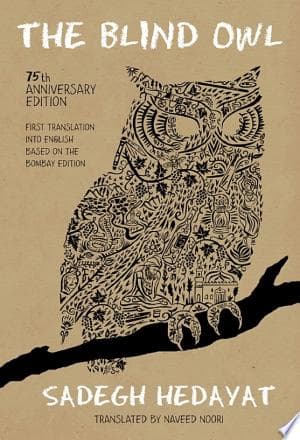
Synopsis
Covers the whole plot, including the ending.
- Difficulty
- Hard
- Read it if
- You are fascinated by existential philosophy, psychological horror, unreliable narrators, and exploring the darkest corners of human despair and obsession.
- Skip it if
- You prefer clear narratives, optimistic themes, or dislike grotesque imagery and a pervasive sense of hopelessness.
The Blind Owl Quotes
“There are sores which slowly erode the mind in solitude like a kind of canker.”
“I am writing only for my shadow on the wall. I must make myself known to it.”
“Life is a painful, fleeting moment that has no other purpose than to perpetuate pain.”
“Death is not the end. It is a journey to the land of shadows.”
“The world is a prison, and we are all prisoners condemned to death.”
“I saw my own face in the mirror and did not recognize it.”
“Love is a disease, and I am infected with it.”
“Time is a river that flows backward in my memory.”
“The owl is blind because it sees only in the dark.”
“I am a corpse who thinks, a dead man who writes.”
“Beauty is a mask that hides the horror of existence.”
“My shadow is my only companion, and even it betrays me.”
“The past is a ghost that haunts the present.”
“To understand me, you must first lose your mind.”
Quiz
10 questions on the plot and the characters. Each answer comes with a short explanation.
Question 1
What is the primary substance the narrator is addicted to throughout 'The Blind Owl'?
- Alcohol
- Opium
- Cocaine
- Hashish
Show answer
B. Opium The narrator is explicitly described as an opium addict, which fuels his descent into madness and shapes the hallucinatory, dream-like narrative of the book.
Question 2
What recurring image involves animals with a distinctive physical ailment in the narrator's visions?
- Three blind owls with broken wings
- Four cadaverous black horses with rasping coughs
- A pack of coughing hyenas
- Two limping donkeys with wheezing breath
Show answer
B. Four cadaverous black horses with rasping coughs The four black horses with rasping coughs are a key recurring image that symbolizes death and decay, central to the book's haunting and surreal atmosphere.
Question 3
What object does the narrator hide that contains a poisonous substance?
- A dagger coated with venom
- A vial of arsenic
- An urn of poisoned wine
- A box of tainted sweets
Show answer
C. An urn of poisoned wine The hidden urn of poisoned wine is one of the intricately woven mental images that recur in the narrative, representing themes of death, temptation, and self-destruction.
Question 4
What is the narrator compelled to do as his obsession with the beautiful woman intensifies?
- Paint her portrait repeatedly
- Record his obsession in writing
- Follow her secretly through the city
- Compose poems dedicated to her
Show answer
B. Record his obsession in writing The narrator is driven to write down his experiences and obsessions, which forms the very text of 'The Blind Owl', blurring the line between reality and madness.
Question 5
Which character is described as having a 'spine-chilling laugh' that haunts the narrator?
- The narrator's father
- An old man
- A mysterious doctor
- The woman's brother
Show answer
B. An old man The old man with a spine-chilling laugh is another recurring figure in the narrator's visions, symbolizing mortality and the uncanny, and contributing to the novel's oppressive, nightmarish quality.
Question 6
How does the structure of 'The Blind Owl' reflect the narrator's mental state?
- Through a linear, chronological plot that clearly separates reality from fantasy
- By using a series of intricately woven events that revolve around the same set of mental images
- Via multiple narrators who provide objective perspectives on the events
- Through footnotes and annotations that explain the symbolism
Show answer
B. By using a series of intricately woven events that revolve around the same set of mental images The book's non-linear, repetitive structure mirrors the narrator's opium-fueled hallucinations and descent into madness, blurring boundaries between memory, dream, and reality.
Question 7
What major theme does 'The Blind Owl' explore through the narrator's experiences?
- The joys of romantic love and fulfillment
- Political rebellion against societal norms
- Loss and spiritual degradation
- Scientific discovery and enlightenment
Show answer
C. Loss and spiritual degradation The book is described as 'a haunting tale of loss and spiritual degradation,' focusing on the narrator's despair and moral decay after losing his mysterious lover.
Question 8
Why is 'The Blind Owl' considered a seminal work in modern Iranian literature?
- Because it was the first Iranian novel translated into English
- Due to its groundbreaking use of surrealism and psychological depth by Sadegh Hedayat, Iran's most renowned modern fiction writer
- As it presents a historical account of Iran's political changes
- Because it follows traditional Persian storytelling techniques without innovation
Show answer
B. Due to its groundbreaking use of surrealism and psychological depth by Sadegh Hedayat, Iran's most renowned modern fiction writer Hedayat's innovative blend of surrealism, psychological exploration, and dark themes in 'The Blind Owl' established it as a classic and influential text in modern Iranian literature.
Question 9
What practical effect does the narrator's obsession have on his perception of reality?
- It sharpens his senses and makes him more alert to dangers
- It drives him further into frenzy and madness, blurring the line between hallucination and actual events
- It leads him to become a successful artist inspired by his visions
- It helps him reconcile with his past and find peace
Show answer
B. It drives him further into frenzy and madness, blurring the line between hallucination and actual events The narrator's fixation on the mysterious woman exacerbates his opium-induced madness, causing reality to dissolve into a series of repetitive, nightmarish visions.
Question 10
How does the introduction by Porochista Khakpour contextualize 'The Blind Owl' for contemporary audiences?
- By comparing it to Western horror novels and downplaying its Iranian roots
- Through a biographical focus solely on Hedayat's personal life
- By presenting it as a straightforward love story without deeper meaning
- As a classic of modern Iranian literature, highlighting its enduring relevance and haunting themes
Show answer
D. As a classic of modern Iranian literature, highlighting its enduring relevance and haunting themes Khakpour's introduction frames the novel as a significant literary work that continues to resonate, bridging its historical context with modern readership and emphasizing its themes of loss and madness.
The Blind Owl FAQ
What is 'The Blind Owl' about?
'The Blind Owl' is a haunting novel about an opium addict who spirals into madness after losing a mysterious lover. The narrator obsessively records his experiences, which revolve around recurring surreal images like an old man with a spine-chilling laugh and four cadaverous black horses, driving him further into despair and spiritual degradation.
Who is Sadegh Hedayat?
Sadegh Hedayat was Iran's most renowned modern fiction writer, considered a seminal figure in Persian literature. 'The Blind Owl' is his most famous work, known for its psychological depth and surreal narrative style that explores themes of madness and existential despair.
Is 'The Blind Owl' based on real events?
No, 'The Blind Owl' is not based on real events but is a work of fiction that delves into psychological and philosophical themes. It uses surreal and symbolic imagery to explore the narrator's descent into madness, reflecting Hedayat's own existential concerns rather than literal autobiography.
What are the main themes in 'The Blind Owl'?
The main themes include loss, madness, obsession, and spiritual degradation. The novel explores existential despair through surreal imagery and a fragmented narrative, delving into the psychological turmoil of the narrator as he grapples with his obsession and addiction.
How does 'The Blind Owl' compare to other works of modern literature?
'The Blind Owl' is often compared to works by authors like Franz Kafka and Edgar Allan Poe due to its surreal and psychological depth. It stands out as a unique contribution to modern Persian literature, blending existential philosophy with haunting, symbolic imagery in a way that has influenced many later writers.
Does 'The Blind Owl' work as an introduction to Persian literature?
Yes, 'The Blind Owl' works as a compelling introduction to modern Persian literature, as it is considered a classic and seminal work. However, its dark, surreal themes may be challenging for some readers, so it's best approached with an openness to psychological and philosophical exploration.
What is the significance of the recurring images in 'The Blind Owl'?
The recurring images, such as the old man with a laugh, black horses, and poisoned wine, symbolize the narrator's obsessive thoughts and descent into madness. They create a surreal, dream-like atmosphere that reinforces the themes of loss and spiritual decay, weaving a complex psychological tapestry.
How different is 'The Blind Owl' from traditional Persian literature?
'The Blind Owl' differs significantly from traditional Persian literature by embracing modernist techniques like surrealism and psychological introspection. While traditional works often focus on epic or romantic themes, Hedayat's novel delves into existential despair and madness, marking a shift toward contemporary philosophical concerns in Iranian fiction.
Is 'The Blind Owl' suitable for all readers?
No, 'The Blind Owl' may not be suitable for all readers due to its dark themes of madness, addiction, and existential despair. It contains surreal and disturbing imagery, so it's recommended for mature audiences interested in psychological and philosophical literature.
What role does opium addiction play in 'The Blind Owl'?
Opium addiction serves as a catalyst for the narrator's madness and spiritual degradation, blurring the lines between reality and hallucination. It amplifies his obsessive thoughts and despair, making it a central element in exploring themes of loss and psychological collapse throughout the novel.
About the author

Sadegh Hedayat was an Iranian writer and translator. Best known for his novel The Blind Owl, he was one of the earliest Iranian writers to adopt literary modernism in their career.
Similar books
- Nausea
Jean-Paul Sartre
3.9 (86k) average on GoodreadsPhilosophyExplores existential angst and the absurdity of existence through a protagonist's fragmented perceptions.
- The Stranger
Albert Camus
4.1 (3k) average on GoodreadsFantasyFeatures an emotionally detached protagonist grappling with meaninglessness and societal indifference.
- Notes from Underground
Fyodor Dostoevsky
4.2 (84k) average on GoodreadsPsychologyBoth feature unreliable, alienated narrators. However, Dostoevsky's Underground Man engages in verbose, intellectual diatribes, while Hedayat's narrator is more passive, a victim of his own mind's machinations.
- Brave New World
Aldous Huxley
4.0 (1.4M) average on GoodreadsFantasyIn a future where happiness comes from chemicals and individuality is gone, one man's desire for real experience threatens the calm, controlled society.
- Life of Pi
Yann Martel
3.9 (1.3M) average on GoodreadsFantasyStranded in the vast Pacific, a young Indian boy forms an unlikely bond with a Bengal tiger, questioning belief and survival.
- The Picture of Dorian Gray
Oscar Wilde
4.1 (966k) average on GoodreadsFantasyA beautiful young man's soul decays within a cursed portrait, mirroring the grotesque cost of his hedonistic pursuit of eternal youth and illicit pleasure.




Enjoyed the summary?
A summary gives you the shape of the book. The book itself has the detail, the examples and the voice.
Find The Blind Owl on AmazonAs an Amazon Associate, BookBrief earns from qualifying purchases. How we're funded