
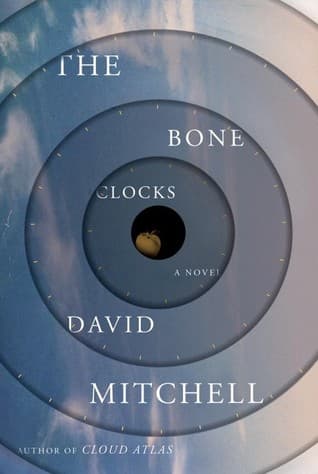
Synopsis
Covers the whole plot, including the ending.
- Difficulty
- Hard
- Pacing
- Variable
- Mood
- Philosophical, Expansive, Mysterious, Epic, Melancholy
- Read it if
- You enjoy sprawling, interconnected narratives that blend literary fiction with elements of fantasy and science fiction, exploring themes of immortality and human nature across different time periods and perspectives.
- Skip it if
- You prefer straightforward plots, dislike non-linear storytelling, or are put off by a significant commitment to a long, complex book with a large cast of characters and a slow build to its fantastical elements.
The Bone Clocks Plot Summary
Covers the whole plot, including the ending.
A Teenage Runaway and the Radio People
In July 1984, fifteen-year-old Holly Sykes, living in Gravesend, Kent, has a violent argument with her mother and runs away. A mysterious older woman named Mrs. Constanza picks her up and drives her to a secluded cottage. There, Holly experiences disorienting events, including visions and encounters with strange figures. One figure leaves a cryptic note in her pocket. She also meets a young boy, who seems to be a 'radio person' like herself. Eventually, Holly escapes the cottage and is found by the police, having been missing for several days. She returns home, but the encounter leaves her deeply disturbed and aware of an invisible world entering her reality.
Hugo Lamb's Ambition and Deception
In 1991, Hugo Lamb, a charming but manipulative Cambridge student, pursues a career in finance while navigating a complex relationship with his girlfriend, Scarlett. He is ambitious and believes in accumulating wealth and power. Hugo encounters Holly Sykes at a party, where she works as a bartender. He is drawn to her and tries to seduce her, but she rejects him. Hugo's story highlights his moral flexibility and his focus on self-interest, contrasting sharply with Holly's more intuitive and ethical nature. His interactions hint at a larger network of connections among the characters, though he remains largely unaware of the mystical undercurrents.
Ed Brubeck in Iraq
In 2004, Ed Brubeck, a war correspondent, is reporting from occupied Iraq. He is married to Holly Sykes and they have two children, Chloe and Aoife. Ed struggles with the moral ambiguities of his work, the constant danger, and the strain it places on his family life. During his deployment, he witnesses the horrors of war and the corruption within journalism. He also experiences a premonition or vision related to Holly's past encounter with the 'radio people,' though he dismisses it as stress. His segment explores integrity, fatherhood, and the impact of global conflict on individual lives, subtly hinting at the broader supernatural conflict through Holly's connection.
Crispin Hershey's Literary Decline
In 2015, Crispin Hershey, a mid-list author, attends a literary festival in Ireland. He is struggling with writer's block, dwindling sales, and the public's perception of his work. At the festival, he encounters his literary rival, Felix Finch, with whom he has a long-standing feud. Crispin also meets Holly Sykes, who is working as an event organizer. He is intrigued by her and they develop a professional, if somewhat strained, relationship. Crispin's narrative focuses on the pressures of the publishing world, the fragility of fame, and the search for artistic meaning. His interactions with Holly subtly draw him into the periphery of the larger mystical conflict, though he remains largely oblivious.
Holly Sykes: A Psychic's Life
In 2025, Holly Sykes is living in London, working as a psychic and medium. She has embraced her abilities, which she now understands are connected to a larger, ancient conflict. She provides guidance and comfort to her clients, but also feels the weight of her unique perception. Holly is raising her granddaughter, Eliza, and reflects on her past, including her marriage to Ed Brubeck and the challenges of motherhood. She continues to experience subtle communications from the 'radio people,' who reveal themselves to be more than just voices. This section solidifies Holly's role as a central figure in the supernatural war, preparing her for the direct confrontation to come.
The Horologists' Sanctuary
In 2025, after a direct attack from the Anchorites, Holly is rescued by Esther Little and other members of the Horologists, an ancient order dedicated to fighting the Anchorites. She is taken to their hidden sanctuary, known as the 'Blind Spot,' a place outside normal time and space. Here, Holly learns more about the true nature of the conflict: a centuries-old war between the Horologists, who reincarnate and use psychic energy, and the Anchorites, who steal souls to extend their lives. Holly begins training to develop her own psychic abilities under the guidance of the Horologists, preparing to join their ranks in the ongoing battle.
The Anchorites' Pursuit
Throughout 2025-2030, the Anchorites, led by figures like Dr. Marinus and Madame Eva Crommelynck, actively pursue Holly Sykes. They believe she possesses a unique and powerful 'soul-stream' that can sustain their extended lives, which are achieved by siphoning the souls of others. Their methods are brutal and manipulative, using human pawns and psychic attacks. The narrative reveals more about the Anchorites' history, their rituals, and their deep-seated fear of death. Their relentless pursuit of Holly underscores the high stakes of the supernatural war and the existential threat they pose to humanity and the Horologists.
The Battle of the Blind Spot
In 2030, the Anchorites launch a massive assault on the Horologists' sanctuary, the Blind Spot. Holly, now trained in psychic combat, fights alongside Esther Little, Marinus (who has defected from the Anchorites), and other Horologists. The battle is fierce and devastating, involving powerful psychic attacks, temporal distortions, and physical combat. Many Horologists are killed, and the sanctuary itself is severely damaged. Holly plays a key role in defending the Blind Spot, using her unique abilities to counter the Anchorites' attacks. This confrontation is a major turning point, highlighting the sacrifices and costs of the endless war.
The 'End of the World' and the Horologists' Retreat
Following the devastating Battle of the Blind Spot in 2030, the Horologists suffer significant losses and are forced to abandon their sanctuary. The 'End of the World,' a global environmental and societal collapse, has also begun to unfold in the background, further complicating their struggle. Holly, along with the surviving Horologists, must adapt to a world increasingly hostile and chaotic. They realize the war against the Anchorites is far from over, but their immediate priority shifts to survival and regrouping. This section depicts the immediate aftermath of the climax, setting the stage for the final confrontation and the broader implications of their fight.
The Final Stand in the Irish Sea
In 2043, with the world in a state of severe ecological collapse, Holly Sykes and the remaining Horologists are living on a remote island in the Irish Sea. The Anchorites, weakened but still a threat, launch a final, desperate attack. The battle is fought amidst a dying world, with diminishing psychic resources on both sides. Holly, now a powerful and experienced Horologist, confronts the last remaining high-ranking Anchorites. The conflict culminates in a devastating psychic showdown, where Holly must use all her strength and the collective power of her allies to finally defeat the ancient enemy, ensuring humanity's ultimate survival, though in a drastically changed world.
The Bone Clocks Characters
Holly Sykes
Protagonist
A sensitive woman with psychic abilities, caught in an ancient war.
Holly Sykes is the central protagonist, whose life is chronicled from her rebellious teenage years in 1984 to her old age in a post-apocalyptic future. From a young age, she hears 'radio people,' which are actually psychic communications. She is intuitive, empathetic, and resilient, often feeling like an outsider due to her unique perceptions. Holly marries Ed Brubeck and has two children, living a seemingly normal life while unknowingly being a 'lightning rod' for supernatural forces. Her journey is one of self-discovery, accepting her psychic gifts, and ultimately becoming a powerful Horologist.
Relationships: Mrs. Constanza (Mysterious woman who initially abducts her, later revealed to be a Horologist); Hugo Lamb (Brief, uncomfortable encounter; he attempts to seduce her); Ed Brubeck (Her husband, father of her children); Chloe Brubeck (Her daughter); Aoife Brubeck (Her daughter); Crispin Hershey (Acquaintance from a literary festival); Esther Little (Mentor and fellow Horologist); Marinus (Initially an Anchorite, later a Horologist ally)
Hugo Lamb
Supporting
An ambitious and manipulative Cambridge student turned corrupt financier.
Hugo Lamb is a charming but morally ambiguous character. He is driven by ambition, a desire for wealth, and a need for social climbing. His narrative focuses on his university life, his manipulative relationships, and his entry into the financial world. Hugo represents the more cynical and self-serving aspects of human nature, often exploiting others for his own gain. He briefly encounters Holly Sykes but remains largely unaware of the supernatural conflict that she is entangled in. His story provides a contrasting perspective on human motivations and societal values.
Relationships: Scarlett (His girlfriend, whom he manipulates); Holly Sykes (Brief, failed romantic interest)
Ed Brubeck
Supporting
A dedicated but conflicted war correspondent and Holly's husband.
Ed Brubeck is a principled war correspondent who struggles with the ethical dilemmas and personal toll of his profession. He is a loving husband to Holly and a devoted father, but his work often takes him away from his family, creating strain. Ed represents the 'normal' human world, largely oblivious to the supernatural war surrounding Holly, though he occasionally experiences fleeting glimpses of it. His chapters explore themes of truth, sacrifice, and the impact of global events on individual lives, grounding the fantastical elements in a relatable human context.
Relationships: Holly Sykes (His wife); Chloe Brubeck (His daughter); Aoife Brubeck (His daughter)
Crispin Hershey
Supporting
A cynical, self-deprecating author struggling with his career and rivalries.
Crispin Hershey is a middle-aged author whose career is in decline. He is witty, often sarcastic, and deeply insecure about his literary legacy. His narrative explores the cutthroat world of publishing, the pressures of fame, and the search for artistic meaning. He has a long-standing rivalry with fellow author Felix Finch. Crispin encounters Holly Sykes at a literary festival, and his story shows how ordinary lives can intersect with the extraordinary. Despite his cynicism, he possesses a degree of integrity and self-awareness, making him a relatable figure amidst the fantastical elements.
Relationships: Felix Finch (His literary rival); Holly Sykes (Acquaintance and later friend)
Marinus
Supporting
An ancient, enigmatic entity who shifts allegiance between Anchorites and Horologists.
Marinus is a complex and ancient character, initially appearing as an Anchorite, a soul-stealing immortal. However, his true nature is more nuanced. He is a 'Horologist gone rogue,' a sentient 'soul-stream' that has existed for centuries, capable of inhabiting different bodies. Marinus struggles with his own past actions and the moral implications of the war. He eventually defects to the Horologists, becoming a crucial ally to Holly Sykes. His character embodies the philosophical and ethical core of the novel, questioning the nature of life, death, and immortality.
Relationships: Madame Eva Crommelynck (Fellow Anchorite, his former superior); Holly Sykes (Ally and mentor, eventually a friend); Esther Little (Fellow Horologist)
Esther Little
Supporting
A wise and ancient Horologist, mentor to Holly Sykes.
Esther Little is a powerful and ancient Horologist, a member of the order dedicated to fighting the Anchorites. She is one of the 'radio people' Holly heard as a child. Esther acts as a mentor and guide to Holly, helping her understand her abilities and the true nature of the eternal conflict. She is wise, patient, and deeply committed to the Horologist cause, having lived many lives. Esther represents the collective wisdom and resilience of the Horologists, providing essential context and support to Holly's journey.
Relationships: Holly Sykes (Mentor and friend); Marinus (Fellow Horologist)
Madame Eva Crommelynck
Antagonist
A powerful and cruel Anchorite leader, seeking immortality through soul-theft.
Madame Eva Crommelynck is one of the primary antagonists, a high-ranking and ancient Anchorite. She is ruthless, manipulative, and utterly devoted to the Anchorite cause of achieving immortality by siphoning the 'soul-streams' of others. She represents the embodiment of evil and selfish desire for perpetual life, without regard for human cost. Crommelynck is a formidable psychic opponent, and her pursuit of Holly Sykes drives much of the supernatural plot. Her character highlights the dark side of immortality and the corrupting influence of power.
Relationships: Marinus (Her former subordinate and fellow Anchorite); Holly Sykes (Her primary target and enemy)
Chloe Brubeck
Supporting
Holly and Ed's daughter, who also possesses nascent psychic abilities.
Chloe Brubeck is Holly and Ed's daughter, who, like her mother, exhibits subtle psychic sensitivities. Her presence in the narrative, particularly in Holly's later chapters, highlights the inherited nature of the 'soul-stream' and the potential for new generations to join the Horologist cause. She is a source of comfort and connection for Holly in a rapidly changing world. Chloe represents hope for the future and the continuation of the spiritual lineage, even as the world around them faces collapse.
Relationships: Holly Sykes (Her mother); Ed Brubeck (Her father); Aoife Brubeck (Her sister); Eliza (Her daughter, Holly's granddaughter)
The Bone Clocks Themes
The Nature of Immortality and Mortality
The novel explores different forms of existence beyond a single lifespan. The Horologists achieve a form of reincarnation, retaining memories and consciousness across multiple lives. They see death as a 'gate' to rebirth. In contrast, the Anchorites pursue a parasitic immortality, extending their lives by siphoning the 'soul-streams' of others, a process depicted as morally corrupting and unsustainable. This contrast highlights the ethical implications of seeking to defy natural cycles. For example, Marinus's journey from Anchorite to Horologist reflects a rejection of false immortality in favor of a more natural, cyclical existence, emphasizing that true life is found in connection and rebirth, not selfish perpetuation.
“What is soul? The Horologists say it's a river, always flowing. The Anchorites say it's a lake, to be dammed.”
Interconnectedness Across Time and Space
The narrative structure itself, with its six interconnected novellas spanning decades and continents, reinforces the theme of interconnectedness. Characters from one section reappear in others, often unknowingly. Holly Sykes serves as a central link, her 'soul-stream' acting as a beacon that draws others into the larger conflict. The idea that individual lives, choices, and even psychic energies ripple across vast stretches of time and geography is paramount. For instance, Crispin Hershey's brief encounter with Holly at a literary festival, seemingly inconsequential, subtly links him to the ancient struggle, showing how seemingly disparate lives are woven into a larger story.
“Every soul is a coin. Every life, a journey. The river never stops, it just changes banks.”
The Battle Between Good and Evil (or Empathy and Selfishness)
At its core, the novel presents an ancient conflict between two opposing forces: the Horologists and the Anchorites. This is not a simplistic good vs. evil, but rather an exploration of empathy versus extreme selfishness. The Horologists, who reincarnate, value connection, memory, and the natural flow of life and death. The Anchorites, who steal souls, embody radical individualism and a ruthless pursuit of self-preservation at any cost. Holly's journey from an ordinary girl to a powerful Horologist symbolizes the triumph of empathy and interconnectedness over the parasitic nature of the Anchorites, highlighting the moral need to protect life's natural cycles.
“The Anchorites believe in perpetual life. We believe in perpetual living.”
The Power of Storytelling and Narrative
The novel itself shows the power of storytelling, both in its complex narrative structure and in its thematic content. Crispin Hershey's chapters directly address the challenges and importance of writing and legacy. The Horologists' ability to retain memories across reincarnations is a form of continuous storytelling, linking past lives to present identities. The 'radio people' are essentially narratives or communications that shape Holly's perception of reality. The book suggests that stories, whether personal histories or collective myths, are fundamental to understanding existence and navigating the complexities of time and identity. The intricate way each character's story contributes to the larger 'bone clock' narrative emphasizes the lasting power of narrative.
“A good story is a secret that wants to be told.”
Environmental Decay and the Future of Humanity
As the novel progresses into its later sections (2030s and 2040s), it paints a stark picture of a world ravaged by climate change and societal collapse, referred to as the 'End of the World.' This serves as a strong backdrop to the supernatural conflict, suggesting that humanity's self-destructive tendencies mirror the Anchorites' parasitic nature. The dwindling resources and increasing chaos of the external world force the Horologists to adapt and make their fight for survival even more desperate. This theme underscores the fragility of human civilization and connects the personal, spiritual battle to a broader, existential threat to the planet.
“The world was ending, not with a bang, but with a slow, agonizing choke.”
Plot Devices & Literary Techniques
Nested Narrative Structure
A series of interconnected novellas, each with a different protagonist, spanning decades.
The novel employs a unique narrative structure, presenting six distinct but interconnected novellas. Each novella focuses on a different protagonist (Holly, Hugo, Ed, Crispin, Holly again, and a final Horologist perspective) and takes place in a different decade, from 1984 to 2043. While each section feels like a self-contained story, characters and events from earlier sections reappear and gain new meaning in later ones, gradually revealing the overarching plot of the Horologist-Anchorite conflict. This structure allows for multiple perspectives and a vast temporal scope, building a complex world incrementally.
The 'Soul-Stream' Concept
The spiritual essence of a person, capable of reincarnation or being siphoned.
The 'soul-stream' is a central metaphysical concept in the novel, representing the individual's spiritual essence or consciousness. For Horologists, the soul-stream is capable of reincarnation, carrying memories and experiences across multiple lives, forming a continuous 'river.' For Anchorites, it is a resource to be siphoned from others to extend their own lives, like a 'lake' to be dammed. This concept underpins the entire supernatural conflict, defining the stakes of the war and the nature of immortality, as well as Holly's unique significance as a powerful soul-stream.
The 'Blind Spot'
A hidden sanctuary existing outside normal time and space.
The Blind Spot is a crucial setting and plot device for the Horologists. It is a hidden, extra-dimensional sanctuary where they can gather, train, and recover, safe from the Anchorites' immediate pursuit. It functions as a temporal anomaly, allowing Horologists to experience time differently and shield themselves from the outside world. The Blind Spot provides a space for exposition and character development for Holly, enabling her to learn about the war. Its eventual destruction signifies a major turning point in the conflict, forcing the Horologists into a more desperate, mobile existence.
Precognition and Psychic Abilities
Characters possess varying degrees of foresight and mental powers, influencing events.
Throughout the novel, characters like Holly Sykes and the Horologists exhibit various psychic abilities, including precognition, telepathy, and the ability to perceive 'soul-streams.' Holly's early experiences with the 'radio people' are a form of nascent psychic communication. These abilities serve as both a plot catalyst, drawing characters into the supernatural conflict, and a means of combat and communication within the Horologist-Anchorite war. Precognition, in particular, often provides glimpses of future events, creating dramatic irony and foreshadowing, while also highlighting the characters' unique connection to the deeper layers of reality.
The 'Atlas of Clouds' Intertextuality
Subtle references and recurring motifs that connect to David Mitchell's other works.
While not explicitly stated within the novel's plot, 'The Bone Clocks' is deeply embedded in David Mitchell's broader literary universe, often referred to as the 'omnibus.' Characters, names, and even specific phrases or locations from his previous novels, particularly 'Cloud Atlas,' reappear or are subtly referenced. This intertextuality creates a richer, more expansive world for readers familiar with Mitchell's work, suggesting a grander, interconnected meta-narrative. It functions as a subtle reward for dedicated readers and reinforces themes of reincarnation and the cyclical nature of existence across his entire bibliography.
The Bone Clocks Quotes
“The world is a machine for the making of souls.”
“Every life is a story. Every story is a destination.”
“There's a lot of living to do before you're dead.”
“You can't depend on anyone, and you can't depend on anything, except the certainty of change.”
“Sanity is a small price to pay for the truth.”
“A good book, like a good friend, is a life raft.”
“We are all just stories in the end.”
“The past is a foreign country; they do things differently there.”
“Love is a kind of haunting.”
“The future is a mirror, not a window.”
“There are no ordinary lives, only ordinary stories.”
“A library is a hospital for the mind.”
“Every exit is an entry somewhere else.”
“We are not the sum of our mistakes, but the sum of what we learned from them.”
Quiz
10 questions on the plot and the characters. Each answer comes with a short explanation.
Question 1
What event immediately precedes fifteen-year-old Holly Sykes slamming the door on her old life?
- She has a prophetic dream about her future.
- She discovers a hidden family secret.
- She has a scalding row with her mother.
- She is contacted by the 'radio people' again.
Show answer
C. She has a scalding row with her mother. The synopsis states that following a 'scalding row with her mother,' Holly slams the door on her old life, initiating her journey.
Question 2
What unique characteristic is attributed to Holly Sykes, making her a 'lightning rod for psychic phenomena'?
- She has the ability to see into the future at will.
- She was once contacted by voices she knew as 'the radio people'.
- She can communicate with animals telepathically.
- She possesses an innate talent for astral projection.
Show answer
B. She was once contacted by voices she knew as 'the radio people'. The description explicitly states Holly is 'a sensitive child once contacted by voices she knew only as “the radio people,”' making her a lightning rod for psychic phenomena.
Question 3
What is the primary consequence of Holly's 'lost weekend' in the English countryside?
- She finds a hidden treasure that changes her family's fortunes.
- It leads to a shocking disappearance that leaves her family irrevocably scarred.
- She gains extraordinary magical powers.
- She uncovers a secret society of benevolent mystics.
Show answer
B. It leads to a shocking disappearance that leaves her family irrevocably scarred. The synopsis states, 'her lost weekend is merely the prelude to a shocking disappearance that leaves her family irrevocably scarred.'
Question 4
Who are the two opposing factions that Holly's psychic abilities attract the attention of?
- A group of benevolent spirits and a cult of ancient gods.
- A cabal of dangerous mystics and their enemies.
- An alien civilization and a secret government agency.
- A society of time travelers and a rival group of historians.
Show answer
B. A cabal of dangerous mystics and their enemies. The text mentions Holly 'has caught the attention of a cabal of dangerous mystics—and their enemies,' indicating two opposing sides.
Question 5
The unsolved mystery stemming from Holly's disappearance is said to echo through which aspect of her life?
- Only her childhood years.
- Every decade of Holly’s life, affecting all the people Holly loves—even the ones who are not yet born.
- Only the lives of her immediate family members.
- Her professional career, but not her personal relationships.
Show answer
B. Every decade of Holly’s life, affecting all the people Holly loves—even the ones who are not yet born. The synopsis states, 'This unsolved mystery will echo through every decade of Holly’s life, affecting all the people Holly loves—even the ones who are not yet born.'
Question 6
Which of the following characters is NOT explicitly mentioned as having a part to play in the 'surreal, invisible war'?
- A middle-aged writer mourning his exile from the bestseller list.
- A conflicted father who feels alive only while reporting from occupied Iraq.
- A young artist struggling with creative block.
- A Cambridge scholarship boy grooming himself for wealth and influence.
Show answer
C. A young artist struggling with creative block. The description lists the writer, father, and scholarship boy, but makes no mention of a young artist.
Question 7
The narrative structure of 'The Bone Clocks' is suggested to involve the coming together of stories across various times and locations. Which of these is NOT mentioned as a setting where these stories converge?
- The medieval Swiss Alps.
- A futuristic lunar colony.
- The nineteenth-century Australian bush.
- A Manhattan townhouse in the near future.
Show answer
B. A futuristic lunar colony. While many diverse locations are mentioned, a 'futuristic lunar colony' is not among them. The settings include the Swiss Alps, Australian bush, a hotel in Shanghai, and a Manhattan townhouse.
Question 8
What is the implied nature of the 'surreal, invisible war on the margins of our world' that various characters are involved in?
- A conventional military conflict fought in secret.
- A philosophical debate among academics.
- A conflict involving psychic phenomena and dangerous mystics beyond ordinary perception.
- A corporate espionage battle for control of global resources.
Show answer
C. A conflict involving psychic phenomena and dangerous mystics beyond ordinary perception. The 'invisible war' is tied to Holly being a 'lightning rod for psychic phenomena' and catching the attention of 'dangerous mystics—and their enemies,' implying a supernatural or psychic conflict.
Question 9
How does the synopsis characterize the way the individual stories of the diverse characters come together?
- Through a series of violent confrontations.
- Through moments of everyday grace and extraordinary wonder.
- Through a singular, cataclysmic event.
- Through a shared dream sequence experienced by all.
Show answer
B. Through moments of everyday grace and extraordinary wonder. The final sentence states their stories 'come together in moments of everyday grace and extraordinary wonder,' suggesting a blend of the mundane and the fantastical.
Question 10
What is the overarching theme suggested by the echoing mystery of Holly's disappearance and its impact across generations?
- The inevitability of fate and predestination.
- The enduring and far-reaching consequences of past events on future lives and relationships.
- The futility of trying to solve ancient mysteries.
- The ultimate triumph of good over evil in a straightforward battle.
Show answer
B. The enduring and far-reaching consequences of past events on future lives and relationships. The text 'This unsolved mystery will echo through every decade of Holly’s life, affecting all the people Holly loves—even the ones who are not yet born' strongly implies the lasting and intergenerational impact of events.
The Bone Clocks FAQ
What is the central premise of 'The Bone Clocks' and who is Holly Sykes?
'The Bone Clocks' follows Holly Sykes across six decades of her life, starting from her teenage runaway period in 1984. She is a 'lightning rod' for psychic phenomena, unknowingly entangled in an ancient, invisible war between two immortal factions: the Horologists and the Anchorites. Her journey connects various seemingly disparate characters and events.
Who are the Horologists and the Anchorites, and what is their conflict about?
The Horologists are a benevolent faction of reincarnating souls who live many lives, retaining memories and evolving spiritually. The Anchorites, conversely, are malevolent immortals who extend their lives by 'siphoning' the souls of others, particularly sensitive individuals like Holly. Their conflict is a cosmic battle over life, death, and the nature of the soul.
How do the different narrative sections, each with a different protagonist, contribute to the overall story?
Each section is narrated by a different character whose life intersects with Holly Sykes at some point, providing a multifaceted view of her life and the unfolding supernatural conflict. These diverse perspectives, from Hugo Lamb to Ed Brubeck and Crispin Hershey, gradually reveal the hidden war and Holly's central role within it, building a mosaic of her existence.
What role does Crispin Hershey, the jaded writer, play in the story?
Crispin Hershey is a novelist who experiences a resurgence in his career due to a chance encounter with Holly Sykes and later finds himself inadvertently caught in the periphery of the Horologist-Anchorite war. His section provides a satirical look at the literary world and also serves to introduce some of the more overt supernatural elements through his interaction with the Horologist Marinus.
What is the significance of the 'radio people' Holly hears as a child?
The 'radio people' are the earliest manifestations of Holly's sensitivity to the spiritual world, specifically the voices of the Horologists attempting to communicate with her. This ability marks her as a 'psychosensitive,' a target for the Anchorites and a potential asset for the Horologists, setting the stage for her lifelong involvement in their conflict.
How does Holly Sykes's 'lost weekend' in 1984 connect to the larger conflict?
During her 1984 runaway period, Holly is unwittingly drawn into the periphery of the Anchorite 'siphon' process, making her a marked individual. She encounters Esther Little, an Anchorite, and Marinus, a Horologist, for the first time, establishing her as a pivotal figure in their ongoing war and leading to the 'shocking disappearance' mentioned in the synopsis.
Are there any connections to other David Mitchell novels within 'The Bone Clocks'?
Yes, 'The Bone Clocks' is deeply interconnected with Mitchell's 'ubervolume.' Characters like Marinus and Dr. Iris Marinus-Fenby appear in 'The Thousand Autumns of Jacob de Zoet' and 'Ghostwritten,' respectively. The Horologists' concept of soul reincarnation and the 'Black Hats' (Anchorites) also echo themes and entities from 'Cloud Atlas' and 'Ghostwritten,' weaving a larger narrative tapestry.
What is the significance of the tattoo Holly receives from Esther Little?
The tattoo given to Holly by Esther Little is a symbolic and literal mark of the Anchorites' claim on her soul. It acts as a beacon or a 'tag' that allows them to track her and makes her vulnerable to their siphoning attempts. It represents her unwitting entanglement in their dark world.
What is the role of the 'Atemporal' in the Horologist and Anchorite lore?
The Atemporal refers to the realm or state of existence outside of conventional time where souls reside between lives or during the Horologists' 'transmigration.' It is the source of their power and knowledge, and the Anchorites' quest for immortality is an attempt to defy its natural order by avoiding return to the Atemporal.
How does Holly Sykes evolve psychologically throughout her life in response to the supernatural elements?
Initially, Holly is a sensitive and somewhat naive teenager, dismissive of her unique abilities. As she ages, she becomes more aware and accepting of her connection to the supernatural, eventually embracing her role in the Horologist cause. Her experiences, particularly the loss of loved ones, harden her but also solidify her resolve and understanding of the cosmic battle.
What psychological impact does the 'unsolved mystery' of Holly's disappearance have on her family, particularly her mother?
The 'unsolved mystery' of Holly's initial disappearance leaves her family, especially her mother, with deep trauma and unresolved grief. It creates a lasting void, fueling guilt and speculation, and shapes their relationships and perspectives for decades, demonstrating the profound psychological ripple effect of such an event.
How does the book explore themes of mortality and the human desire for immortality?
The novel directly confronts mortality through the natural lifespans of human characters like Holly and Ed, contrasting it with the extreme desires of the Anchorites for eternal physical life. The Horologists offer an alternative perspective on immortality through reincarnation and spiritual evolution, presenting a nuanced exploration of what it means to live and die.
Discuss the psychological impact of the 'End of the World' scenario in the final section.
The 'End of the World' scenario, depicted through Holly's perspective in 2043, creates a profound sense of despair, regret, and the fragility of humanity. It forces Holly to confront the ultimate consequences of environmental neglect and the failure of human cooperation, leading to deep reflection on her life choices and the meaning of survival.
Is the ultimate victory of the Horologists over the Anchorites a definitive 'happy ending'?
While the Horologists ultimately defeat the Anchorites, the ending is bittersweet due to the subsequent collapse of civilization in 2043. It suggests that cosmic victories do not negate human failings, leaving readers to ponder whether the spiritual triumph is enough when the physical world is destroyed. It's a complex resolution, not a simple 'happy ending'.
What is the metaphorical significance of the 'bone clocks' in the title?
The 'bone clocks' refer to human bodies, which are finite and subject to the passage of time, like clocks made of bone. It symbolizes the transient nature of mortal life and serves as a contrast to the eternal, reincarnating souls of the Horologists and the desperate, unnatural immortality sought by the Anchorites. It highlights the central theme of time and mortality.
How does the novel blend literary fiction with elements of fantasy, mystery, and science fiction?
The novel grounds its narrative in realistic character development and social commentary (literary fiction), while introducing an ancient battle between immortal factions (fantasy). The initial disappearance of Holly and the slow reveal of the supernatural war create a sense of mystery. The final section, set in a dystopian future, firmly places it in science fiction, demonstrating a masterful genre blend.
Does the book offer a definitive answer on the existence of the soul or an afterlife?
The book strongly suggests the existence of a soul and an afterlife through the Horologists' reincarnation and their interactions with the Atemporal. While presented within a fictional framework, the detailed lore and consistent portrayal of these elements lean towards an affirmative answer within the novel's universe, offering a specific metaphysical model.
What message, if any, does 'The Bone Clocks' convey about humanity's future?
The final section, 'An Horologist's Report,' presents a bleak vision of humanity's future, ravaged by climate change and societal collapse. It serves as a cautionary tale, suggesting that despite individual acts of heroism or cosmic victories, humanity's collective choices regarding the environment and social responsibility ultimately determine its fate.
About the author
Similar books
- Cloud Atlas
David Mitchell
4.0 (216k) average on GoodreadsLiterary FictionShares a similar non-linear, interconnected narrative structure and exploration of reincarnation and human connection across time.
- Life of Pi
Yann Martel
3.9 (1.3M) average on GoodreadsFantasyFeatures elements of magical realism and a philosophical exploration of belief and survival.
- Jonathan Strange & Mr Norrell
Susanna Clarke
3.8 (198k) average on GoodreadsFantasyCombines historical fiction with intricate, deep-seated magical systems and a large scope.
- The Old Man and the Sea
Ernest Hemingway
3.8 (831k) average on GoodreadsLiterary FictionA Cuban fisherman's long struggle with a giant marlin becomes a story of endurance and dignity, now retold for young adults with illustrations, phonetic guides, and writing prompts in Traditional Chinese.
- One Hundred Years of Solitude
Gabriel García Márquez
4.1 (753k) average on GoodreadsLiterary FictionThrough the multi-generational story of the Buendía family, a mythical town deals with the repeating patterns of time, love, and solitude, as the extraordinary mixes with the ordinary.
- The Goldfinch
Donna Tartt
3.9 (720k) average on GoodreadsLiterary FictionHaunted by a tragic explosion and clutching a stolen Dutch masterpiece, a young orphan navigates the opulent drawing rooms of New York and the gritty underbelly of the art world, desperately seeking connection and redemption amidst a life spiraling into crime and obsession.





Enjoyed the summary?
A summary gives you the shape of the book. The book itself has the detail, the examples and the voice.
Find The Bone Clocks on AmazonAs an Amazon Associate, BookBrief earns from qualifying purchases. How we're funded