
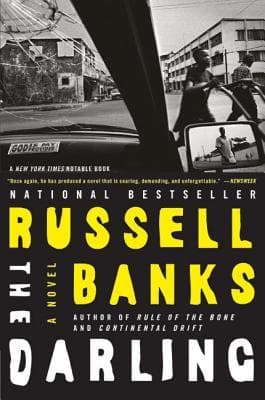
Synopsis
Covers the whole plot, including the ending.
- Difficulty
- Medium
- Pacing
- Variable
- Mood
- Somber, Reflective, Intense, Unsettling
- Read it if
- You are interested in character-driven literary fiction exploring themes of political exile, motherhood, and the devastating impact of war, particularly in the context of African history and American radicalism.
- Skip it if
- You prefer fast-paced thrillers or stories with clear-cut heroes and villains, or find extensive descriptions of war's brutality difficult to read.
The Darling Plot Summary
Covers the whole plot, including the ending.
Escape to Liberia
In 1975, Hannah Musgrave, a disillusioned American radical, escapes the FBI for her involvement with the Weather Underground. She goes to Liberia, a West African nation with historical ties to the US. Hannah quickly adjusts to her new surroundings, finding anonymity and freedom from her past. She meets and falls in love with Daniel, a Liberian university professor, and they marry. Hannah embraces Liberian culture and starts a new life, believing she has moved past her radical American identity and the dangerous politics she left behind. Her first years in Liberia are quiet and domestic, a deliberate attempt to shed her former self.
A New Life and Motherhood
Hannah and Daniel settle into a comfortable life in Monrovia. Over the next decade, they have three daughters: Caro, Ruth, and Penny. Hannah works for a local aid organization, while Daniel teaches. They live a relatively privileged life compared to many Liberians, enjoying peace despite simmering political tensions. Hannah focuses almost entirely on her family, trying to bury her radical past, believing she has found a safe haven. However, Liberia's political situation becomes volatile, with growing discontent against President Samuel Doe's regime, which will affect their lives.
Encounter with Charles Taylor
Daniel's academic and political connections lead him to Charles Taylor, a rising and charismatic figure in Liberian politics, then serving in Doe's government. Initially, Taylor seems a modernizing force, but his ambition and ruthlessness quickly appear. Hannah and Daniel become part of Taylor's social circle, attending gatherings at his home. Hannah is both fascinated and repelled by Taylor's charm and his desire for power. She observes his manipulative nature and how he builds loyalty through charisma and intimidation. This closeness to Taylor, a man who will become central to Liberia's civil war, is a turning point for Hannah and her family, drawing them into the country's turbulent future.
The Coup and Growing Instability
Liberia's political situation quickly worsens. President Samuel Doe's regime becomes repressive, leading to widespread discontent. Charles Taylor, having fled Liberia after embezzlement accusations, reappears as a rebel leader, forming the National Patriotic Front of Liberia (NPFL). Civil war erupts, bringing chaos and brutality. Hannah and Daniel are caught in the violence. Monrovia becomes a battleground, and their family's safety is constantly threatened. Hannah sees the war's horrors firsthand — destruction, displacement, and executions. The peace of their lives shatters, and Hannah faces the grim realities of their precarious existence in a nation consumed by conflict. Her past experiences with political violence, though different, resurface.
Hannah's Daughters and the War's Impact
The civil war takes a severe toll on Hannah's daughters. Caro, the eldest, becomes withdrawn and fearful, struggling to understand the violence. Ruth, the middle daughter, shows resilience, even bravado, trying to protect her younger sister. Penny, the youngest, is too young to grasp the horror but is deeply affected by the constant fear. Hannah, trying to shield them, makes desperate decisions for their safety. The girls' innocence is lost, and Hannah deals with the guilt of bringing them into such a dangerous world, questioning her choices and how her radical past affects their present suffering.
The Decision to Flee (Again)
As the war intensifies and Monrovia becomes perilous, Hannah realizes staying in Liberia is no longer an option for her children's safety. The city is under siege, and aid is scarce. After much agonizing, she makes the heartbreaking decision to send her three daughters to the United States to live with her estranged sister, whom she has had minimal contact with since her radical days. This decision is emotionally difficult, as it means separating from her children and sending them back to the country she fled. It shows a failure in her attempt to create a new, safe life for them, forcing her to confront the pull of her American past and its implications.
Life in War-Torn Liberia
After sending her daughters away, Hannah and Daniel remain in Liberia, enduring the civil war. They struggle for survival amidst destruction, looting, and constant threats of violence. Hannah, using her past experience and resilience, becomes resourceful, finding ways to get food and maintain a semblance of life. Daniel, deeply affected by his country's disintegration, becomes despondent. Their relationship is tested by the extreme conditions, but they cling to each other for support. Hannah's commitment to Liberia, even without her children, shows a deep sense of belonging and a refusal to abandon the life she built, despite its current horrors.
The Daughters' Struggle in America
Meanwhile, in the United States, Hannah's three daughters struggle to adapt to their new lives in rural New Hampshire with their Aunt Helen, Hannah's sister. The culture shock is immense, moving from war-torn Liberia to a quiet, unfamiliar American town. They face difficulties integrating into school and making friends. More significantly, they deal with feelings of abandonment and resentment towards their mother for sending them away. Caro, the eldest, feels the burden of responsibility for her younger sisters. Ruth, still resilient, tries to make sense of their new world, while Penny struggles with the emotional trauma of separation. Their experiences highlight the lasting impact of their mother's choices on their young lives.
Hannah's Return to America
Years later, after the war in Liberia has somewhat subsided and Daniel has died, Hannah returns to the United States. Her return is not a triumph but a re-entry into a life she abandoned. She faces the legal consequences of her past radical activities, though much of the original fervor has faded. More importantly, she confronts the emotional fallout of her long absence from her daughters. The reunion is strained, marked by unspoken resentments and the vast emotional distance that has grown between them. Hannah tries to reconnect with her now-adult daughters, but the scars of their separation and difficult upbringing in Liberia and America are deep, making reconciliation a complex and painful process.
Seeking Forgiveness and Understanding
Hannah dedicates herself to understanding her daughters' experiences and explaining her own. She recounts her life in Liberia, her love for Daniel, and the impossible choices she faced during the civil war. She also grapples with her past as a radical, reflecting on the ideals that drove her and the compromises she made. Her daughters, each in their own way, struggle to reconcile the mother they remember with the woman before them. Caro remains guarded, Ruth is more willing to engage, and Penny, though still carrying trauma, yearns for connection. The process of forgiveness and understanding is slow and hard, highlighting the lasting impact of her decisions on their shared history and individual identities.
Reconciliation and Lingering Wounds
Over time, a fragile reconciliation begins to emerge between Hannah and her daughters. They begin to communicate more openly, sharing their pain and perspectives. While complete understanding or erasure of the past is impossible, they find common ground in their shared history and their love, however complicated, for each other. Hannah accepts that her choices had profound and sometimes damaging consequences, and her daughters begin to see her not just as an absent mother but as a complex woman shaped by extraordinary circumstances. The novel concludes with a sense of enduring connection, but also an acknowledgment that the wounds inflicted by war, separation, and radical idealism leave indelible marks on individuals and families, forever shaping their identities.
The Darling Characters
Hannah Musgrave
Protagonist
A former American radical who finds a new life in Liberia, only to be caught in its civil war.
Hannah is a complex and independent woman, driven by a blend of idealism, a desire for anonymity, and later, maternal devotion. She flees America as a member of the Weather Underground, seeking a fresh start and a rejection of her past. In Liberia, she transforms from a political activist into a wife and mother, embracing a new culture. She is resilient, resourceful, and capable of both fierce love and difficult, self-preserving decisions. Her internal conflict stems from her past radical identity clashing with her present maternal role and the brutal realities of war.
Relationships: Daniel (Husband, intellectual partner, and emotional anchor in Liberia.); Caro (Eldest daughter, with whom she has a strained and resentful relationship after the separation.); Ruth (Middle daughter, resilient and more open to understanding her mother.); Penny (Youngest daughter, deeply affected by the trauma of separation and war.); Charles Taylor (Acquaintance and later a figure of fear and political entanglement.)
Daniel
Supporting
Hannah's Liberian husband, a university professor and intellectual caught in his country's turmoil.
Daniel is an intelligent and compassionate Liberian professor who provides Hannah with stability and a deep connection in her new life. He is proud of his country and initially optimistic about its future, but he becomes increasingly disillusioned and broken by the civil war. He represents the educated, hopeful segment of Liberian society that is ultimately crushed by the conflict. His love for Hannah and their daughters is unwavering, but he struggles to cope with the escalating violence and the destruction of his world.
Relationships: Hannah Musgrave (Wife and partner, providing her with a new family and home.); Caro, Ruth, Penny (Loving father to their three daughters.)
Caro
Supporting
Hannah's eldest daughter, who carries the burden of responsibility and resentment.
Caro is the eldest of Hannah's three daughters, and as such, she bears much of the emotional weight of their family's ordeal. She is initially a bright and curious child but becomes withdrawn and resentful after being sent to America. She struggles with feelings of abandonment and feels a protective, almost maternal, responsibility for her younger sisters. Her relationship with Hannah is particularly strained, as she struggles to forgive her mother's choices and understand her past.
Relationships: Hannah Musgrave (Daughter, with a complex and often strained relationship.); Ruth (Sister, with whom she shares a bond of shared trauma.); Penny (Sister, for whom she feels protective.)
Ruth
Supporting
Hannah's middle daughter, resilient and more open to understanding.
Ruth is the middle daughter, characterized by her resilience and a pragmatic approach to their traumatic experiences. While deeply affected by the war and the separation from her mother, she shows a greater capacity for adaptation and understanding than Caro. She often acts as a bridge between her sisters and later between her sisters and Hannah, seeking to make sense of their fractured lives. She is observant and thoughtful, trying to piece together the narrative of her family's past.
Relationships: Hannah Musgrave (Daughter, seeking to understand her mother's motivations.); Caro (Sister, with whom she shares a close bond.); Penny (Sister, for whom she cares deeply.)
Penny
Supporting
Hannah's youngest daughter, deeply affected by the trauma of separation.
Penny is the youngest of Hannah's daughters, and her early childhood is defined by the chaos of the Liberian civil war and the subsequent separation from her mother. She is too young to fully intellectualize the events but carries the deep emotional scars of trauma and abandonment. Her struggles often manifest in quiet distress and a longing for connection. She represents the most innocent victim of the political and personal upheavals that define the family's story, yearning for the maternal bond that was disrupted.
Relationships: Hannah Musgrave (Daughter, deeply affected by her mother's absence.); Caro (Sister, who often acts as a surrogate mother figure.); Ruth (Sister, with whom she shares a close bond.)
Charles Taylor
Antagonist/Mentioned
The infamous Liberian warlord and ex-president, whose rise to power directly impacts Hannah's family.
Charles Taylor is depicted as a charismatic, ambitious, and utterly ruthless figure. Initially, he appears as a political operator, but he quickly transforms into a brutal warlord who plunges Liberia into a devastating civil war. He embodies the corrupting nature of power and the destructive force of political ambition. While not a direct character in many scenes, his presence looms large over Hannah's life in Liberia, as her family's fate becomes inextricably linked to his actions and the war he instigates. He represents the external forces of chaos that shatter Hannah's carefully constructed new life.
Relationships: Hannah Musgrave (Acquaintance whose actions indirectly force Hannah's critical decisions.); Daniel (Acquaintance and former colleague whose political connections brought him into Taylor's orbit.)
Helen
Supporting
Hannah's estranged sister, who reluctantly takes in her nieces.
Helen is Hannah's older sister in the United States, representing a more conventional and stable life. She is initially estranged from Hannah due to Hannah's radical past and sudden disappearance. When Hannah's daughters arrive, Helen reluctantly takes them in, providing a safe, albeit unfamiliar, home. She struggles to understand Hannah's choices and the girls' Liberian upbringing, but she ultimately provides the care and stability the girls desperately need. Her practical nature contrasts with Hannah's idealism.
Relationships: Hannah Musgrave (Estranged sister, later reconnected through their shared family.); Caro, Ruth, Penny (Aunt and temporary guardian.)
The Darling Themes
The Enduring Consequences of Idealism
The novel explores how youthful idealism, even when seemingly abandoned, continues to shape a person's life and impact those around them. Hannah's radical past with the Weather Underground, though suppressed in Liberia, is not truly left behind. Her desire for a 'pure' life, free from American corruption, leads her to a country that ultimately mirrors, in its own brutal way, the political violence she sought to escape. The decision to send her daughters to America forces her to confront the compromises of her ideals and the unforeseen, painful consequences of her choices on her children's lives. The theme highlights that intentions, no matter how noble, do not always lead to desired outcomes, and the past inevitably catches up.
“What had been revolutionary passion had become, in the intervening years, a kind of stubborn, almost pathological independence.”
Motherhood and Sacrifice
A central theme is the agonizing nature of motherhood, especially in extreme situations. Hannah's journey in Liberia transforms her from a political fugitive into a fiercely protective mother. Her ultimate sacrifice — sending her daughters away to ensure their survival — is the hardest decision she makes. This act of separation, meant to save them, paradoxically causes deep emotional trauma and resentment in her children. The novel explores the impossible choices mothers face, the guilt they carry, and the enduring bond that persists even through separation and misunderstanding, as seen in Hannah's efforts to reconcile with her adult daughters.
“A mother's love was a kind of madness, she knew, an irrational, self-consuming fire.”
Identity and Belonging
Hannah's search for identity and belonging is a recurring idea. She tries to shed her American radical identity in Liberia, embracing a new culture, a new family, and a new sense of self. However, the civil war shatters this illusion of belonging, forcing her to confront her 'otherness' and the precariousness of her adopted home. Her daughters also deal with their dual identities — Liberian-born but American-raised, caught between two cultures and two narratives of their mother's life. The novel suggests that identity is not easily shed or acquired, but rather a complex layering of experiences, origins, and allegiances, often shaped by trauma and displacement.
“She had wanted to erase herself, to become someone else entirely, but the past, like a shadow, always followed.”
The Scars of War and Trauma
The devastating impact of civil war and its lasting psychological scars are clearly shown. The Liberian conflict is not merely a backdrop but a character, shaping every aspect of Hannah's and her family's lives. The novel details the loss of innocence for Hannah's daughters, who witness violence and endure the trauma of displacement and abandonment. Even after the physical war ends, the emotional and psychological wounds persist, affecting relationships, behavior, and the ability to find peace. The story shows how trauma can be inherited and how societies, like individuals, struggle to heal from violence.
“The war had taken everything from them, not just their home, but their childhoods, their innocence, their sense of safety.”
Plot Devices & Literary Techniques
Non-linear Narrative
The story often shifts between time periods, particularly between Hannah's past in Liberia and her present in America.
The novel employs a non-linear narrative structure, frequently jumping between Hannah's experiences in Liberia during the civil war and her later life in America as she tries to reconnect with her daughters. This device allows the author to gradually reveal Hannah's past, building suspense and highlighting the long-term consequences of her choices. It also enables a deeper exploration of themes like memory, guilt, and the enduring impact of trauma, as Hannah and her daughters process events from different temporal perspectives. This structure mirrors the fractured nature of memory and identity in the wake of profound upheaval.
Dual Perspective/Focal Characters
While primarily Hannah's story, the narrative occasionally shifts to or heavily features the perspectives of her daughters.
Although Hannah is the central protagonist, the novel frequently delves into the experiences and perspectives of her three daughters, especially once they are in America. This device provides a crucial counterpoint to Hannah's own narrative, allowing the reader to understand the profound impact of her choices from the viewpoint of those most affected. It highlights the generational divide in understanding trauma and sacrifice, and it deepens the emotional complexity of the family's struggle for reconciliation. By showing the daughters' struggles, the novel emphasizes the far-reaching consequences of political and personal decisions.
Symbolism of the 'Darling'
The title itself refers to Hannah's pet chimpanzee and symbolizes lost innocence and the brutal realities of nature and war.
The 'Darling' refers to Hannah's pet chimpanzee in Liberia, which she eventually releases into the wild for its own survival. The chimpanzee initially symbolizes Hannah's attempt to create a new, wild, and 'innocent' life for herself and her children, free from the constraints of civilization. However, its eventual fate in the brutal Liberian jungle, and the chimpanzees' own capacity for violence, becomes a potent symbol of the harsh realities of nature, the breakdown of order during wartime, and the loss of innocence. It foreshadows the difficult decisions Hannah makes and the savagery that ultimately consumes her adopted home.
The Darling Quotes
“It was the same story everywhere, really, the story of the powerful and the powerless, and how the powerful always found a way to take what they wanted from the powerless, even if it meant destroying them in the process.”
“The past, she knew, was a country you could never truly leave, no matter how far you traveled or how many borders you crossed.”
“She had always believed that truth, like love, was something you had to fight for, something you had to earn.”
“The jungle was a living, breathing thing, ancient and indifferent, swallowing up everything in its path, including human history.”
“There was a kind of freedom in anonymity, she discovered, a shedding of the burdens of who she used to be.”
“Children, she thought, were the truest mirrors, reflecting back all the hopes and fears and failures of their parents.”
“Guilt, she understood, was a luxury, a indulgence for those who had time and space to feel it.”
“The sound of the chimpanzees, a chorus of shrieks and hoots, was the soundtrack to her new life, wild and untamed.”
“History, she knew, was not just written by the victors, but also by the forgotten, by the silent ones.”
“Love, in a place like this, was not a soft thing, but a hard, resilient thing, forged in fire.”
“She had wanted to change the world, and instead, the world had changed her.”
“There were no easy answers, only choices, and each choice led to another, deeper into the maze.”
“The past was not merely prologue; it was the entire play, constantly being re-enacted, whether you wanted it to be or not.”
“She understood then that loneliness was not an absence of others, but an absence of self.”
Quiz
10 questions on the plot and the characters. Each answer comes with a short explanation.
Question 1
What is Hannah Musgrave's primary reason for fleeing the United States?
- She was seeking a new career opportunity in West Africa.
- She was a political radical and member of the Weather Underground, wanted by the authorities.
- She wanted to escape a bad marriage and start fresh.
- She was an anthropologist studying Liberian culture.
Show answer
B. She was a political radical and member of the Weather Underground, wanted by the authorities. Hannah Musgrave flees the US because of her involvement with the Weather Underground, making her a fugitive.
Question 2
Which West African country does Hannah Musgrave flee to with her Liberian husband?
- Sierra Leone
- Ghana
- Liberia
- Ivory Coast
Show answer
C. Liberia The book explicitly states that Hannah and her Liberian husband go to Liberia.
Question 3
What kind of animals does Hannah Musgrave become involved with protecting or raising in Liberia?
- Elephants
- Chimpanzees
- Lions
- Gorillas
Show answer
B. Chimpanzees Hannah dedicates herself to the care and protection of chimpanzees in Liberia, which becomes a significant part of her life there.
Question 4
Who is the notorious warlord and ex-president that Hannah and her husband become friends with in Liberia?
- Samuel Doe
- Prince Johnson
- Charles Taylor
- Ellen Johnson Sirleaf
Show answer
C. Charles Taylor The synopsis explicitly states that Hannah and her husband become friends with Charles Taylor, a key figure in Liberian history.
Question 5
What is the primary thematic tension explored through Hannah's past as a Weather Underground member and her life in Liberia?
- The conflict between personal ambition and familial duty.
- The struggle between idealism, radicalism, and the harsh realities of political and personal consequences.
- The contrast between urban and rural lifestyles.
- The differences between American and African legal systems.
Show answer
B. The struggle between idealism, radicalism, and the harsh realities of political and personal consequences. Hannah's journey from a radical activist to a woman facing the consequences of her past and the violence of Liberia highlights the clash between revolutionary ideals and their often brutal outcomes.
Question 6
How does Hannah's encounter with Charles Taylor specifically impact her family later in the novel?
- Taylor helps Hannah secure safe passage back to the US for her children.
- Taylor's actions and the civil war he orchestrates directly endanger Hannah's children, forcing her to make a critical choice.
- Taylor offers Hannah's children political asylum in a neighboring country.
- Taylor facilitates a reunion between Hannah and her estranged American family.
Show answer
B. Taylor's actions and the civil war he orchestrates directly endanger Hannah's children, forcing her to make a critical choice. The synopsis states that Hannah's encounter with Taylor 'triggers a series of events whose momentum catches Hannah's family in its grip and forces her to make a heartrending choice,' directly linking Taylor's influence to her family's peril.
Question 7
What 'heartrending choice' is Hannah ultimately forced to make regarding her family?
- Whether to return to the Weather Underground or remain in Liberia.
- To abandon her chimpanzee sanctuary to protect her children, or risk their lives by staying.
- To betray Charles Taylor to the international authorities or face execution.
- To divorce her Liberian husband or force him to leave the country.
Show answer
B. To abandon her chimpanzee sanctuary to protect her children, or risk their lives by staying. While the synopsis doesn't explicitly detail the choice, the core conflict often revolves around Hannah's dedication to her adopted life and children versus the escalating violence, forcing her to choose between them and her work/home in Liberia.
Question 8
The novel uses a dual narrative structure, often alternating between Hannah's past in the US and her present in Liberia. What effect does this have on the reader's understanding of Hannah's character?
- It simplifies her motivations, making her a straightforward protagonist.
- It emphasizes her complete transformation, showing no connection between her past and present selves.
- It reveals the enduring impact of her radical youth on her adult choices and moral compass, creating a complex, layered character.
- It serves merely to provide historical context without deeper character insight.
Show answer
C. It reveals the enduring impact of her radical youth on her adult choices and moral compass, creating a complex, layered character. By juxtaposing her past radicalism with her present struggles, the novel deeply explores how her youthful idealism and choices continue to shape her identity and reactions to the chaos around her.
Question 9
How does Russell Banks typically portray the political and social landscape of Liberia in 'The Darling'?
- As a stable, developing nation offering a peaceful refuge.
- As a vibrant democracy struggling with minor internal issues.
- As a country descending into brutal civil war, corruption, and chaos.
- As a picturesque backdrop for Hannah's personal adventures, devoid of conflict.
Show answer
C. As a country descending into brutal civil war, corruption, and chaos. The setting of the book during the Liberian Civil War, with Charles Taylor as a key figure, indicates a portrayal of a country embroiled in extreme violence and instability.
Question 10
A significant internal conflict for Hannah Musgrave is reconciling her past revolutionary ideals with what she witnesses and experiences in Liberia. What specific aspect of Liberian society challenges her former beliefs the most?
- The efficiency of the local bureaucracy.
- The rise of a charismatic leader who embodies the very corruption and violence she once fought against.
- The peaceful coexistence of different ethnic groups.
- The success of socialist economic policies.
Show answer
B. The rise of a charismatic leader who embodies the very corruption and violence she once fought against. Her friendship with Charles Taylor, a warlord, forces her to confront the brutal realities of power and the devastating consequences of 'revolution' in a way that contrasts sharply with her youthful, perhaps more abstract, revolutionary ideals.
The Darling FAQ
Who is Hannah Musgrave and what is her initial motivation for leaving the United States?
Hannah Musgrave is the protagonist of 'The Darling,' a former member of the radical Weather Underground. She flees the United States in 1975 to escape potential prosecution for her involvement in domestic political bombings, seeking refuge and a new identity far from her past revolutionary activities.
How does Hannah's life in Liberia begin, and what is her profession there?
Hannah's life in Liberia begins with a sense of anonymity and purpose. She works as a veterinarian, dedicating herself to caring for chimpanzees at a sanctuary, a role that allows her to channel her intense energy and desire for contribution into a less politically charged environment.
Who is Silas and what is his relationship with Hannah?
Silas is Hannah's Liberian husband, a kind and stable man who provides her with a sense of normalcy and belonging in her adopted country. Their relationship is a grounding force for Hannah, offering her a domestic life distinct from her turbulent past.
How does Charles Taylor enter Hannah's life and what is his initial connection to her?
Charles Taylor enters Hannah's life through their mutual social circles in Liberia. Initially, he is presented as a charismatic and ambitious figure, and he and Hannah's husband Silas develop a friendship, which gradually draws Hannah into his orbit.
What pivotal event forces Hannah to make a 'heartrending choice' at the climax of the novel?
The pivotal event is the escalation of civil war in Liberia and Charles Taylor's ascent to power, which directly endangers Hannah's chimpanzee sanctuary and, more critically, her family. She is forced to choose between protecting her animals and securing the safety of her children, who become entangled in Taylor's violent regime.
What is the significance of the chimpanzees in Hannah's life and the overall narrative?
The chimpanzees represent Hannah's attempt at redemption and a pure, unblemished commitment, contrasting sharply with her destructive past. They symbolize innocence and vulnerability, making their eventual fate under Taylor's regime a tragic mirror of human suffering and the collapse of order.
Are there any parallels between Hannah's radical past in the Weather Underground and Charles Taylor's rise to power?
Yes, there are subtle parallels. Both Hannah's Weather Underground activities and Charles Taylor's actions involve a conviction in a cause, a willingness to use violence for political ends, and a charismatic leadership style among their followers, highlighting the often-blurred lines between revolutionary ideals and destructive power.
How does the novel use the setting of Liberia to reflect Hannah's internal state?
Liberia, with its beauty, its political instability, and its eventual descent into chaos, mirrors Hannah's internal landscape. The initial hope and peace she finds there reflect her desire for a fresh start, while the country's unraveling parallels the re-emergence of her own unresolved past and moral dilemmas.
What does Hannah's relationship with her children reveal about her character development?
Hannah's relationship with her children reveals her profound capacity for love and her shifting priorities from abstract political ideals to concrete personal responsibility. Their safety becomes her ultimate concern, demonstrating a maturation that prioritizes nurturing life over revolutionary destruction.
How does Hannah grapple with her past actions and identity as a former Weather Underground member while in Liberia?
Hannah grapples with her past by initially trying to suppress it, immersing herself in her work with the chimpanzees. However, the escalating violence in Liberia and her proximity to Charles Taylor force her to confront the echoes of her own radicalism and the consequences of political extremism.
Does Hannah ever fully reconcile her American identity with her Liberian life?
Hannah never fully reconciles her American identity with her Liberian life; instead, she lives in a constant state of tension between them. Her past in America informs her perspective, while her present in Liberia demands a new set of loyalties, creating a divided self that is central to her character.
How does the novel portray the psychological impact of war and political instability on individuals like Hannah and her family?
The novel portrays the devastating psychological impact of war through the gradual erosion of safety, trust, and moral certainties. Hannah and her family experience trauma, loss, and the constant threat of violence, forcing them into survival mode and challenging their fundamental beliefs about humanity and justice.
Is Hannah ultimately a sympathetic character, despite her radical past?
Hannah is presented as a complex, ultimately sympathetic character. While her past actions are morally ambiguous, her dedication to the chimpanzees, her love for her family, and her struggles to navigate the horrors of war invite reader empathy, showing her evolution from an ideologue to a person driven by love and survival.
What is the novel's stance on the nature of political radicalism and its long-term consequences?
The novel suggests that political radicalism, while often born of conviction, can lead to unforeseen and destructive consequences, both for individuals and societies. It explores how revolutionary fervor can morph into tyranny, and how personal ideals can be corrupted or rendered irrelevant by the realities of power and violence.
How does 'The Darling' comment on the intersection of personal morality and political expediency?
'The Darling' profoundly comments on this intersection by showing Hannah's struggle to maintain her personal morality in the face of political expediency, particularly through her interactions with Charles Taylor. It suggests that in extreme circumstances, individuals are often forced to compromise their ethics for survival or the protection of loved ones.
Does the novel offer any hope for redemption or resolution for Hannah?
The novel offers a nuanced view of redemption. While Hannah experiences profound loss and makes agonizing choices, her survival and continued dedication to her children suggest a form of personal, if not complete, resolution. It implies that redemption might lie in enduring and protecting life amidst chaos, rather than in a clean slate.
What is the significance of the novel's dual settings in America and Liberia?
The dual settings highlight the stark contrast between Hannah's privileged, ideologically driven youth in America and the brutal realities of war and survival in Liberia. It underscores the global reach of political conflicts and how individuals can be shaped and broken by vastly different societal pressures.
How does Russell Banks use the character of Charles Taylor to explore themes of power and corruption?
Russell Banks uses Charles Taylor as an embodiment of charismatic evil and the corrupting nature of absolute power. Taylor's charm and ruthlessness demonstrate how a leader can manipulate loyalty and exploit instability to achieve and maintain control, regardless of the human cost.
About the author

Russell Banks is an American author known for his fiction that often explores themes of identity and social issues. His notable works include "Rule of the Bone," which follows a young man's journey of self-discovery, "Affliction," a dark tale of family and violence, and "The Darling," which delves into the complexities of love and politics.
Similar books
- Americanah
Chimamanda Ngozi Adichie
4.3 (264k) average on GoodreadsLiterary FictionExplores themes of immigration, identity, and the complexities of African and American experiences.
- The Poisonwood Bible
Barbara Kingsolver
4.1 (659k) average on GoodreadsLiterary FictionFeatures an American family in Africa grappling with cultural clashes and political upheaval.
- Cutting for Stone
Abraham Verghese
4.3 (337k) average on GoodreadsLiterary FictionEpic story set against a backdrop of political turmoil in an African nation, focusing on family and difficult choices.
- A Bend in the River
V. S. Naipaul
3.8 (15k) average on GoodreadsLiterary FictionBanks' "The Darling" shares with Naipaul's "A Bend in the River" a critical examination of post-colonial African nations through the eyes of an outsider. Both novels explore themes of disillusionment and the breakdown of societal order. However, Naipaul's protagonist, Salim, is an Indian Muslim merchant, offering a different 'outsider' perspective on African identity and corruption, whereas Banks focuses on a white American woman grappling with her own historical baggage and complicity. Naipaul's prose is often more detached and observational, while Banks delves deeper into Hannah's psychological torment and moral reckoning, making "The Darling" feel more intimately personal.
- The Old Man and the Sea
Ernest Hemingway
3.8 (831k) average on GoodreadsLiterary FictionA Cuban fisherman's long struggle with a giant marlin becomes a story of endurance and dignity, now retold for young adults with illustrations, phonetic guides, and writing prompts in Traditional Chinese.
- One Hundred Years of Solitude
Gabriel García Márquez
4.1 (753k) average on GoodreadsLiterary FictionThrough the multi-generational story of the Buendía family, a mythical town deals with the repeating patterns of time, love, and solitude, as the extraordinary mixes with the ordinary.





Enjoyed the summary?
A summary gives you the shape of the book. The book itself has the detail, the examples and the voice.
Find The Darling on AmazonAs an Amazon Associate, BookBrief earns from qualifying purchases. How we're funded