
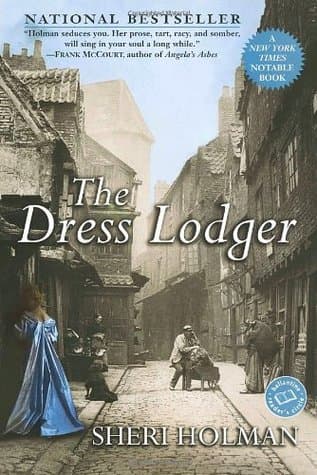
Synopsis
Covers the whole plot, including the ending.
- Difficulty
- Medium
- Pacing
- Moderate
- Mood
- Dark, Atmospheric, Gritty, Suspenseful, Melancholy
- Read it if
- You enjoy dark, atmospheric historical fiction with a strong sense of place and a compelling mystery, featuring complex characters struggling against societal prejudices and dire circumstances.
- Skip it if
- You prefer lighthearted reads, are sensitive to graphic descriptions of poverty, disease, and violence, or dislike morally ambiguous characters.
The Dress Lodger Plot Summary
Covers the whole plot, including the ending.
The Blue Dress and the Cholera
In 1831 Sunderland, England, a cholera epidemic holds the city. Fifteen-year-old Gustine works by day as a potter's assistant. By night, she becomes a 'dress lodger,' renting an elegant blue dress to sell herself on the streets. Her only goal is to earn enough money to feed and protect her infant son, Mungo, who has scrofula. The city is a place of desperation, fear, and widespread death, with the poor especially at risk. Gustine is always on edge, not only because of her work's dangers but also the constant threat of disease and the shame of her situation. She lives in a squalid lodging house, fighting hunger and the smell of illness and despair.
Dr. Chiver's Obsession
Dr. Henry Chiver is a disgraced anatomist, haunted by a past scandal involving grave robbing for science. Now a surgeon in Sunderland, he wants to understand and fight the cholera epidemic. Believing traditional medical theories are wrong, Chiver secretly buys fresh cadavers, often from local grave robbers called 'resurrectionists,' to dissect and study the disease's effects. He wants to find a cure and fix his reputation, even if it means acting outside the law and public acceptance. His assistant, Mr. Bales, helps him with these secret activities, though often with moral doubts.
A Gruesome Discovery
One night, walking through the empty streets, Gustine finds a horrific scene: a dismembered body, clearly murdered, with its organs carefully removed. The discovery shocks the already terrified community. The police, led by Inspector Swift, start an investigation. They first suspect body snatchers or even the medical community, given the mutilation. Gustine, afraid of being blamed because she was there and because of her illegal work, tries to avoid attention. But the incident deeply disturbs her and shows her more of her world's harsh realities.
Gustine and Chiver's First Encounter
Gustine first meets Dr. Chiver when he treats a street urchin she knows, or perhaps when she herself seeks medical help for a small illness. Their paths cross in Sunderland's grim setting. Chiver notices Gustine's unusual beauty and endurance. He senses a depth in her that goes beyond her circumstances. Gustine, in turn, is drawn to Chiver's quiet intensity and the hope he offers, despite his strange reputation. Their first meetings are hesitant, marked by the large social gap between them, yet a unique connection begins to form, linking their futures.
The Resurrectionists and Dr. Chiver's Dilemma
Dr. Chiver continues to rely on the resurrectionists, especially a man named Boddy, to give him fresh cadavers for his cholera research. This illegal trade puts him at constant risk of exposure and further public blame. He knows his methods are morally unclear and legally risky, but his need to find a cure outweighs his fear of social ruin. He believes his actions serve a greater good, even as he struggles with the ethics of dissecting the recently dead, especially those from the city's poorest areas.
Mungo's Declining Health
Mungo's scrofula gets much worse, causing Gustine great distress. His fragile health causes constant worry, and she becomes more desperate to save him. The little money she earns as a dress lodger is barely enough for food, let alone proper medical care. This desperation pushes her to take bigger risks and consider more extreme ways to ensure Mungo's survival. Her love for her son drives all her actions, making her vulnerable but also fiercely determined against overwhelming odds.
The Killer's Modus Operandi
More dismembered bodies are found, all showing the same chilling pattern: specific internal organs carefully removed. Inspector Swift and the police are confused, as the murders do not seem random. The precision of the cuts points to someone with anatomical knowledge, leading suspicion to fall on the medical community, especially those in surgery or anatomical study. Fear among the people grows, and rumors of a 'monster' preying on the city's vulnerable spread, making public distrust of doctors and medicine worse.
Gustine's Desperate Plea
Overwhelmed by Mungo's worsening condition, Gustine sets aside her pride and asks Dr. Chiver for help. She brings Mungo to him, pleading for his medical knowledge. Chiver, despite his cold manner, is moved by Gustine's strong devotion and Mungo's suffering. He agrees to examine the child and offers what medical help he can, forming a deeper, more personal link between them. This interaction goes beyond their first professional and social boundaries. Chiver sees Gustine not just as a 'dress lodger' but as a mother fighting for her child's life, and Gustine sees Chiver as a possible savior.
The Truth About the Murders
The investigation eventually uncovers the shocking truth behind the murders. The killer is Mr. Bales, Dr. Chiver's seemingly quiet assistant. Driven by a twisted view of Chiver's anatomical work and a desire to 'help' in his research, Bales has been murdering people, specifically targeting the most vulnerable, to give Chiver fresh, 'perfect' specimens for his cholera dissections. He believes he is helping Chiver's scientific efforts, unaware of the moral line he has crossed. The revelation devastates both Gustine and Chiver, forcing them to face the horrific results of Chiver's unusual methods and the dark side of human desperation.
Confrontation and Resolution
Gustine, realizing the horrifying truth, confronts Mr. Bales. The confrontation is violent and terrifying, as Bales, lost in his delusion, tries to silence her. Dr. Chiver arrives, having also put together the horrifying puzzle, and steps in, leading to a dramatic struggle. Bales is eventually controlled and captured by the authorities, ending his terror. The climax is a brutal confrontation that brings justice to the victims and forces Gustine and Chiver to deal with the moral complexities of their choices and the tragic events that have happened.
Aftermath and New Beginnings
After Bales' capture, Sunderland slowly begins to recover from the fear and horror of the murders, though the cholera epidemic continues. Dr. Chiver, deeply affected by Bales' actions and the moral implications of his own work, must now balance his scientific ambition with the human cost. Gustine, having faced terrible horrors, must now find a way to build a new life for herself and Mungo. The city remains a place of hardship, but the killer's exposure brings some closure, allowing for a fragile hope to appear amidst the lingering despair.
Gustine's Choice
Gustine, having endured so much, makes a choice about her future. She is no longer just a 'dress lodger' but a survivor who has seen humanity's darkest parts. Her relationship with Dr. Chiver, born from shared desperation and understanding, reaches a turning point. While their bond is clear, their future connection is uncertain, shaped by their traumas and their places in society. Gustine's decision shows her endurance and her strong commitment to Mungo's well-being, even as she considers a different kind of life.
Principal Figures
Gustine
Protagonist
A resilient young woman who works as a dress lodger to save her son.
Gustine is a fifteen-year-old girl living in poverty in cholera-ridden Sunderland. Despite her youth, she possesses remarkable resilience and fierce determination, driven by an unwavering love for her infant son, Mungo. She works as a potter's assistant by day and a 'dress lodger' (a prostitute who rents a gown) by night, enduring the harsh realities of her world to provide for him. She is observant, pragmatic, and deeply empathetic, often seeing the humanity in others even amidst their suffering. Her beauty, hidden beneath the grime of her existence, often draws unwanted attention but also offers a glimmer of hope for a different future.
Relationships: Mungo (Her infant son, her primary motivation and love.); Dr. Henry Chiver (A complex, evolving relationship of mutual understanding, desperation, and potential affection.); Mr. Bales (Victim of his murderous actions, later his confronter.)
Dr. Henry Chiver
Supporting/Protagonist
A disgraced anatomist obsessed with finding a cure for cholera.
Dr. Henry Chiver is a brilliant but socially isolated anatomist, haunted by a past scandal involving grave robbing. He is driven by a profound scientific curiosity and a desperate need for redemption, particularly in the face of the cholera epidemic. He operates outside conventional medical practices, resorting to illicit cadaver dissections to understand the disease. Chiver is a man of contradictions: outwardly cold and detached, but with a deep, albeit often repressed, sense of morality and compassion. He struggles with the ethical implications of his actions, yet believes his work is for the greater good.
Relationships: Gustine (A complex, evolving relationship of mutual understanding, desperation, and potential affection.); Mr. Bales (His assistant, later revealed as the murderer, whom Chiver unknowingly inspired.); Mr. Boddy (A resurrectionist, his illicit supplier of cadavers.)
Mungo
Supporting
Gustine's infant son, suffering from scrofula.
Mungo is Gustine's infant son, a fragile and sickly child suffering from scrofula. He is the sole focus of Gustine's love and the driving force behind all her desperate actions. Mungo represents innocence and vulnerability in a brutal world, and his illness serves as a constant reminder of the precariousness of life in Sunderland. His presence underscores the immense sacrifices Gustine makes and the depths of a mother's love. Though he cannot speak, his suffering communicates the pervasive hardship faced by the city's poorest inhabitants.
Relationships: Gustine (His mother, his sole protector and provider.); Dr. Henry Chiver (His potential savior, who provides medical care.)
Mr. Bales
Antagonist
Dr. Chiver's assistant and the serial killer.
Mr. Bales is Dr. Chiver's meek and seemingly devoted assistant. Beneath his quiet demeanor, however, lies a deeply disturbed and deluded mind. He idolizes Dr. Chiver and misinterprets his scientific pursuits, believing he must provide Chiver with 'perfect' specimens for his cholera research. This twisted loyalty leads him to become a serial killer, meticulously dismembering his victims to harvest specific organs. Bales embodies the horrific consequences of unchecked ambition and the dangers of a distorted sense of purpose, revealing himself to be a chilling and precise murderer.
Relationships: Dr. Henry Chiver (His employer, whom he idolizes and murders for.); Gustine (A potential victim and eventual confronter.)
Inspector Swift
Supporting
The police inspector investigating the murders.
Inspector Swift is the police officer tasked with investigating the gruesome murders in Sunderland. He represents the limited, often overwhelmed, authority in a city ravaged by disease and crime. Swift is a diligent but somewhat conventional investigator, struggling to comprehend the unusual nature of the killings. He grapples with public fear and distrust, particularly towards the medical community, and works within the constraints of early 19th-century forensic methods. His presence highlights the challenge of maintaining order and justice in a chaotic and desperate environment.
Relationships: Gustine (A potential witness, whom he initially views with suspicion.); Dr. Henry Chiver (A suspect due to his anatomical practices.)
Mr. Boddy
Supporting
A grave robber who supplies cadavers to Dr. Chiver.
Mr. Boddy is one of the 'resurrectionists' or grave robbers who illicitly supplies cadavers to Dr. Chiver for his anatomical studies. He operates in the shadows of Sunderland, a pragmatic and amoral character who profits from death. Boddy represents the grim underside of medical advancement in the era, where the demand for bodies for dissection led to a thriving, if illegal, trade. He is shrewd and understands the unspoken rules of his illicit profession, providing a crucial, albeit morally dubious, link in Chiver's research.
Relationships: Dr. Henry Chiver (His client, providing illicit cadavers.)
Mrs. Poole
Supporting
Gustine's landlady.
Mrs. Poole is the landlady of the squalid lodging house where Gustine and Mungo reside. She is a practical, often stern, woman whose primary concern is collecting rent and maintaining some semblance of order in her chaotic establishment. While not overtly cruel, she is hardened by the harsh realities of life in Sunderland and shows little personal warmth or empathy. Her character highlights the constant struggle for survival among the poor and the transactional nature of relationships in such desperate circumstances. She represents the unyielding economic pressures faced by Gustine.
Relationships: Gustine (Her tenant, whom she provides lodging to for a fee.)
The Blue Dress
Mentioned
The dress Gustine rents for her 'lodging' work.
The blue dress is not a character in the traditional sense, but a powerful symbolic entity. It is the elegant gown Gustine rents for her work as a dress lodger, transforming her from a poverty-stricken girl into a figure of allure on the streets. The dress represents both her means of survival and her degradation. It is a disguise, a tool, and a stark contrast to her true circumstances, highlighting the performative aspect of her profession and the illusion she creates for her clients. It embodies the theme of appearance versus reality and the sacrifices Gustine makes.
Relationships: Gustine (Her tool for survival and a symbol of her profession.)
Themes & Insights
Survival and Desperation
The novel shows the struggle for survival in 1830s Sunderland, a city with cholera and poverty. Gustine's every action, from working as a potter's assistant to her illegal job as a dress lodger, comes from the need to feed and protect her infant son, Mungo. Desperation also affects Dr. Chiver, whose illegal grave robbing comes from a desire to find a cholera cure. This theme appears in the squalid living conditions, the constant threat of disease and hunger, and characters' willingness to cross moral and legal lines to stay alive or reach goals. The discovery of dismembered bodies highlights the brutal extremes people go to, whether for survival or twisted ambition.
“In a city of the dead, only the desperate truly lived.”
The Price of Scientific Progress
The novel explores ethical problems in science, especially before modern medical ethics. Dr. Chiver's search for a cholera cure leads him to illegal acts like buying cadavers from resurrectionists. This raises questions about whether the end justifies the means and the moral cost of knowledge. Mr. Bales' horrific actions, murdering to provide 'perfect' specimens, show the extreme and unintended results when scientific ambition is unchecked and misunderstood. The public's distrust of doctors and medicine, fueled by these practices and the terror of cholera, further complicates the story, suggesting that progress often comes with a human and ethical price.
“Knowledge, bought with blood, was still knowledge.”
Appearance vs. Reality
This theme is central to Gustine's character and Sunderland's society. Gustine's 'blue dress' lets her appear elegant and alluring, hiding her true identity as a poor mother. This contrast shows how people perform to survive and the illusions they create to deal with harsh realities. Similarly, Dr. Chiver keeps a respectable appearance as a surgeon while secretly doing morally questionable anatomical research. Mr. Bales' quiet exterior hides a monstrous killer. The novel constantly reminds the reader that what seems to be on the surface, whether a beautiful dress or a professional manner, often hides a darker or more desperate truth.
“The blue dress was a lie, but it was a necessary one.”
Love and Sacrifice
At the novel's heart is Gustine's love for her son, Mungo. This love makes her make great sacrifices, including selling her body, to ensure his survival and well-being. Her willingness to endure hardship, risk her safety, and face social blame for Mungo shows the powerful, unconditional nature of maternal love. Even Dr. Chiver's actions, though driven by science, include sacrifice, as he risks his reputation and freedom for what he believes is a greater good. The theme explores how love can make people do extraordinary, sometimes desperate, acts of selflessness.
“Every penny was a breath for Mungo, every touch a prayer.”
Social Class and Injustice
The clear divisions of 19th-century British society are a constant theme. The novel shows the lives of the poor, like Gustine, who live in squalor and face constant threat of disease and exploitation, contrasted with the relative privilege of people like Dr. Chiver, who, despite his own struggles, has access to education and resources. The poor are the main victims of both the cholera epidemic and the serial killer, showing their vulnerability and lack of power. The justice system, through Inspector Swift, often struggles to protect the lower classes, who are also often viewed with suspicion. This theme shows the injustices in the social hierarchy and the devastating impact of poverty.
“Cholera had no respect for station, but it found its easiest prey among those with none.”
Plot Devices & Literary Techniques
The Cholera Epidemic
A pervasive backdrop that drives character actions and creates a sense of dread.
The cholera epidemic of 1831 serves as more than just a setting; it is a central plot device that functions as a constant, looming threat and a catalyst for much of the story's action. It creates an atmosphere of fear, desperation, and social breakdown, impacting every character's life. The epidemic fuels Dr. Chiver's obsessive research, pushes Gustine to extreme measures for survival, and contributes to the general chaos that allows a serial killer to operate. It also highlights the medical ignorance and societal vulnerability of the era, making the city itself a character shaped by disease.
The Blue Dress
A symbolic object representing Gustine's dual life and the theme of appearance vs. reality.
The blue dress is a powerful symbolic plot device. It is the rented gown Gustine wears while working as a 'dress lodger,' transforming her from a poverty-stricken girl into a figure of allure. The dress represents her means of survival, her degradation, and the stark contrast between her outward appearance and her inner reality. It allows her to navigate different social strata, albeit illicitly, and highlights the performative aspect of her profession. The dress is a constant visual reminder of her sacrifices and the desperate measures she takes to protect her son.
The Dismembered Bodies
A macabre mystery that drives the narrative and exposes the dark side of medical ambition.
The discovery of the dismembered bodies, with their organs meticulously removed, serves as the central mystery and a key plot device. It introduces a horrifying element of crime into the already grim setting, immediately raising the stakes. The nature of the mutilations points towards someone with anatomical knowledge, drawing suspicion to the medical community and particularly to Dr. Chiver. This device not only propels the police investigation but also forces characters to confront the dark ethical implications of their actions and the terrifying consequences of unchecked scientific zeal, ultimately revealing the true antagonist.
Grave Robbing (Resurrectionists)
An illicit practice that facilitates Dr. Chiver's research and highlights moral ambiguity.
Grave robbing, carried out by 'resurrectionists' like Mr. Boddy, is a crucial plot device that enables Dr. Chiver's illicit anatomical research. This practice underscores the moral ambiguity of medical advancement in the 19th century, where the demand for cadavers for dissection often outweighed ethical considerations. It places Chiver in legal and social jeopardy, while also highlighting the desperation of those involved in the trade. The presence of grave robbers connects the legitimate medical world with the criminal underworld, blurring the lines between science and depravity, and indirectly setting the stage for the murders.
The Dress Lodger Quotes
“The wind was a hungry beast, gnawing at the corners of the houses, searching for a way in.”
“What is a body but a vessel for the soul, and what is the soul but a fleeting breath?”
“Sunderland was a town built on coal and ships, and the stench of both clung to everything.”
“Fear was a constant companion, a shadow that never quite left her side.”
“The rich had their doctors, and the poor had their prayers.”
“Every secret was a burden, and hers was growing heavier with each passing day.”
“The darkness held more than just shadows; it held the whispers of forgotten things.”
“Hope was a dangerous thing, a flickering candle in a world determined to blow it out.”
“He saw not a woman, but a collection of parts, a puzzle to be solved.”
“The dead told no tales, but their bodies often did.”
“To survive was to adapt, to shed one skin for another, again and again.”
“The past was a relentless pursuer, always a step behind, always catching up.”
“In the labyrinth of the human body, even the most skilled surgeon could get lost.”
“Beauty was a fragile thing, easily marred, easily lost in the grime of Sunderland.”
“The truth was a scalpel, sharp and unforgiving, cutting through the layers of deceit.”
Quiz
10 questions on the plot and the characters. Each answer comes with a short explanation.
Question 1
What is Gustine's primary occupation during the day?
- Seamstress
- Potter's assistant
- Fishmonger
- Housemaid
Show answer
B. Potter's assistant Gustine works as a potter's assistant by day to earn money, contrasting with her night occupation as a dress lodger.
Question 2
In what city and country is 'The Dress Lodger' primarily set?
- London, England
- Edinburgh, Scotland
- Sunderland, England
- Dublin, Ireland
Show answer
C. Sunderland, England The story takes place in Sunderland, England, a city grappling with the cholera epidemic of 1831.
Question 3
What is the main reason Gustine becomes a 'dress lodger'?
- To buy herself a better life
- To support her family
- To feed and protect her baby boy
- To escape her day job
Show answer
C. To feed and protect her baby boy Gustine's primary motivation for selling herself as a dress lodger is to provide for her fragile baby boy, highlighting her maternal devotion.
Question 4
What historical event or condition significantly impacts the setting of the novel?
- The Industrial Revolution
- The Napoleonic Wars
- The cholera epidemic of 1831
- The Great Famine
Show answer
C. The cholera epidemic of 1831 The city of Sunderland is quarantined due to the cholera epidemic of 1831, which is a central element of the novel's historical context.
Question 5
Who is Dr. Henry Chiver?
- Gustine's estranged father
- A wealthy merchant who employs Gustine
- A doctor with a dark past who becomes linked with Gustine
- The local magistrate investigating the 'dress lodger' activities
Show answer
C. A doctor with a dark past who becomes linked with Gustine Dr. Henry Chiver is introduced as a doctor with a troubled past who forms a significant connection with Gustine.
Question 6
What does the 'rented gown' symbolize for Gustine in her role as a dress lodger?
- Her desire for social climbing and wealth
- A temporary escape from her impoverished reality and a means to earn money
- A gift from a secret admirer
- Her true identity as a noblewoman in disguise
Show answer
B. A temporary escape from her impoverished reality and a means to earn money The rented gown allows Gustine to assume a different persona and earn money, representing a temporary facade and a means of survival rather than genuine aspiration for wealth.
Question 7
What is the general public's attitude towards medicine during the cholera epidemic in the novel?
- Widespread trust and reliance on doctors
- A mix of hope and suspicion, often leaning towards suspicion
- Complete indifference to medical advancements
- Active support for public health initiatives
Show answer
B. A mix of hope and suspicion, often leaning towards suspicion The novel explicitly states that 'suspicion of medicine runs rampant like a fever,' indicating a general distrust or skepticism towards medical practices during the epidemic.
Question 8
How does Gustine's character embody the theme of 'crossing lines'?
- By moving between different social classes and moral boundaries for survival
- By attempting to start a revolution against the upper class
- By physically crossing the quarantine lines in and out of the city
- By disguising herself as a man to work in male-dominated professions
Show answer
A. By moving between different social classes and moral boundaries for survival Gustine's journey involves traversing the boundaries between 'rich and destitute, decorum and abandon, damnation and salvation' through her dual life, embodying the theme of crossing societal and moral lines.
Question 9
What distinguishes 'The Dress Lodger' as a 'captivating historical thriller charged with a distinctly modern voice'?
- Its use of contemporary slang and anachronistic technology
- Its focus on historical accuracy above all else, with no modern interpretation
- Its blend of historical setting with psychological depth and relatable human struggles, presented in an engaging narrative style
- Its reliance solely on historical documents for dialogue and plot
Show answer
C. Its blend of historical setting with psychological depth and relatable human struggles, presented in an engaging narrative style The description highlights the novel's ability to combine its historical setting with a narrative voice that resonates with contemporary readers, focusing on universal human struggles and psychological complexity within the thriller genre.
Question 10
What is the significance of the 'elegant blue dress' Gustine wears as a dress lodger?
- It is a family heirloom passed down through generations.
- It symbolizes her dreams of marrying into a wealthy family.
- It's a rented garment that transforms her appearance, allowing her to embody a different, more desirable persona for her nightly occupation.
- It's a clue left behind by a mysterious benefactor.
Show answer
C. It's a rented garment that transforms her appearance, allowing her to embody a different, more desirable persona for her nightly occupation. The 'elegant blue dress' is specifically mentioned as a 'rented gown,' which Gustine uses to transform herself for her night work, symbolizing the facade she adopts and the temporary nature of her elevated appearance.
The Dress Lodger FAQ
What is the central premise of 'The Dress Lodger' and its historical setting?
'The Dress Lodger' is set in Sunderland, England, during the devastating cholera epidemic of 1831. It follows Gustine, a 15-year-old girl who works as a potter's assistant by day and 'dress lodger'—a prostitute who rents an elegant blue gown—by night to support her infant son. The novel explores themes of survival, social class, and the burgeoning medical understanding of the time amidst the public's fear and suspicion.
Who is Gustine and what drives her actions throughout the novel?
Gustine is the defiant and resourceful protagonist, a young mother driven solely by her fierce love and desire to protect her fragile baby boy, Mungo. Her nightly prostitution as a 'dress lodger' is a desperate measure to earn enough money for food, shelter, and medicine, illustrating the extreme lengths she will go to ensure Mungo's survival in a harsh, unforgiving world.
Who is Dr. Henry Chiver and what is his role in the story?
Dr. Henry Chiver is a disgraced surgeon haunted by a dark past, specifically a botched operation that led to a woman's death. He arrives in Sunderland to study the cholera epidemic, hoping to redeem himself through medical research. His scientific curiosity and desperation for atonement lead him to Gustine, as he seeks to understand the disease's origins through anatomical study, often crossing ethical boundaries.
What is the significance of the 'dress lodger' concept in the book?
The 'dress lodger' is a specific type of prostitution where women rent an elegant gown to appear more respectable and attract wealthier clients. This concept highlights the stark class divisions and the performative nature of survival for women like Gustine. The blue dress itself becomes a symbol of both her desperation and her fleeting moments of perceived dignity or allure.
How does the cholera epidemic influence the plot and character development?
The cholera epidemic is more than just a backdrop; it's a relentless force shaping every aspect of the plot. It creates widespread panic, suspicion of doctors, and an environment where death is commonplace, driving characters like Gustine to extreme measures and pushing Dr. Chiver to desperate scientific pursuits. The fear of contagion and the search for its cause are central to the narrative's tension.
What is the true nature of the relationship between Dr. Chiver and Gustine, beyond their initial encounter?
Their relationship evolves from a transactional one into a complex, almost symbiotic bond. Chiver is initially drawn to Gustine for her anatomical uniqueness, believing her to hold clues to cholera. Gustine, in turn, sees Chiver as a potential savior for her son. They become mutually dependent, with Chiver's scientific obsession intertwining with Gustine's maternal desperation, leading them both to ethically questionable acts.
What is the 'secret' Dr. Chiver is trying to uncover about the cholera victims?
Dr. Chiver is obsessed with finding a specific anatomical anomaly in the bodies of cholera victims, particularly in their intestines, believing it holds the key to the disease's origin and cure. He performs illicit dissections, driven by the theory that there is a physical, visible cause for the illness, rather than a spiritual or environmental one, pushing the boundaries of medical ethics.
How does the character of Mrs. Peach, the dress renter, contribute to the narrative's themes?
Mrs. Peach, the proprietor of the dress lodging house, represents the exploitation and control women exercised over other women in this desperate world. She profits from Gustine's vulnerability, embodying a cynical pragmatism. Her character highlights the systemic nature of poverty and how individuals, even those who have themselves suffered, can become complicit in the exploitation of others.
What is the significance of the 'anatomical theater' and its depiction in the novel?
The anatomical theater represents the brutal reality of early medical science and the public's morbid fascination with the human body, especially in death. It's where Dr. Chiver hopes to find answers, but also where the line between scientific inquiry and disrespectful exploitation blurs. The scenes within the theater emphasize the era's lack of regard for the deceased, particularly the poor, who often became subjects for dissection.
How does Gustine's love for Mungo shape her moral compass?
Gustine's love for Mungo is her absolute north star, overriding conventional morality. She commits prostitution, theft, and even participates in morally ambiguous acts with Dr. Chiver, all justified in her mind by the imperative to keep her son alive. This maternal devotion reveals the profound gray areas of survival, where 'good' and 'bad' actions are redefined by desperate necessity.
Analyze Dr. Chiver's psychological motivations for his extreme medical practices.
Dr. Chiver is driven by a potent mix of professional ambition, scientific curiosity, and a deep-seated guilt over a past medical failure. He is desperate for redemption, believing that discovering the cause of cholera will atone for his previous mistakes. This psychological burden pushes him to extreme and unethical practices, viewing the dead bodies primarily as objects for scientific inquiry rather than once-living individuals.
How does the novel explore the concept of 'purity' and 'corruption' in its characters?
The novel constantly blurs the lines between purity and corruption. Gustine, though a prostitute, is 'pure' in her maternal love. Dr. Chiver, a man of science, engages in 'corrupt' practices for what he believes is a pure scientific goal. The cholera itself is seen as a corruption of the body. The narrative suggests that in extreme circumstances, these concepts are fluid and often intertwined, challenging simplistic moral judgments.
What psychological impact does the constant threat of cholera have on the community and individual characters?
The constant threat of cholera breeds widespread paranoia, suspicion, and a pervasive sense of helplessness. For the community, it fuels riots against doctors and fosters a fatalistic outlook. For individuals like Gustine, it intensifies her desperation, while for Dr. Chiver, it becomes an obsessive focus. The disease's invisible nature fosters psychological terror, pushing people to irrational behaviors and extreme measures.
Is Gustine a victim or an agent of her own destiny?
Gustine is both. She is undeniably a victim of her circumstances—poverty, gender, and the epidemic—which force her into prostitution. However, she is also a powerful agent of her own destiny, making active, defiant choices to survive and protect her son. Her resilience and resourcefulness in such a bleak environment demonstrate her agency, even within extreme constraints, making her a complex and compelling character.
Does the novel offer a hopeful or bleak outlook on humanity?
The novel presents a largely bleak, yet nuanced, outlook. While it vividly portrays humanity's capacity for cruelty, exploitation, and despair amidst suffering, it also highlights the enduring power of maternal love and the human drive for knowledge and redemption. The ending, though not traditionally 'happy,' suggests a continuation of life and struggle, leaving room for a sliver of resilience rather than outright despair.
How does the ending of the novel resolve the fates of Gustine and Dr. Chiver?
The ending sees Gustine making a profound sacrifice for Mungo's future, ensuring his survival even if it means her own uncertain fate. Dr. Chiver's ultimate discovery, while scientifically significant, comes with a heavy personal cost, and his redemption remains ambiguous. Their paths diverge, with Gustine finding a form of peace through her sacrifice, and Chiver continuing his scientific pursuit, burdened by his past actions.
What is the novel's commentary on the relationship between science and ethics?
'The Dress Lodger' critically examines the nascent stages of modern medicine, highlighting the often-blurred lines between scientific advancement and ethical boundaries. Dr. Chiver's actions, driven by a desire to understand cholera, involve grave robbing and disrespect for the dead. The novel questions whether the pursuit of knowledge, no matter how noble the end goal, justifies morally questionable means, particularly when the vulnerable are exploited.
How does the author use the historical setting to comment on contemporary social issues?
Sheri Holman uses the 1831 cholera epidemic and the plight of the poor in Sunderland to draw parallels with contemporary social issues. The stark class divisions, the exploitation of the vulnerable, the desperate measures people take for survival, and the public's distrust of institutions (like medicine) resonate with modern discussions about poverty, healthcare access, and social justice. The historical setting acts as a powerful lens through which to view timeless human struggles.
About the author

Sheri Holman is an American author known for her fiction. Her notable work, The Dress Lodger, explores themes of love and loss in a historical setting. Holman's writing often delves into complex characters and intricate narratives.
Similar books
- Alias Grace
Margaret Atwood
4.0 (111k) average on GoodreadsLiterary FictionExplores the lives of marginalized women in a historical context with a psychological depth.
- The Alienist
Caleb Carr
4.1 (182k) average on GoodreadsFictionWhile both are historical serial killer mysteries, Carr's The Alienist maintains a more relentless, procedural pace, focusing heavily on psychological profiling and investigation. The Dress Lodger takes a more contemplative approach, prioritizing character development and thematic exploration (e.g., societal impact of cholera) over pure plot momentum.
- Fingersmith
Sarah Waters
4.0 (81k) average on GoodreadsHistorical FictionBoth novels excel at immersing readers in meticulously recreated historical periods and feature strong female protagonists navigating harsh realities. However, Waters often employs more intricate plot structures with twists and deceptions, whereas Holman's narrative, while engaging, is more linear in its mystery progression.
- An Instance of the Fingerpost
Iain Pears
3.9 (21k) average on GoodreadsThrillerPears uses multiple unreliable narrators to construct a complex, multifaceted historical mystery, offering diverse perspectives on events. While The Dress Lodger has a more linear narrative, the shifting focus between Gustine and Chiver provides a similar, albeit less fragmented, exploration of truth and individual experiences within the historical context.
- To Kill a Mockingbird
Harper Lee
4.3 (4.5M) average on GoodreadsHistorical FictionIn the 1930s Jim Crow South, Harper Lee writes about racial injustice, moral growth, and the quiet courage of a lawyer father, Atticus Finch, as seen through his young daughter's eyes.
- The Great Gatsby
F. Scott Fitzgerald
3.9 (3.8M) average on GoodreadsHistorical FictionIn the opulent Roaring Twenties, a mysterious millionaire's lavish parties hide his desperate, tragic pursuit of a lost love, exposing the emptiness within the American Dream.





Enjoyed the summary?
A summary gives you the shape of the book. The book itself has the detail, the examples and the voice.
Find The Dress Lodger on AmazonAs an Amazon Associate, BookBrief earns from qualifying purchases. How we're funded