
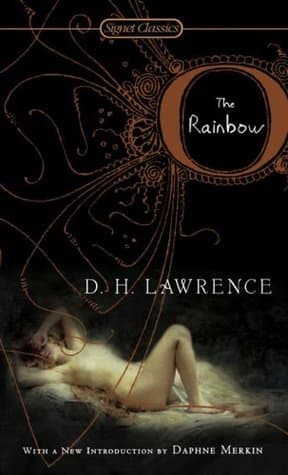
Synopsis
Covers the whole plot, including the ending.
- Difficulty
- Medium
- Pacing
- Slow
- Mood
- Introspective, Profound, Passionate, Melancholic, Evolving
- Read it if
- You enjoy deep dives into character psychology and generational sagas, with a focus on societal change and the search for individual meaning.
- Skip it if
- You prefer fast-paced plots with clear resolutions, or find extensive internal monologues and philosophical explorations tedious.
The Rainbow Plot Summary
Covers the whole plot, including the ending.
The Brangwens of Marsh Farm
The novel introduces the Brangwen family, who have farmed Marsh Farm in Cossethay, Nottinghamshire, for generations. Their lives are tied to the land and agricultural work. The men are strong and sensual, content with their physical existence, while the women desire a connection to the wider world, like the church or town. This contrast sets up the family's future struggles. The story highlights the Brangwen men's interactions with the land and the women's longing for intellectual and spiritual growth beyond their rural life, showing the core values and limits of their world.
Tom Brangwen and Lydia Lensky
Tom Brangwen, a strong and somewhat sad young farmer, feels a desire for something more than his family's traditional life. He meets Lydia Lensky, a Polish immigrant and widow of a Polish doctor, who lives in the nearby vicarage with her young daughter, Anna. Lydia is unusual and quiet, carrying a deep sadness and a calm intensity that fascinates Tom. Their courtship is marked by a strong, almost primal attraction, despite language differences and their varied backgrounds. Tom is drawn to her otherness and her deep experiences, seeing her as a way to a richer, more complex life. He proposes, and they marry, bringing Lydia and Anna to Marsh Farm.
The Early Years of Tom and Lydia's Marriage
After their marriage, Tom and Lydia struggle to truly understand each other. Lydia is withdrawn, still burdened by her past, while Tom is passionate but unrefined in his attempts to reach her. Their initial connection, though strong, does not immediately lead to domestic peace. They live in isolated intimacy, each dealing with their own inner thoughts. Anna, Lydia's daughter, watches this dynamic, often feeling like an outsider in their intense, silent drama. Over time, a deep, often unspoken, bond of shared experience and mutual respect forms between Tom and Lydia, based on their physical and emotional commitment and their growing family.
Anna and Will Brangwen
Anna Lensky, now grown, is a spirited and sensual young woman who has her mother's intensity and her stepfather Tom's earthy energy. She falls in love with Will Brangwen, Tom's nephew, a skilled craftsman and religious man with a fervent, almost mystical sensibility. Their courtship is marked by a powerful, often stormy passion, a clash of their strong wills and different desires. Anna seeks a complete, all-encompassing union, while Will is drawn to a more spiritual, almost ascetic love. Their marriage is a battleground of wills and desires, with intense physical love but also deep misunderstandings and periods of separation as they both seek dominance and fulfillment. Their life together centers on their growing family.
The Conflict in Anna and Will's Marriage
Anna and Will Brangwen's marriage is marked by a fierce struggle for power and understanding. Anna, deeply sensual and grounded in the physical world, dislikes Will's spiritual idealism and his need for a higher, more abstract connection, especially his devotion to the church. She tries to dismantle his spiritual world, challenging his beliefs and pulling him back to the physical reality of their shared life and children. Will, in turn, finds Anna's overwhelming physicality and her refusal to acknowledge anything beyond the immediate oppressive. Their arguments are often silent but deeply felt, appearing as emotional coldness and intense, reconciling passion. This constant push and pull defines their bond as they navigate their desires and conflicting views of love and life.
The Birth of Ursula Brangwen
Amidst Anna and Will's intense, often turbulent relationship, their first child, Ursula Brangwen, is born. Ursula is a character of great spirit and intelligence, inheriting the strong will of both parents and the deep desire for a meaningful existence common to the Brangwen women. From a young age, she is sensitive and observant, absorbing the unspoken tensions and passionate undercurrents of her parents' marriage. Her birth shifts the narrative's focus, as the story gradually moves to her experiences and developing consciousness. Ursula represents a new generation, one that will actively try to break free from traditional limits and inherited struggles, striving for a more expansive and self-determined life.
Ursula's Childhood and Education
Ursula's childhood is marked by a strong will and often rebellious spirit, frequently clashing with her parents, especially her mother, Anna. She is independent and curious, seeking meaning beyond the home. As she grows, she attends secondary school, where she excels academically and begins to form her own intellectual identity. Her schooling exposes her to new ideas and social circles, broadening her world beyond the Brangwen farm. She forms intense friendships and experiences her first crushes, beginning to explore her developing sexuality and emotions. These early experiences set the stage for her later search for self-fulfillment and her questioning of social norms, as she deals with the expectations placed on young women of her time.
Ursula's First Love and Teaching Career
As a young woman, Ursula enters a passionate and complicated relationship with Anton Skrebensky, an officer in the Reserves and a distant cousin. Their love affair is intense and physically charged, but Ursula finds Skrebensky's conventionality and his inability to match her spiritual and intellectual aspirations unsatisfying. He represents the established order and an emotional limit that Ursula, in her quest for complete fulfillment, cannot accept. At the same time, Ursula takes a teaching position in a working-class school, an experience that proves deeply disappointing. The harsh realities of the classroom, the unruly children, and the restrictive environment challenge her idealism and force her to confront her own power and influence, leading to a period of deep thought and frustration.
Ursula's Relationship with Winifred Inger
While teaching, Ursula develops a close and intensely emotional relationship with Winifred Inger, a fellow teacher who embodies a more modern, independent spirit. Their bond is intellectually stimulating and physically charged, exploring themes of female companionship, passion, and the search for identity outside traditional heterosexual relationships. Winifred, with her strong, almost masculine presence and her socialist ideals, offers Ursula an alternative view of womanhood and a different kind of love. This relationship is important in Ursula's self-discovery, allowing her to explore parts of her sexuality and emotional needs that Skrebensky could not fulfill. However, this relationship also proves ultimately unsatisfying for Ursula, as she continues to search for a more complete union.
Ursula and Skrebensky's Reunion and Breakup
Ursula later reunites with Anton Skrebensky, who has returned from South Africa. Their passion reignites, leading to a period of intense physical intimacy and renewed hope for a shared future. They travel to Europe together. However, their basic differences remain. Ursula's desire for an absolute, transcendent union clashes with Skrebensky's more conventional and grounded desires. She finds him unable to match her spiritual intensity and her demand for complete fusion. Their relationship ends in a powerful, almost violent breakup, as Ursula realizes that Skrebensky cannot provide the deep fulfillment she seeks, leaving her feeling alienated and searching for a new path.
Ursula's Pregnancy and Crisis
Following her final separation from Skrebensky, Ursula discovers she is pregnant. This unwanted pregnancy causes a deep personal crisis, forcing her to confront her future and her desire for independence. She is torn between the social expectations of marriage and motherhood and her strong longing for self-realization. During this time, she has a traumatic encounter with a herd of horses in a field, an event that deeply shakes her and leaves her scarred. This experience, an almost symbolic attack by raw nature, leads to a miscarriage. The loss of the child, while devastating, also marks a turning point for Ursula, as she is freed from the immediate constraints of motherhood and can re-evaluate her life's direction.
Ursula's Vision of the Rainbow
After her miscarriage and deep emotional turmoil, Ursula experiences a powerful and symbolic vision. She sees a rainbow arching over the landscape, a vivid and intensely personal symbol of hope, promise, and a new beginning. This vision represents a deep spiritual awakening and a renewed sense of purpose. It signifies her rejection of old, fragmented ways of living and her desire for a more complete, integrated existence, where the physical and spiritual, the individual and the universal, can be harmonized. The rainbow becomes a symbol for a new, holistic way of being, a future where she can achieve self-fulfillment and contribute to a more authentic society, marking the end of her long journey of self-discovery.
Principal Figures
Tom Brangwen
Protagonist (first generation)
The patriarch of the first generation, a farmer seeking deeper connection.
Tom Brangwen is a strong, sensual, and somewhat melancholic farmer. He is deeply connected to the land and the rhythms of agricultural life, yet he feels a profound yearning for something beyond his immediate, physical existence. He is a man of deep feeling, though often inarticulate, and is drawn to the mysterious and intellectual Lydia Lensky, seeing in her a gateway to a richer world. His love is intense and possessive, yet also capable of great tenderness and understanding.
Relationships: Lydia Lensky (Husband, deeply devoted and drawn to her otherness.); Anna Brangwen (Adoptive father, loves her deeply and provides stability.)
Lydia Lensky
Protagonist (first generation)
A Polish émigré and widow who brings an intellectual and spiritual depth to the Brangwen family.
Lydia Lensky is a reserved and enigmatic Polish widow, burdened by past sorrow and loss. She possesses an intellectual and spiritual depth that sets her apart from the rural Brangwen family. Despite her initial withdrawal, she is capable of intense passion and a quiet strength. She struggles to reconcile her European past with her new English life, and her inner world remains largely private, yet profoundly influential on those around her, particularly Tom and her daughter Anna.
Relationships: Tom Brangwen (Wife, finds profound connection and stability with him.); Anna Brangwen (Mother, has an intense but often silent bond with her daughter.)
Anna Brangwen (née Lensky)
Protagonist (second generation)
Tom's adopted daughter, a spirited and sensual woman who seeks complete union.
Anna is the daughter of Lydia Lensky and adopted daughter of Tom Brangwen. She inherits her mother's intensity and her stepfather's earthy vitality. She is fiercely sensual, practical, and deeply rooted in the physical world and the joy of life. Anna seeks a complete, all-encompassing union in her marriage, often clashing with her husband Will's more spiritual and abstract desires. She is a strong mother, deriving immense satisfaction from her children and domestic life, yet also capable of great frustration and possessiveness.
Relationships: Tom Brangwen (Adopted daughter, loves and respects him deeply.); Lydia Lensky (Daughter, shares an intense, sometimes competitive, bond.); Will Brangwen (Wife, their relationship is a battleground of intense passion and conflict.); Ursula Brangwen (Mother, often clashes with her strong-willed eldest daughter.)
Will Brangwen
Supporting (second generation)
Tom's nephew, a craftsman and devout man, often at odds with his wife's sensuality.
Will Brangwen is Tom's nephew, a skilled craftsman, and a deeply religious man with a fervent, almost mystical sensibility. He is drawn to the spiritual and the abstract, finding solace and meaning in the church and his craft. His love for Anna is passionate, but he struggles with her overwhelming physicality and her attempts to pull him away from his spiritual pursuits. He yearns for a higher, more symbolic connection, which often puts him in conflict with Anna's more grounded desires. He is sensitive and artistic, but also prone to withdrawal and resentment.
Relationships: Anna Brangwen (Husband, their relationship is a mix of intense passion and profound conflict.); Ursula Brangwen (Father, shares a complex bond, influencing her spiritual side.)
Ursula Brangwen
Protagonist (third generation)
Anna's spirited daughter, who rejects conventional womanhood in search of self-knowledge.
Ursula Brangwen is the central protagonist of the latter half of the novel, a fiercely intelligent, passionate, and independent young woman. She inherits the strong will of her parents and the Brangwen women's deep yearning for a meaningful existence beyond societal norms. She is highly sensitive, intellectually curious, and driven by an intense desire for self-knowledge and complete fulfillment. Ursula grapples with societal expectations for women, exploring various paths—education, teaching, and different forms of love—in her quest for an authentic and integrated self.
Relationships: Anna Brangwen (Daughter, often clashes with her mother's practicality.); Will Brangwen (Daughter, shares a more intellectual and spiritual bond with her father.); Anton Skrebensky (Lover, an intense but ultimately unsatisfying romantic relationship.); Winifred Inger (Lover/Friend, an intense, intellectual, and physically charged relationship.)
Anton Skrebensky
Supporting (third generation)
Ursula's lover, an officer representing conventionality and societal expectations.
Anton Skrebensky is an officer in the Reserves and a distant cousin, who becomes Ursula's first significant lover. He is handsome, charming, and represents the established social order and conventional masculinity. While capable of intense physical passion, Skrebensky ultimately lacks the spiritual and intellectual depth that Ursula craves. He seeks a comfortable, traditional life and struggles to understand Ursula's profound yearning for something beyond the ordinary, leading to their eventual separation.
Relationships: Ursula Brangwen (Lover, their relationship is passionate but ultimately unsatisfying for Ursula.)
Winifred Inger
Supporting (third generation)
A fellow teacher and Ursula's intellectual and emotional confidante.
Winifred Inger is a fellow teacher whom Ursula meets during her time in the school. She is a strong, independent woman with socialist ideals, embodying a more modern and unconventional approach to life. Winifred is intellectually stimulating and physically assertive, offering Ursula an alternative vision of female companionship and love. Their relationship is intense and complex, exploring themes of female desire and intellectual camaraderie, but ultimately proves to be another stepping stone in Ursula's journey rather than a final destination.
Relationships: Ursula Brangwen (Lover/Friend, an intense, intellectual, and physically charged bond.)
Alfred Brangwen
Mentioned (first generation)
Tom's brother and father of Will.
Alfred Brangwen is Tom's brother and Will Brangwen's father. He embodies the traditional Brangwen connection to the land and a more conventional, less introspective masculinity than Tom. He is a steady, hardworking farmer, representing the continuity of the family's agricultural heritage. His role is primarily to establish the broader Brangwen family context and the generational differences in temperament and aspiration.
Relationships: Tom Brangwen (Brother.); Will Brangwen (Father.)
Themes & Insights
The Search for Fulfillment and Self-Knowledge
This theme is key to all three generations of Brangwen women, especially Ursula. The early Brangwen women desire something beyond farm life, looking to the church or town. Lydia Lensky brings intellectual and spiritual depth, but Anna and Ursula actively seek self-knowledge. Anna finds fulfillment in her intense, physical marriage and children, but Ursula rejects these as ultimate goals. Her journey through education, teaching, and various relationships (with Skrebensky, Winifred) is a constant search to define herself and find a complete existence, ending in her symbolic vision of the rainbow, which represents a new promise of self-realization.
“She wanted to learn, to know, to be herself. She wanted to know what it was to be a woman, and what it was to be a man.”
The Nature of Love and Marriage
The novel explores the complexities of love and marriage across three generations, moving from the primal, often unspoken bond of Tom and Lydia, to the passionate yet conflict-ridden union of Anna and Will, and finally to Ursula's radical re-evaluation. Tom and Lydia's love is rooted in a deep, almost instinctual connection. Anna and Will's marriage is a constant battle between physical desire and spiritual yearning, showing how love can be both fulfilling and destructive. Ursula, however, challenges traditional marital structures, seeking a love that includes both physical and spiritual fusion, but ultimately finding conventional relationships (like with Skrebensky) inadequate for her desires, pushing her to redefine true partnership.
“And the rainbow stood on the earth. She knew that the rainbow was the sign of the covenant. The old, ideal world was gone.”
The Conflict Between the Physical and the Spiritual
This theme creates tension throughout the novel, especially in the Brangwen women's desire for something beyond their physical, farm life. Tom Brangwen, though sensual, is drawn to Lydia's intellect. The most clear conflict appears in Anna and Will's marriage: Anna is deeply rooted in the physical and material world, finding fulfillment in her body and children, while Will is drawn to abstract spirituality and the church. Ursula, in her own development, struggles to reconcile these two aspects within herself and in her relationships. She deals with the limits of purely physical love (Skrebensky) and seeks a fusion where the sensual and spiritual are integrated, symbolized by her ultimate vision of the rainbow, bridging heaven and earth.
“She wanted to be a pure, a white flame of the spirit, a gem; and she was a strange, dark, wild creature of the earth.”
Industrialization and Social Change
The novel subtly but significantly tracks the impact of industrialization and societal changes on the rural Brangwen family. Initially, the family is deeply tied to the land, their lives dictated by agricultural cycles. As generations pass, the growing industrial towns, mines, and factories represent a new, often alienating, world. Ursula's experiences teaching in a working-class school expose her to the harsh realities of industrial society and its effect on people. This societal change contributes to the characters' sense of displacement and their search for meaning beyond traditional roles and communities, highlighting the tension between the lasting natural world and England's rapidly changing modern landscape.
“It was the town that called, the church that called, the world that called.”
The Role of Women and Female Independence
The novel looks closely at the changing role of women in society. The early Brangwen women, while strong, are mostly confined to domestic life and desire external connection. Lydia Lensky, a widow, brings a different model of female experience. Anna Brangwen, though powerful in her home, still operates within traditional marital structures. However, Ursula most clearly challenges the conventional role of womanhood. She pursues education, a career, and explores various forms of love and sexuality, actively rejecting the limits placed on women. Her journey is one of strong independence, as she seeks to define her own identity and purpose outside marriage and motherhood, paving the way for a new kind of female autonomy.
“She wanted to be a whole, independent human being, not a part of a man.”
Plot Devices & Literary Techniques
Generational Saga
The narrative spans three generations of the Brangwen family, tracing their evolution.
The novel employs a generational saga structure, beginning with Tom Brangwen and Lydia Lensky, moving to their daughter Anna Brangwen, and culminating with Anna's daughter, Ursula Brangwen. This device allows Lawrence to explore the gradual shifts in societal values, family dynamics, and individual consciousness over time. Each generation builds upon, reacts against, or reinterprets the experiences of the preceding one, highlighting themes of tradition vs. modernity, the evolving nature of love, and the persistent search for self-fulfillment as the world around them changes from a rural, agrarian society to an increasingly industrialized one.
Symbolism of the Rainbow
The rainbow serves as a central, multifaceted symbol of hope, covenant, and new beginnings.
The rainbow is the most prominent symbol in the novel, appearing explicitly at its climax. Initially, it represents a covenant and a promise, linking the individual to the divine and the natural world. For Ursula, the final vision of the rainbow signifies a profound spiritual awakening and a rejection of the fragmented, unsatisfying existence she has known. It symbolizes a new covenant of self-realization, a bridge between the physical and spiritual, and a promise of a more integrated and vital future, where she can achieve wholeness and contribute to a new, more authentic society. It encapsulates the novel's overarching theme of striving for a richer, more profound existence.
Nature Imagery
Extensive use of natural landscapes and animal interactions reflects characters' inner states and primal forces.
Lawrence frequently uses vivid and often visceral nature imagery to reflect the characters' emotional and psychological states. The Brangwens' deep connection to the land at Marsh Farm, the changing seasons, and specific natural phenomena (like the moon, the stars, or the horses) are not merely settings but active participants in the narrative. The encounter with the horses, for instance, is a pivotal moment for Ursula, symbolizing raw, untamed forces and her own subconscious struggles. This device emphasizes the primal, instinctual aspects of human experience and highlights the characters' profound, often unspoken, relationship with the natural world, contrasting it with the encroaching industrial age.
Free Indirect Discourse
The narrative voice often blends with the characters' thoughts and feelings, creating deep psychological insight.
Lawrence frequently employs free indirect discourse, where the narrator's voice merges with a character's internal thoughts, feelings, and perceptions without explicit markers like 'she thought' or 'he felt.' This technique allows for deep psychological penetration into the characters' inner lives, particularly for the Brangwen women. It blurs the line between objective narration and subjective experience, giving the reader immediate and intimate access to their desires, frustrations, and evolving consciousness. This device is crucial for portraying the complex, often inarticulate emotional landscapes of characters like Lydia, Anna, and especially Ursula, making their internal struggles palpable and immediate.
The Rainbow Quotes
“She was a woman, and how was she to know the great unknown that lay beyond her, in the world of men?”
“The child was like a flower, opening its petals to the sun, and the sun was her father.”
“It was as if the Brangwens had been born into a world of light, and they were trying to find their way out of it.”
“She was a strange, wild thing, with a spirit that would not be tamed.”
“The world was a great, dark forest, and she was a tiny, lost creature within it.”
“He wanted to be rid of his own limitations, to be free, to be utterly himself.”
“They were like two separate stars, revolving around each other, yet never quite touching.”
“The rainbow stood on the land, a arch of colours, a bridge of promise.”
“She felt herself a tree, rooted in the earth, drawing strength from it.”
“He felt as if he were standing on the edge of a precipice, looking down into a vast, unknown abyss.”
“The world was opening out to her, like a great flower, revealing its hidden depths.”
“They were always seeking, always striving, never quite finding what they sought.”
“She wanted to be herself, utterly and magnificently herself, beyond any man.”
Quiz
10 questions on the plot and the characters. Each answer comes with a short explanation.
Question 1
Which family is central to the narrative of 'The Rainbow'?
- The Morels
- The Brangwens
- The Crichs
- The Birkins
Show answer
B. The Brangwens The novel 'The Rainbow' primarily follows the lives and experiences of three generations of the Brangwen family.
Question 2
What is the nationality of Lydia Lensky, Tom Brangwen's wife?
- German
- Russian
- Polish
- French
Show answer
C. Polish Lydia Lensky is described as a Polish widow whom Tom Brangwen marries.
Question 3
Which character rejects the conventional role of womanhood in her search for self-knowledge?
- Lydia Lensky
- Anna Brangwen
- Ursula Brangwen
- Gudrun Brangwen
Show answer
C. Ursula Brangwen Ursula, Anna's spirited daughter, is explicitly stated to reject the conventional role of womanhood in her search for self-knowledge.
Question 4
What is the primary setting for the Brangwen family's life in 'The Rainbow'?
- Industrial cities of the North
- Coastal towns of England
- Rural Midlands of England
- The Scottish Highlands
Show answer
C. Rural Midlands of England The novel is set in the rural Midlands of England, emphasizing the family's deep connection to the land.
Question 5
What kind of conflict erupts between Tom Brangwen and Lydia Lensky after their marriage, as described in the synopsis?
- Financial disputes
- Religious differences
- Conflict and passion
- Disagreements over farming practices
Show answer
C. Conflict and passion The synopsis states that Tom Brangwen is 'unprepared for the conflict and passion that erupts between them' after marrying Lydia.
Question 6
How many generations of the Brangwen family are central to the story of 'The Rainbow'?
- Two generations
- Three generations
- Four generations
- One generation
Show answer
B. Three generations The novel 'revolves around three generations of the Brangwens,' highlighting the family's generational saga.
Question 7
What key theme is highlighted by Ursula's journey in 'The Rainbow'?
- The importance of social conformity
- The pursuit of material wealth
- The search for individual fulfillment and self-knowledge
- The stability of traditional family structures
Show answer
C. The search for individual fulfillment and self-knowledge Ursula's character arc is specifically described as a 'search for self-knowledge' and a rejection of conventional roles, aligning with themes of individual fulfillment.
Question 8
What is Anna's relationship to Tom Brangwen at the beginning of his marriage to Lydia?
- She is Tom's biological daughter from a previous marriage.
- She is Lydia's daughter, adopted by Tom.
- She is Tom's niece who comes to live with them.
- She is a young farmhand working for Tom.
Show answer
B. She is Lydia's daughter, adopted by Tom. The text states that Tom Brangwen 'adopts her daughter Anna as his own' when he marries Lydia Lensky.
Question 9
The Brangwen family is described as 'strong, vigorous, and deeply involved with the land.' What does this characteristic imply about their connection to their environment?
- They are detached from nature and prefer urban life.
- Their lives and identities are intricately linked to their rural surroundings and agricultural work.
- They view the land merely as a source of income, without emotional attachment.
- Their involvement with the land is superficial and temporary.
Show answer
B. Their lives and identities are intricately linked to their rural surroundings and agricultural work. Being 'deeply involved with the land' in a rural setting suggests a profound, integral connection between their lives, identities, and the agricultural environment.
Question 10
Given the description, what might be a central conflict that arises from the Brangwens' deep involvement with the land and Ursula's desire for self-knowledge?
- A conflict between urban development and rural preservation.
- A tension between traditional, land-bound existence and individual aspirations for a broader, less conventional life.
- A struggle against supernatural forces affecting the land.
- A competition between families for land ownership.
Show answer
B. A tension between traditional, land-bound existence and individual aspirations for a broader, less conventional life. The family's deep connection to the land represents a traditional, rooted existence, which is likely to clash with Ursula's rejection of conventional womanhood and search for individual fulfillment, creating a central tension.
The Rainbow FAQ
What is the central theme explored through the Brangwen family across three generations?
The novel explores the evolving relationship between humanity and nature, the search for spiritual and emotional fulfillment beyond conventional societal structures, and the struggle for individual identity and self-realization, particularly for women, against a backdrop of industrialization and changing social norms.
How does Tom Brangwen's marriage to Lydia Lensky impact the Brangwen family dynamics?
Tom's marriage to Lydia, a Polish widow with a daughter, introduces an element of foreignness and intellectual depth into the earthy Brangwen household. Their initial struggles to connect on a profound level, despite their deep love, highlight the clash between instinct and intellect, and set a precedent for the complex relationships of subsequent generations.
What role does the land and the farm play in the lives of the first generation Brangwens, particularly Tom?
For Tom Brangwen and his generation, the land is not merely a source of livelihood but a fundamental aspect of their identity and spiritual connection. It provides a sense of rootedness, continuity, and a primal connection to life, often serving as a silent witness and influence on their emotional and physical experiences.
How does Anna Lensky's relationship with her stepfather, Tom, evolve and shape her own search for identity?
Anna initially views Tom with a mixture of fear and fascination, but their bond deepens into a profound, almost spiritual connection that transcends conventional familial love. This intense early relationship, marked by both struggle and deep understanding, profoundly influences her later search for a partner who can match that primal intensity and spiritual connection.
What makes Ursula Brangwen's journey for self-knowledge distinct from her mother and grandmother's experiences?
Ursula's journey is marked by a more explicit rejection of traditional female roles and a conscious quest for intellectual and spiritual independence, often clashing with societal expectations. She actively seeks education and professional life, and grapples with her sexuality and spiritual yearnings in ways her predecessors, while strong, did not articulate or pursue with the same modern intensity.
What is the significance of the 'rainbow' imagery that appears throughout the novel?
The rainbow symbolizes a covenant, a bridge between the earthly and the divine, and a promise of renewal and spiritual fulfillment after struggle. It represents the ultimate goal of the Brangwens' spiritual and emotional striving, a vision of harmonious unity and a new, more integrated way of being, particularly for Ursula at the novel's end.
How do the Brangwen men's attitudes towards industrialization subtly differ across generations?
While the early Brangwen men are deeply rooted in agrarian life, later generations like Will Brangwen, Anna's husband, embrace industrial work but still feel a pull towards the land's spiritual meaning. Tom Brangwen's attachment to the land is almost primal, whereas Will's is more of a conscious choice for a different kind of fulfillment, and Ursula's male partners represent a further detachment from rural life.
Are there specific recurring symbols or motifs, besides the rainbow, that link the three generations?
Fire and darkness are recurring motifs, representing passion, destruction, and the unknown depths of human experience. The 'arch' or 'pillar' of a relationship, symbolizing the structure and connection between individuals, also appears, reflecting the Brangwens' constant search for profound and lasting bonds.
How does Lydia Lensky's past as a Polish aristocrat subtly influence her interactions and emotional landscape?
Lydia's aristocratic past and her experiences with loss in Poland instill in her a certain reserve and an intellectual depth that sets her apart from the earthy Brangwens. Her internal world is rich and complex, and her struggles to articulate it create an initial barrier with Tom, shaping her unique contribution to the family's psychological makeup.
Analyze the psychological impact of Ursula Brangwen's relationship with Anton Skrebensky.
Ursula's relationship with Skrebensky is a tumultuous one, marked by her desire for an equal, spiritual connection and his inability to provide it, rooted in his more conventional, societal-bound perspective. Psychologically, it pushes Ursula to confront her own desires for dominance and submission, and ultimately solidifies her resolve to seek a more profound and independent self-fulfillment beyond traditional romance.
How does the concept of 'blood-consciousness' manifest in the Brangwen family relationships?
'Blood-consciousness' refers to a primal, instinctual, and non-verbal understanding between individuals, deeply rooted in their physical and emotional being. It manifests in the intense, often unspoken bonds between Tom and Lydia, and later Anna and Will, where a deep physical and spiritual connection precedes or supersedes intellectual understanding, driving much of their passion and conflict.
Discuss the psychological significance of Ursula's encounters with the horses near the end of the novel.
Ursula's terrifying encounter with the horses represents a confrontation with untamed, primal forces, both external and internal. Psychologically, it symbolizes her struggle with the overwhelming, instinctual aspects of life and her own subconscious, forcing her to shed societal illusions and embrace a more raw, authentic understanding of existence, paving the way for her ultimate vision.
To what extent do the Brangwen women, despite their independent spirits, remain bound by their relationships with men?
While each Brangwen woman strives for individuality, their identities are undeniably shaped by their relationships with men, which serve as catalysts for their growth and self-discovery. However, the novel suggests that true fulfillment for Ursula lies in transcending these male-centric definitions and finding an inner spiritual autonomy, rather than being solely defined by her partners.
Is Ursula Brangwen's final vision of the rainbow a true resolution or an ambiguous promise?
The final vision is open to interpretation; while it offers a powerful image of hope and a new future, it's also presented as a vision, not a concrete reality. It suggests a potential for spiritual renewal and a more integrated human existence, but leaves the reader to ponder whether Ursula will truly achieve this in her individual life or if it remains a symbolic aspiration for humanity.
How does the novel challenge or uphold traditional views of marriage and family in early 20th-century England?
The novel profoundly challenges traditional views by depicting marriage not as a static institution but as a dynamic, often tumultuous process of merging two distinct souls, fraught with conflict and the constant search for deeper connection. It emphasizes individual fulfillment within and beyond the marital bond, particularly for women, questioning societal expectations of domesticity and submission.
Could the Brangwen family be seen as a microcosm of society's spiritual and social evolution during the period?
Yes, the Brangwen family's journey can be seen as a microcosm. Their evolution from deep connection to the land to grappling with industrialization, education, and changing gender roles mirrors the broader societal shifts in England from a rural, agrarian past to a more industrialized, modern era, with a simultaneous search for spiritual meaning amidst these changes.
What is the significance of the varying degrees of education and intellectual pursuit among the Brangwen women?
The increasing emphasis on education for each successive Brangwen woman highlights the changing opportunities and aspirations for women. Lydia is largely self-taught, Anna finds her fulfillment in domesticity and a more primal connection, while Ursula actively pursues higher education and a professional career, reflecting the growing desire for intellectual and social independence for women in the early 20th century.
Does the novel suggest a cyclical nature of human experience or a linear progression towards enlightenment?
The novel suggests both. There are cyclical patterns in the passionate struggles and searches for fulfillment across generations, echoing similar emotional challenges. However, there's also a linear progression, particularly evident in Ursula's journey, which pushes further towards conscious self-awareness and a more radical break from tradition, hinting at a potential for evolving human consciousness.
About the author

D.H. Lawrence was a prominent English novelist, poet, playwright, and essayist whose works explored themes of sexuality, industrialization, and the human condition. His most controversial and famous novel, "Lady Chatterley's Lover," challenged societal norms and censorship. Other notable works include "The Rainbow," "Women in Love," and "Sons and Lovers," solidifying his place as a significant figure in modernist literature.
Similar books
- Sons and Lovers
David Herbert Lawrence
Explores family dynamics, complex relationships, and societal expectations in early 20th-century England.
- Middlemarch
George Eliot
4.0 (136k) average on GoodreadsHistorical FictionOffers a panoramic view of provincial life, complex character studies, and the search for purpose within societal constraints.
- Mrs Dalloway
Virginia Woolf
3.8 (361k) average on GoodreadsFictionWhile both are modernist masterpieces exploring inner lives, Woolf's novel uses a fragmented, stream-of-consciousness narrative over a single day, focusing on societal interactions. Lawrence's scope is multi-generational, examining broader societal shifts through family lineage and a more visceral exploration of desire, as noted by F.R. Leavis's appreciation of Lawrence's 'dark gods'.
- Howards End
E.M. Forster
4.0 (79k) average on GoodreadsLiterary FictionForster's novel explores class, property, and personal connection with a more measured tone and overtly structured social commentary. Lawrence's The Rainbow is more visceral, less concerned with social niceties and more with the raw, often uncomfortable, truths of human desire and spiritual striving, emphasizing the primal connection to land and instinct, a theme Lessing also explored in her works.
- To Kill a Mockingbird
Harper Lee
4.3 (4.5M) average on GoodreadsHistorical FictionIn the 1930s Jim Crow South, Harper Lee writes about racial injustice, moral growth, and the quiet courage of a lawyer father, Atticus Finch, as seen through his young daughter's eyes.
- The Great Gatsby
F. Scott Fitzgerald
3.9 (3.8M) average on GoodreadsHistorical FictionIn the opulent Roaring Twenties, a mysterious millionaire's lavish parties hide his desperate, tragic pursuit of a lost love, exposing the emptiness within the American Dream.



Enjoyed the summary?
A summary gives you the shape of the book. The book itself has the detail, the examples and the voice.
Find The Rainbow on AmazonAs an Amazon Associate, BookBrief earns from qualifying purchases. How we're funded