
Synopsis
Covers the whole plot, including the ending.
- Difficulty
- Medium
- Pacing
- Slow
- Mood
- Melancholy, Atmospheric, Tragic, Reflective
- Read it if
- You enjoy classic tragic romances, deep character studies, and atmospheric settings.
- Skip it if
- You prefer fast-paced plots, happy endings, or lighthearted stories.
The Return of the Native Plot Summary
Covers the whole plot, including the ending.
The Heath and Its Inhabitants
The novel opens on Egdon Heath, a large, old, and somewhat empty moor in Wessex. It is November, and dusk covers the heath. Diggory Venn, a reddleman (a traveling seller of red ochre), drives his van. He meets Thomasin Yeobright, who is returning from a failed attempt to marry Damon Wildeve, the local innkeeper. Wildeve, known for being changeable, had postponed the wedding, leaving Thomasin upset. Meanwhile, Eustacia Vye, a beautiful but restless young woman who dislikes the heath and wants a more exciting life, is introduced. She is seen on a barrow, watching a bonfire, a symbol of old pagan rituals, and showing her unhappiness with her surroundings.
The Failed Wedding and Wildeve's Indecision
Thomasin Yeobright returns home to her aunt, Mrs. Yeobright, after the failed wedding. The delay is said to be a mistake in the marriage license, but it is clear that Wildeve's changing feelings, especially his interest in Eustacia Vye, are the real reason. Diggory Venn, who loves Thomasin and has waited for her, tries to help, urging Wildeve to marry her. Wildeve, however, feels torn between his duty to Thomasin and his strong, often conflicted, feelings for Eustacia. His indecision upsets Thomasin and increases Eustacia's wish for a more dramatic life.
Clym's Return and Eustacia's Hopes
Clym Yeobright, Mrs. Yeobright's son and Thomasin's cousin, returns to Egdon Heath from Paris, where he worked as a diamond merchant. His arrival is met with anticipation, especially by Eustacia Vye, who sees him as a way to escape the heath and find a more sophisticated life. Clym, however, is tired of city life and plans to become a schoolmaster on the heath, educating its people. This difference in goals immediately creates tension between Clym and Eustacia, as her romantic view of him clashes with his practical aims. His return also complicates the existing romantic relationships.
Clym and Eustacia's Courtship
Despite their different goals, Clym and Eustacia are drawn to each other. Eustacia likes Clym's intelligence and his Parisian past, while Clym is charmed by her beauty and passion. Their courtship continues, much to Mrs. Yeobright's disapproval. She thinks Eustacia is lazy and too eager to leave the heath. Mrs. Yeobright fears Eustacia will distract Clym from his goals and make him unhappy. Wildeve, still in love with Eustacia, watches their growing relationship with jealousy, further complicating the emotional situation on the heath.
Mrs. Yeobright's Disapproval and the Wedding
Mrs. Yeobright strongly opposes Clym's marriage to Eustacia, believing Eustacia is a frivolous and unsuitable wife who will only bring him misery. She tells Clym her concerns, pointing out Eustacia's lack of work ethic and her desire for a life away from the heath. However, Clym, blinded by love, ignores his mother's warnings. He and Eustacia marry in secret to avoid Mrs. Yeobright's further objections. Their marriage separates Clym from his mother and sets the stage for future problems, as Eustacia's hopes for a grander life remain unfulfilled by Clym's simple ambitions.
Clym's Illness and Eustacia's Disillusionment
Clym's plan to become a schoolmaster is interrupted when his eyesight fails due to his studies. Unable to read or teach, he is forced to become a furze-cutter on the heath, a manual job that ties him to the environment Eustacia hates. This change shatters Eustacia's view of Clym and their future. She had hoped his return would lead to an exciting life, but instead, she finds herself married to a laborer, stuck on the heath. Her unhappiness grows, leading to a sense of being trapped in her marriage.
Wildeve's Inheritance and Renewed Temptation
Damon Wildeve suddenly inherits money, making him wealthy. This change revives Eustacia's hopes of escaping her life with Clym. She sees Wildeve's new wealth as a way to get the glamorous life she wants. Wildeve, still in love with Eustacia despite his marriage to Thomasin, is encouraged by his inheritance and starts pursuing Eustacia more actively, sending gifts and looking for chances to meet. This creates a dangerous temptation for Eustacia, who feels stifled by Clym's simple life and her confinement on the heath, leading her to consider an affair.
The Fatal Misunderstanding
Mrs. Yeobright, still estranged from Clym, tries to reconcile by visiting their home while Clym is asleep and Eustacia is with Wildeve. Eustacia, afraid Clym will discover Wildeve, delays opening the door to Mrs. Yeobright. Tired and heartbroken by the perceived slight, Mrs. Yeobright collapses on the heath and is fatally bitten by an adder. Clym, waking later, finds his mother dying and learns of her visit. He wrongly believes Eustacia deliberately refused to let his mother in, causing a deep and bitter separation between them. This tragic misunderstanding, caused by poor communication and bad timing, damages their marriage.
Clym's Grief and Accusation
Overwhelmed by grief and guilt over his mother's death, Clym learns the full details of her last moments, including her attempt to visit him and Eustacia's delay in opening the door. He concludes that Eustacia intentionally locked his mother out, believing she caused his mother's death. In his pain, Clym confronts Eustacia, accusing her of matricide. Eustacia, though she did delay, denies bad intent, but Clym's accusations are strong. This confrontation marks the end of their marriage, as Clym's love turns to resentment, and Eustacia feels condemned.
Eustacia's Flight and Tragic End
Unable to bear Clym's accusations and the heath's oppressive atmosphere, Eustacia decides to run away, hoping to escape her misery. She plans to meet Damon Wildeve, who has offered to take her to Budmouth, a coastal town, and perhaps to America. During a stormy night, as Eustacia tries to cross a weir to meet Wildeve, she slips and falls into the raging water. Wildeve, trying to save her, also drowns. Their bodies are found later, ending their intertwined and tragic lives, leaving Clym in deep despair and guilt.
Thomasin and Diggory's Marriage
After Eustacia and Wildeve's deaths, Thomasin is left a widow with a child. Diggory Venn, who has shown steady loyalty and love for Thomasin throughout the novel, continues to offer his quiet support. After a period of mourning, Thomasin, recognizing Diggory's reliable character and genuine affection, agrees to marry him. Their marriage, though not one of passionate romance like Eustacia and Clym's, represents a quieter, more stable happiness, built on mutual respect and deep affection. It offers a contrasting, more hopeful outcome amid the novel's sorrow.
Clym's Redemption and Solitary Life
After his mother and Eustacia's deaths, Clym is filled with guilt and regret. He thinks deeply about his actions and his role in the tragedies. He eventually finds peace by becoming an itinerant preacher on Egdon Heath. He travels from village to village, giving sermons that combine moral lessons with observations on human nature and life's hardships. Clym lives a solitary life, forever marked by his past, but dedicated to serving the community he once wanted to educate. He finds a quiet, reflective life, embodying a form of tragic redemption on the heath that shaped his destiny.
The Return of the Native Characters
Clym Yeobright
Protagonist
The 'native' who returns to Egdon Heath with altruistic ideals.
Clym is a thoughtful, intelligent, and idealistic young man who returns to Egdon Heath from Paris. Weary of the superficiality of city life, he dreams of becoming a schoolmaster to uplift the local community. He is driven by a desire for purpose and selflessness, often at odds with the more worldly desires of those around him. Though initially blinded by his love for Eustacia, he is deeply principled and suffers profoundly from the tragic consequences of his choices and misunderstandings. His earnestness and intellectual depth set him apart.
Relationships: Eustacia Vye (Passionate but ultimately doomed marriage, marked by differing aspirations and tragic misunderstanding.); Mrs. Yeobright (Devoted son, but their relationship becomes strained due to his marriage, leading to tragic estrangement.); Thomasin Yeobright (Cousin; protective and caring.); Damon Wildeve (Rival for Eustacia's affection, though Clym is largely unaware of Wildeve's continued pursuit.)
Eustacia Vye
Protagonist
A beautiful, passionate woman who yearns for excitement beyond Egdon Heath.
Eustacia is strikingly beautiful, passionate, and deeply discontented with her life on Egdon Heath. She yearns for romance, excitement, and a more sophisticated existence, believing herself destined for a grander fate. Her romantic ideals are often unrealistic, and she struggles with idleness and boredom. She is prone to dramatic gestures and can be self-absorbed, yet she also possesses a powerful, almost tragic magnetism. Her desire for escape drives many of her decisions, ultimately leading to her downfall.
Relationships: Clym Yeobright (Object of her initial hopes for escape, later her husband, whose simple life deeply disappoints her.); Damon Wildeve (Former lover and persistent admirer, a constant temptation for excitement and escape.); Mrs. Yeobright (Antagonistic relationship; Mrs. Yeobright disapproves of her, and Eustacia resents her interference.); Diggory Venn (Brief, largely transactional interactions; Venn observes her with a critical eye.)
Damon Wildeve
Supporting/Antagonist
The fickle, restless innkeeper torn between two women.
Damon Wildeve is the local innkeeper, a man of some education and charm, but also indecisive, restless, and easily swayed by passion. He is initially engaged to Thomasin but remains infatuated with Eustacia, unable to commit fully to either. His sudden inheritance provides him with the means to pursue his desires more freely, making him a catalyst for much of the novel's tragedy. He represents the destructive power of unchecked desire and a lack of moral conviction, often acting impulsively and selfishly, though not entirely without a conscience.
Relationships: Thomasin Yeobright (Fiancé, later husband; his commitment to her is often reluctant and overshadowed by his feelings for Eustacia.); Eustacia Vye (Object of his enduring infatuation and an illicit affair.); Diggory Venn (Rival for Thomasin's hand; Venn often thwarts Wildeve's less honorable intentions.)
Thomasin Yeobright
Supporting/Protagonist
Sweet-natured, gentle, and long-suffering cousin to Clym.
Thomasin is Clym's gentle, kind-hearted, and somewhat passive cousin. She is deeply devoted to her aunt, Mrs. Yeobright, and initially to Damon Wildeve. She embodies a more traditional, humble feminine ideal, content with a simple life on the heath. Despite being repeatedly hurt by Wildeve, she maintains her sweet disposition. She is patient and forgiving, representing a contrast to Eustacia's fiery temperament. Her ultimate happiness comes from a stable, loving relationship rather than grand passion or escape.
Relationships: Clym Yeobright (Cousin; they share a close, supportive bond.); Damon Wildeve (Fiancé, later husband; she loves him despite his flaws, but is often hurt by his inconstancy.); Mrs. Yeobright (Niece; they share a deep, affectionate bond.); Diggory Venn (Object of Venn's unwavering love; eventually becomes his wife.)
Mrs. Yeobright
Supporting
Clym's strong-willed, opinionated mother and Thomasin's aunt.
Mrs. Yeobright is a proud, strong-willed, and deeply loving mother to Clym and aunt to Thomasin. She is fiercely protective of her family and possesses a keen understanding of human nature, often seeing flaws in others that her son overlooks. She is pragmatic and has a deep connection to the heath, disapproving of Eustacia's idleness and ambition. Her stubbornness and Clym's defiance lead to a tragic estrangement, but her intentions are always rooted in love and concern for her son's well-being. Her death is a pivotal moment in the novel.
Relationships: Clym Yeobright (Loving but overbearing mother; their conflict over Eustacia leads to estrangement.); Thomasin Yeobright (Affectionate aunt and guardian, supportive and protective.); Eustacia Vye (Antagonistic; she strongly disapproves of Eustacia as a wife for Clym.)
Diggory Venn
Supporting
The reddleman, a patient and steadfast admirer of Thomasin.
Diggory Venn is the reddleman, a traveling seller of red ochre, whose skin and clothes are stained crimson. He is a quiet, observant, and deeply honorable man, utterly devoted to Thomasin Yeobright. He acts as a silent guardian, often intervening discreetly to protect Thomasin or ensure her well-being. His patience and unwavering loyalty contrast sharply with Wildeve's fickleness and Eustacia's restlessness. He represents the steadfast, enduring qualities of the heath and its people, eventually finding happiness with Thomasin after years of devoted service.
Relationships: Thomasin Yeobright (Deeply and patiently in love with her; eventually becomes her husband.); Damon Wildeve (Rival for Thomasin's affection; often acts to thwart Wildeve's selfish plans.); Eustacia Vye (Observes her actions and sometimes intervenes to protect Thomasin from her influence.)
Christian Cantle
Supporting/Mentioned
A superstitious and timid heath-dweller.
Christian is a timid, superstitious, and somewhat simple-minded young man who lives on the heath. He is often used for comic relief due to his exaggerated fears and gullibility, particularly regarding omens and witchcraft. He works for Mrs. Yeobright and later for Clym. His character serves to highlight the rustic beliefs and isolated nature of the heath's inhabitants, providing a contrast to the more complex psychological struggles of the main characters. He is a minor but memorable figure.
Relationships: Mrs. Yeobright (Servant and object of her occasional exasperation.); Clym Yeobright (Servant; provides information to Clym regarding his mother's death.)
Johnny Nunsuch
Mentioned
A young boy from the heath who witnesses key events.
Johnny Nunsuch is a young boy from the heath who, by chance, witnesses several critical moments in the narrative, including Mrs. Yeobright's final moments and the adder bite. His innocent testimony plays a crucial role in Clym's misunderstanding of Eustacia's actions. He is a minor character whose presence serves as a narrative device to convey vital information and underscore the role of chance and observation in the unfolding tragedy.
Relationships: Mrs. Yeobright (Witnesses her death.); Clym Yeobright (Provides key, though misinterpreted, information to Clym.)
The Return of the Native Themes
Man vs. Nature/Fate
Hardy explores the idea that human lives are often subject to forces beyond their control, whether nature's indifference or fate's cruel hand. Egdon Heath acts as a strong, almost living character, often reflecting or influencing the characters' lives. The heath's size and age make human efforts seem small. For example, Mrs. Yeobright's death from an adder bite, a random accident on the heath, shows nature's indifference to human suffering. The constant interplay of chance events, like Wildeve's inheritance or Clym's failing eyesight, emphasizes that life's path is often decided by random, uncontrollable events, not just by individual will.
“A Saturday afternoon in November was approaching the time of twilight, and the vast tract of unenclosed wild known as Egdon Heath embrowned itself moment by moment. Overhead the hollow stretch of sky was colourless and severe.”
Discontent and Unfulfilled Desire
This theme is best shown by Eustacia Vye, whose constant desire for a more exciting life beyond Egdon Heath drives her actions. Her unhappiness with her surroundings and her marriage to Clym, who offers a simple, intellectual life instead of the dramatic romance she wants, leads to her disappointment and tragic end. Wildeve also feels restless, unable to be content with one person or path. Clym, too, feels a form of discontent when he tires of Paris's superficiality. The novel suggests that unfulfilled desires, especially when they clash with reality, can lead to unhappiness and destructive choices, showing how hard it is to find contentment when one's inner world conflicts with external circumstances.
“To be loved to madness—such was her great desire. A visit from a celebrity, a passing troop of soldiers, a strayed reveller from the outer world of pleasure—anything, in short, that might break the monotony of the heath.”
Love, Passion, and Responsibility
The novel examines different aspects of love and passion, and the responsibilities that come with them. The strong, almost obsessive love between Eustacia and Clym, and Eustacia and Wildeve, contrasts with the quieter, steady affection of Thomasin and Diggory Venn. Hardy explores how intense passion, without practicality or responsibility, can lead to ruin, as seen in Eustacia and Wildeve's tragic fates. Clym's love for Eustacia, though pure at first, blinds him to his mother's warnings and eventually turns to resentment. Diggory Venn's patient, steady love for Thomasin, however, shows that true devotion, with responsibility and selflessness, can lead to lasting happiness, even if it lacks the drama of more turbulent relationships.
“She was a woman who, if she had seen a man for the first time—and had been told that he was to be her husband—would have loved him in a month, and been happy in a year.”
Social Class and Aspiration
The novel explores the strict social structures of rural Wessex and the difficulties of moving up socially or even keeping a desired social status. Clym's choice to leave his successful career in Paris to become a humble schoolmaster on the heath is seen by his mother as a step down, a waste of his potential. Eustacia's desire for a more refined, city life is directly linked to her wish to escape the perceived limits of her social position on the heath. Wildeve's sudden inheritance raises his status, making him more appealing to Eustacia, as it promises an escape from their current social circle. The characters' aspirations are often tied to their social standing, and the clash between these aspirations and their environment often leads to conflict and unhappiness.
“He was a native of the heath; but Clym Yeobright had by no means grown up in a heath-like mood. He had been to Paris, and was a diamond merchant.”
Plot Devices & Literary Techniques
Egdon Heath as a Character
The vast, ancient moor acts as a powerful, almost sentient force in the narrative.
Egdon Heath is not merely a setting but a dominant, almost anthropomorphic character. Its vastness, ancientness, and often desolate beauty profoundly influence the moods and destinies of the human characters. It symbolizes fate, nature's indifference, and the unyielding power of the environment. The heath both confines and defines the characters, particularly Eustacia, who despises it, and Clym, who seeks to serve it. Its changing appearance reflects the emotional landscape of the story, and its untamed nature often dictates the tragic turns of events, such as Mrs. Yeobright's death, emphasizing humanity's smallness in the face of natural forces.
Dramatic Irony
The audience is aware of information that the characters are not, leading to tragic misunderstandings.
Hardy frequently employs dramatic irony to heighten the sense of tragedy and inevitability. A prime example is the fatal misunderstanding surrounding Mrs. Yeobright's death. The reader knows that Eustacia's delay in opening the door was due to Wildeve's presence and her fear of Clym's reaction, not malicious intent. However, Clym, informed only by Johnny Nunsuch's partial testimony, believes Eustacia deliberately shut his mother out. This disparity in knowledge between the characters and the reader creates intense pathos and underscores the tragic consequences of miscommunication and unfortunate timing, driving the plot towards its sorrowful conclusion.
Symbolism of Fire and Light
Bonfires, candles, and darkness symbolize passion, hope, knowledge, and despair.
Fire and light are recurring symbols throughout the novel. The opening scene features ancient bonfires on the heath, representing pagan rituals, passion, and a connection to an older, wilder past—a world Eustacia desperately clings to. Candles and artificial light often signify human attempts to create warmth, intimacy, or knowledge. Conversely, darkness and shadow represent despair, ignorance, and the unknown. Eustacia's association with fire and passion contrasts with Clym's desire for the 'light' of knowledge and education. The dwindling of fires, or their sudden extinguishment, often foreshadows impending doom or the loss of hope and vitality for the characters.
Coincidence and Chance
Random events frequently alter the course of characters' lives, highlighting the role of fate.
Hardy heavily relies on coincidence and chance to drive the plot and underscore the theme of fate. Events such as Wildeve's unexpected inheritance, Clym's failing eyesight, or the precise timing of Mrs. Yeobright's visit coinciding with Wildeve's presence at Clym and Eustacia's house are crucial turning points. These random occurrences often seem to conspire against the characters, leading to tragic outcomes that appear inevitable. This device emphasizes Hardy's philosophical view that human will is often powerless against the arbitrary forces of the universe, and that small, unforeseen events can have monumental and devastating consequences on individual lives, reinforcing the pervasive sense of fatalism.
The Return of the Native Quotes
“To be loved to madness--such was her great desire.”
“A loneliness became more and more apparent in her.”
“Happiness is but a half-dream.”
“The place became full of a watchful silence.”
“He was a man who could love with all his might, and whose love was rather a doom than a blessing.”
“She was the raw material of a divinity.”
“Human love, after all, is but a name; and the more we consider it, the more we find that it is but a delusion.”
“To be loved by the man she loved: that was Eustacia's desire.”
“A blaze of love and a blaze of hate are heart-throbs of the same desire.”
“The sea was to him a friend, and the land a foe.”
“It was one of those terrible moments that are for ever burnt into the memory.”
“The face of the heath by day had a certain dullness; but when the sun went down it became a wonderful place.”
“She was a woman of moods, and her moods were often of the kind that lead to tragedy.”
“There are some people who are never content with what they have, but are always striving for something beyond.”
Quiz
10 questions on the plot and the characters. Each answer comes with a short explanation.
Question 1
Which specific geographical location serves as the central setting and a significant symbolic element in 'The Return of the Native'?
- Blackmoor Vale
- Egdon Heath
- Budmouth Regis
- Casterbridge
Show answer
B. Egdon Heath Egdon Heath is explicitly mentioned as 'the wild, haunted Wessex moor' and the central setting, mirroring the characters' fortunes.
Question 2
Who is the character referred to as 'the native' who returns home from a cosmopolitan life in Paris?
- Damon Wildeve
- Diggory Venn
- Clym Yeobright
- Captain Vye
Show answer
C. Clym Yeobright The provided description clearly states, 'The 'native' is Clym Yeobright, who comes home from a cosmopolitan life in Paris.'
Question 3
What is Eustacia Vye's primary desire that makes her feel alienated on Egdon Heath?
- To become a schoolteacher on the heath
- To escape the heath for a more exciting, cosmopolitan life
- To inherit a large fortune and live independently
- To marry Diggory Venn and settle down
Show answer
B. To escape the heath for a more exciting, cosmopolitan life Eustacia Vye yearns for a life of passion and excitement away from the perceived dullness and isolation of Egdon Heath, making her unhappy with her circumstances.
Question 4
Which character is Thomasin Yeobright's fiancé at the beginning of the novel, whose indecisiveness causes her distress?
- Clym Yeobright
- Damon Wildeve
- Diggory Venn
- Timothy Fairway
Show answer
B. Damon Wildeve The text identifies Damon Wildeve as Thomasin's fiancé, and his wavering affections are a key plot point.
Question 5
What is Clym Yeobright's ultimate aspiration after returning to Egdon Heath, which clashes with Eustacia's desires?
- To become a wealthy landowner and expand his property
- To return to Paris with Eustacia and resume his previous life
- To work as a furze-cutter and establish a school for the heath-dwellers
- To join the military and serve abroad
Show answer
C. To work as a furze-cutter and establish a school for the heath-dwellers Clym returns with the idealistic goal of improving the lives of the heath-dwellers by becoming a schoolmaster, a stark contrast to Eustacia's longing for urban excitement.
Question 6
Which character is known for his distinctive reddened appearance due to his profession as a reddleman?
- Damon Wildeve
- Diggory Venn
- Clym Yeobright
- Grandfer Cantle
Show answer
B. Diggory Venn Diggory Venn is the reddleman, whose entire appearance is stained red from his work, making him a memorable and somewhat otherworldly figure on the heath.
Question 7
What tragic event directly leads to Mrs. Yeobright's death, largely due to a misunderstanding and Clym's inability to open the door?
- She falls into a pit on the heath during a storm.
- She is bitten by an adder after being turned away from Clym's house.
- She starves to death after Clym squanders their money.
- She drowns in a pond while searching for Eustacia.
Show answer
B. She is bitten by an adder after being turned away from Clym's house. Mrs. Yeobright dies from an adder bite after being distraught and collapsing on the heath, having been unable to gain entry to Clym's house due to a misunderstanding involving Eustacia.
Question 8
How does the novel ultimately depict the 'diabolical role of chance' in the lives of the characters, particularly concerning their relationships and misfortunes?
- Characters' careful planning consistently leads to their desired outcomes, proving free will's dominance.
- Unforeseen coincidences, misunderstandings, and unfortunate timings frequently thwart characters' intentions and lead to tragic ends.
- The characters' destinies are solely determined by their moral choices, with no external influence.
- Divine intervention guides every major plot development, negating the role of chance.
Show answer
B. Unforeseen coincidences, misunderstandings, and unfortunate timings frequently thwart characters' intentions and lead to tragic ends. The introduction highlights Hardy's exploration of 'the diabolical role of chance in determining the course of a life,' a theme evident in the numerous unfortunate coincidences and misunderstandings that drive the plot's tragedies.
Question 9
What is the ultimate fate of Eustacia Vye and Damon Wildeve?
- They successfully escape Egdon Heath and live happily in Paris.
- They both drown in the weir while attempting to flee the heath during a storm.
- They reconcile with Clym and Thomasin, respectively, and settle down.
- Eustacia becomes a successful actress, and Damon a wealthy merchant.
Show answer
B. They both drown in the weir while attempting to flee the heath during a storm. Both Eustacia and Damon meet a tragic end by drowning in the weir during a stormy night, as Eustacia attempts to leave the heath and Damon attempts to follow her.
Question 10
After the tragic events, what becomes of Clym Yeobright's ambition to be a schoolmaster?
- He successfully establishes his school and becomes a respected local educator.
- He abandons the idea entirely and returns to Paris, disillusioned.
- He eventually becomes an itinerant open-air preacher, speaking to the heath-dwellers.
- He inherits a fortune and dedicates his life to charitable works.
Show answer
C. He eventually becomes an itinerant open-air preacher, speaking to the heath-dwellers. After the deaths of his mother and Eustacia, Clym's original ambition for a school transforms; he becomes a solitary, open-air preacher, reflecting his changed perspective and suffering.
The Return of the Native FAQ
What is the central conflict that drives the plot of 'The Return of the Native'?
The central conflict arises from the clash between individual desires and the unyielding, often indifferent, landscape of Egdon Heath. Clym Yeobright's ambition to educate the heath folk directly contrasts with Eustacia Vye's longing for a glamorous, urban life, while Damon Wildeve's vacillation between Thomasin Yeobright and Eustacia further complicates their interconnected fates, all under the pervasive influence of the heath's somber presence.
Who is Clym Yeobright and what are his aspirations upon returning to Egdon Heath?
Clym Yeobright is the 'native' of the title, returning to Egdon Heath after working as a diamond merchant in Paris. He has become disillusioned with urban life and now dreams of becoming a schoolmaster on the heath, educating its inhabitants and improving their lives, a stark contrast to the worldly desires of Eustacia Vye.
Describe Eustacia Vye's character and her primary motivation throughout the novel.
Eustacia Vye is a passionate, beautiful, and restless woman who feels deeply out of place on Egdon Heath. Her primary motivation is to escape the heath and find a life of excitement, sophistication, and romance, ideally in a large city. She views marriage to Clym as a potential means to this end, mistaking his Parisian past for a guarantee of future urban escape.
What role does Damon Wildeve play in the intertwined relationships of the main characters?
Damon Wildeve is an inn-keeper and engineer, characterized by his indecisiveness and attraction to beauty and novelty. He is initially engaged to Thomasin Yeobright but is also deeply entangled with Eustacia Vye, creating a love triangle that drives much of the novel's romantic conflict and contributes significantly to the tragic outcomes for multiple characters.
How does Thomasin Yeobright differ from Eustacia Vye in her approach to life and love?
Thomasin Yeobright is gentle, innocent, and content with her life on Egdon Heath, embodying a more traditional and submissive femininity. Unlike Eustacia, who craves excitement and escape, Thomasin seeks stability and simple happiness, enduring Damon Wildeve's wavering affections with quiet dignity and a desire for domestic peace.
What is the significance of the bonfires on Guy Fawkes Night at the beginning of the novel?
The bonfires on Guy Fawkes Night serve as a powerful opening image, symbolizing both the ancient, untamed spirit of Egdon Heath and the isolated, yet connected, lives of its inhabitants. They visually represent the characters' passions, their longing for warmth and connection, and foreshadow the burning desires and eventual destruction that will unfold.
How does Mrs. Yeobright's death impact Clym and Eustacia's relationship, and what specific detail leads to it?
Mrs. Yeobright's death irrevocably shatters Clym and Eustacia's marriage, as Clym blames Eustacia for her demise. The specific detail is Eustacia's refusal to open the door to Mrs. Yeobright during a heatwave, fearing a confrontation, which leads to Mrs. Yeobright collapsing and dying from sunstroke and exhaustion on the heath, exacerbated by the adder's bite.
What is the symbolic significance of the adder that bites Mrs. Yeobright?
The adder that bites Mrs. Yeobright is a potent symbol of the heath's inherent dangers and its indifferent, even hostile, nature towards human life. It represents the random, cruel hand of fate and the unexpected, venomous obstacles that arise from the wild environment, contributing directly to a pivotal tragic event.
How does the sound of the heath, particularly the wind, contribute to the novel's atmosphere and themes?
The pervasive sound of the wind across Egdon Heath creates a constant, melancholic atmosphere, reinforcing the heath's vastness and the characters' insignificance. It symbolizes the relentless passage of time, the whispers of fate, and the profound isolation felt by many, particularly Eustacia, who finds its ceaseless murmur a torment rather than a comfort.
Discuss Eustacia Vye's internal conflict between her desires and the reality of her circumstances.
Eustacia's internal conflict stems from her grand romantic ideals and her desire for a life of passion and excitement, clashing brutally with the monotonous reality of Egdon Heath. She constantly struggles with feelings of entrapment and disillusionment, as her husband Clym's humble aspirations fail to match her longing for worldly glamour, leading to profound unhappiness and desperate choices.
Analyze Clym Yeobright's psychological journey from a worldly man to a heath-dweller.
Clym undergoes a profound psychological transformation, moving from the sophisticated world of Paris to embrace a simple, altruistic life on Egdon Heath. His journey reflects a disillusionment with material ambition and a desire for meaningful contribution, but it also reveals a certain idealism and perhaps naivety about the practicalities of his chosen path and the expectations of those around him, especially Eustacia.
How does the concept of 'fate' or 'chance' influence the psychological states of the characters?
The omnipresent concept of 'fate' or 'chance' profoundly affects the characters' psychological states, often leading to resignation, despair, or a sense of powerlessness. Characters like Eustacia feel constantly thwarted by circumstance, contributing to her melancholy and desperation, while Clym's acceptance of his lot after tragedy reflects a fatalistic outlook, suggesting that external forces largely dictate their destinies.
Explore the psychological impact of Egdon Heath itself on the characters' minds.
Egdon Heath exerts a powerful psychological impact, acting almost as a character itself. For some, like Clym, it represents a spiritual home and a source of contentment, but for others, particularly Eustacia, it is a suffocating, oppressive presence that fosters melancholy, restlessness, and a profound sense of isolation and despair, ultimately driving her to desperate actions.
Is Eustacia Vye a tragic heroine, a victim of circumstance, or a flawed character whose choices lead to her downfall?
Eustacia Vye can be interpreted as all three. She is a tragic heroine due to her grand aspirations and ultimate demise, but also a victim of circumstance, trapped by her environment and the men around her. However, her impulsive choices, self-absorption, and inability to compromise also point to her as a flawed character whose own actions significantly contribute to her tragic downfall.
How does Hardy use the landscape of Egdon Heath to reflect or foreshadow the characters' emotional states and destinies?
Hardy masterfully uses Egdon Heath as a mirror and a catalyst for the characters' emotional states and destinies. Its vast, somber, and unchanging nature reflects the characters' feelings of isolation and the futility of their struggles, while its sudden storms and hidden dangers often foreshadow tragic events and the diabolical role of chance in their lives.
To what extent is Clym Yeobright responsible for Eustacia's unhappiness and ultimate fate?
Clym bears some responsibility for Eustacia's unhappiness, primarily because he failed to understand her deep-seated desires for a different life and insisted on his own humble path. His initial idealization of her and his subsequent withdrawal into his studies left her feeling neglected and trapped, contributing to her despair, although her own choices were also significant.
What is the novel's stance on the possibility of social mobility and escaping one's origins?
'The Return of the Native' largely suggests a pessimistic view on social mobility and escaping one's origins, particularly in the context of Egdon Heath. Eustacia's repeated failures to escape, despite her beauty and passion, and Clym's eventual return to a humble existence on the heath, illustrate the powerful, almost inescapable pull of one's environment and predetermined fate.
Discuss the ending of the novel. Does it offer any hope or is it entirely bleak?
The ending of the novel is largely melancholic, with most major characters meeting tragic fates or settling for greatly diminished lives. While Clym finds a degree of peace as an itinerant preacher, and Thomasin eventually finds a quiet solace with her child, the pervasive sense of loss and the unyielding nature of the heath suggest a bleak outlook, with only a faint glimmer of resignation and continuity.
About the author
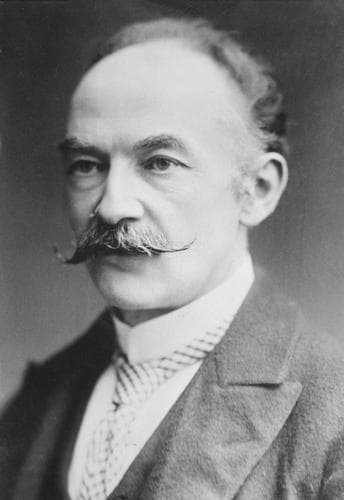
Thomas Hardy was an English novelist and poet. A Victorian realist in the tradition of George Eliot, he was influenced both in his novels and in his poetry by Romanticism, including the poetry of William Wordsworth. He was highly critical of much in Victorian society, especially on the declining status of rural people in Britain, such as those from his native South West England.
Similar books
- Tess of the D'Urbervilles
Thomas Hardy
3.8 (238k) average on GoodreadsHistorical FictionShares similar themes of fate, social critique, and tragic romance in a rural Wessex setting.
- Wuthering Heights
Emily Brontë
3.9 (1.3M) average on GoodreadsHistorical FictionFeatures passionate, doomed love, a wild, isolated setting, and a strong sense of atmospheric tragedy.
- Middlemarch
George Eliot
4.0 (136k) average on GoodreadsHistorical FictionExplores complex character relationships, societal expectations, and the impact of individual choices in a detailed, realistic setting.
- Pride and Prejudice
Jane Austen
4.3 (3M) average on GoodreadsHistorical FictionBoth are romances, but they diverge significantly in tone and outcome. Austen's Pride and Prejudice is a comedic romance where intelligence and good judgment ultimately lead to happy unions, affirming social order. Hardy's romance between Clym and Eustacia is fraught with misunderstanding and conflicting desires, leading to tragic disintegration, highlighting the destructive power of societal expectations and environmental constraints.
- To Kill a Mockingbird
Harper Lee
4.3 (4.5M) average on GoodreadsHistorical FictionIn the 1930s Jim Crow South, Harper Lee writes about racial injustice, moral growth, and the quiet courage of a lawyer father, Atticus Finch, as seen through his young daughter's eyes.
- The Great Gatsby
F. Scott Fitzgerald
3.9 (3.8M) average on GoodreadsHistorical FictionIn the opulent Roaring Twenties, a mysterious millionaire's lavish parties hide his desperate, tragic pursuit of a lost love, exposing the emptiness within the American Dream.




Enjoyed the summary?
A summary gives you the shape of the book. The book itself has the detail, the examples and the voice.
Find The Return of the Native on AmazonAs an Amazon Associate, BookBrief earns from qualifying purchases. How we're funded