

Core Idea
- Difficulty
- Medium
- Read it if
- You are curious about Zen Buddhism, its philosophy, and historical development, and are open to a non-dogmatic, psychologically insightful exploration of Eastern thought.
- Skip it if
- You are looking for a practical 'how-to' meditation guide, a devotional religious text, or prefer Western analytical philosophy without spiritual undertones.
Key Takeaways from The Way of Zen
Zen's Unspeakable Nature
The core of Zen cannot be grasped through intellect or language.
Watts introduces Zen's central paradox: it cannot truly be expressed with words or logic. Trying to define Zen precisely misses its point. It is not a philosophy, a religion in the Western sense, or a set of rules, but an experience, a way of seeing. This resistance to intellectual capture makes Zen both freeing and difficult for Westerners used to systematic thought. The 'way' of Zen is about direct awareness, not theoretical knowledge, emphasizing 'no-mind' (wu-hsin) or 'thinking without thinking.' It moves away from the idea that truth can be put into statements.
“Zen, in its essence, is a liberation from the fetters of language and conceptual thinking.”
In the book: Watts consistently highlights the Zen masters' use of koans and mondo (dialogues) not as puzzles to be solved logically, but as tools to break the student's reliance on intellect and push them towards direct insight. He cites examples of masters striking students or giving nonsensical answers to profound questions to short-circuit conceptual thought.
Try this: Practice mindfulness and meditation not as a means to achieve a specific mental state, but as a way to observe thoughts without judgment and to cultivate a direct, unmediated awareness of the present moment. Challenge your own assumptions that understanding comes solely through verbal explanation or logical deduction.
Related ideas: koan, no-mind, direct-experience
Beyond Dualism
Zen transcends the conventional separation of self and other, subject and object.
One of Zen's key contributions is its removal of dualistic thinking, especially the strict division between the 'self' (ego) and the outside world. Watts explains that this perceived separation is largely a product of language and thought, leading to much suffering. Zen points to a basic interconnectedness, where the individual is not isolated but an integral part of the cosmos. This realization, often called 'enlightenment' or satori, removes the illusion of a separate ego, revealing a unified reality where differences are only functional, not fundamental. It is a shift from 'I exist' to 'existence is happening through me.'
“The basic problem is that we confuse reality with our ideas about reality.”
In the book: Watts frequently refers to the Mahayana Buddhist concept of shunyata (emptiness), explaining it not as nihilism but as the 'empty' nature of all phenomena to be independent and self-existent. He also discusses the Hua-yen (Flower Garland) school's metaphor of Indra's Net, where every jewel reflects every other jewel, illustrating mutual interpenetration.
Try this: Observe moments where you feel a strong separation between yourself and your environment or other people. Question the solidity of your 'self' and experiment with feeling your connection to the broader world. Engage in activities that blur the lines between observer and observed, like immersive art or nature experiences.
Related ideas: dualism, satori, interbeing, shunyata
The Illusion of Control
True freedom arises from letting go of the need to control life.
Watts criticizes the Western focus on control—control over nature, emotions, and the future. He argues that this drive comes from the illusion of a separate ego trying to impose its will, which causes anxiety and frustration. Zen, in contrast, suggests 'letting go,' trusting in life's spontaneous unfolding. This is not passive, but an active alignment with the natural flow, like a surfer riding a wave instead of trying to control it. By not clinging to results or resisting what is inevitable, one finds a deep sense of ease and effectiveness, realizing that true power comes from harmonious participation, not forceful domination.
“The art of living is neither careless abandon nor grim control, but a creative balancing of freedom and discipline.”
In the book: Watts draws parallels between Zen's approach and the fluidity found in Eastern arts like T'ai Chi, calligraphy, and judo, where power comes from yielding and adapting, not rigid force. He also references the Taoist concept of wu wei (non-action), explaining it as action that is spontaneous and in alignment with the natural order, not inaction.
Try this: Identify an area in your life where you are constantly trying to force an outcome. Experiment with consciously releasing your grip and allowing things to unfold naturally for a set period. Observe what happens. Practice 'effortless effort' in your daily tasks, focusing on the process rather than just the end result.
Related ideas: wu-wei, spontaneity, letting-go, flow
Zen's Historical Evolution
Zen's distinct identity emerged from a unique synthesis of Indian Buddhism and Chinese Taoism.
Watts provides important historical context, showing that Zen is not a single, unchanging tradition but a mix of ideas. He traces its beginnings from Indian Mahayana Buddhism, especially the Prajnaparamita sutras and the Lankavatara Sutra, which set the philosophical stage for emptiness and non-duality. However, Zen truly flourished in China, where it blended with local Taoist thought. This blend gave Zen its focus on naturalness, spontaneity, direct experience, and a certain disregard for scriptures and rituals, setting it apart from other Buddhist schools. Understanding this history helps clarify Zen, showing it as a living tradition that adapted to its cultural setting.
“Zen is not a religion in the sense of a cult with a set creed, but a way and a view of life.”
In the book: Watts details the arrival of Bodhidharma in China, often considered the first patriarch of Zen, and the subsequent development of the lineage through figures like Huineng, the Sixth Patriarch, whose 'Platform Sutra' emphasizes sudden enlightenment over gradual practice. He also highlights the influence of Taoist concepts like 'the Way' (Tao) and 'nature' (tzu-jan) on Chan (Zen) Buddhism.
Try this: When exploring any spiritual or philosophical path, research its historical and cultural context to understand its evolution and specific nuances, rather than viewing it as a timeless, unchanging doctrine. Appreciate how different traditions borrow and adapt ideas.
Related ideas: Mahayana-Buddhism, Taoism, Bodhidharma, Huineng
Everyday Enlightenment
Satori is not an escape from reality but a profound re-engagement with it.
Watts clarifies that Zen enlightenment (satori) is not a mystical trance or a permanent escape from ordinary life, but a sudden, direct insight into reality that changes how one sees everyday things. It is about finding the sacred in the ordinary, fully living each moment, whether washing dishes, walking, or drinking tea. This 'this-worldly' spirituality differs from many Western religious traditions that often separate the sacred and the everyday. Zen encourages us to stop searching for external or future salvation and instead awaken to the richness of the present, here and now.
“Zen does not confuse spirituality with thinking about God while one is peeling potatoes. Spirituality is simply the way one lives when one is peeling potatoes or doing anything else.”
In the book: Watts frequently cites the Zen saying, 'Before enlightenment, chop wood, carry water. After enlightenment, chop wood, carry water.' He also references stories of Zen masters achieving satori while performing ordinary tasks, like hearing the sound of a pebble hitting bamboo or seeing a peach blossom.
Try this: Consciously bring your full attention to a routine daily activity, like brewing coffee, walking to work, or eating a meal. Notice the sensations, sounds, and details you usually overlook. Practice savoring these moments without judgment or distraction, aiming to find completeness in the present.
Related ideas: satori, mindfulness, present-moment, everyday-life
The Value of 'No-Mind'
True wisdom arises when the conceptual mind is quieted, allowing direct perception.
Watts introduces the idea of 'no-mind' (wu-hsin or mushin) as central to Zen practice. This does not mean becoming mindless or stupid, but suspending the constant chatter of the analytical mind that filters reality. When the mind is free from this internal commentary and attachment to thoughts, it becomes like a clear mirror, reflecting reality directly without distortion. This state allows for spontaneous, intuitive action and a deeper, more complete understanding that bypasses logical processing. It is the mind of a child, fresh and open, before it is burdened by accumulated knowledge and judgments.
“The greatest secret of Zen is that it is simply what it is.”
In the book: Watts refers to the practice of zazen (seated meditation) as a method for cultivating 'no-mind,' not by trying to stop thoughts, but by observing them without engagement, allowing them to pass like clouds. He also mentions the 'gateless gate' koans, which have no logical answer, forcing the student out of intellectualizing.
Try this: Dedicate time each day to silent contemplation or meditation, even for a few minutes. During this time, simply observe your thoughts without getting caught up in them. Practice pausing before reacting to situations, allowing a moment of 'no-mind' to emerge before responding instinctively.
Related ideas: wu-hsin, zazen, meditation, intuition
Zen and Art
Zen permeates Eastern aesthetics, emphasizing simplicity, naturalness, and spontaneity.
Watts explains how Zen principles are deeply present in various Eastern art forms, from painting and poetry to gardening and the tea ceremony. These arts are not about technical perfection or grand statements, but about capturing the essence of a moment, expressing the 'suchness' of things with minimal effort. The Zen aesthetic values asymmetry, imperfection (wabi-sabi), natural materials, and open spaces, inviting the viewer's participation. This artistic expression comes directly from 'no-mind' and spontaneity, showing deep respect for nature and life's organic flow, rather than imposing human will.
“The Zen aesthetic is not one of grandeur or complexity, but of naturalness, simplicity, and a profound respect for the unplanned.”
In the book: Watts discusses examples like sumi-e (ink wash painting) with its minimalist strokes, haiku poetry's brevity and focus on nature, the design of Zen gardens (karesansui) with their sparse elements, and the ritualistic yet simple movements of the tea ceremony (chanoyu). He highlights how these arts are not merely decorative but are practices for cultivating awareness.
Try this: Seek out and appreciate art forms that emphasize simplicity, naturalness, and suggestion over explicit detail. Try a creative activity (e.g., drawing, writing, gardening) with an emphasis on spontaneous expression and accepting imperfections, rather than striving for a 'perfect' outcome.
Related ideas: wabi-sabi, sumi-e, haiku, tea-ceremony
Beyond Good and Evil
Zen transcends conventional morality by recognizing the interconnectedness of all phenomena.
Watts challenges the Western focus on absolute moral categories of good and evil, arguing that Zen uses a different framework. While not approving harmful actions, Zen recognizes that 'good' and 'bad' are often relative judgments, and strict adherence to moral codes can sometimes cause more suffering. True Zen insight moves beyond this dualistic thinking, understanding that all things arise together. This does not mean moral nihilism, but an ethical stance based on compassion and understanding cause and effect, arising naturally from the realization of interconnectedness, rather than from external rules. It is about acting from an unconditioned heart, not a rulebook.
“The world is not to be improved, but to be accepted as it is.”
In the book: Watts refers to the story of the ox-herding pictures, which illustrate the journey to enlightenment. The final stages depict the enlightened one returning to the marketplace, engaging with the world without judgment, helping others without distinction. He also touches on the Buddhist concept of karma, not as a moral ledger, but as the natural consequence of actions.
Try this: When faced with a moral dilemma, try to look beyond simple good/bad labels. Consider the broader context, the interconnectedness of all involved, and the potential long-term consequences of different actions, rather than just adhering to a rigid rule. Cultivate empathy for all beings, recognizing shared humanity.
Related ideas: karma, non-duality, compassion, ethics
Zen and the West
Watts bridged Zen to Western thought, highlighting its relevance for modern alienation.
Watts's skill is in translating Zen's deep yet often elusive ideas for a Western audience. He saw Zen as a strong remedy for modern problems: alienation, anxiety, and the constant search for outside approval. By removing cultural specifics and presenting Zen's core insights in clear language, Watts showed its universal relevance. He argued that Zen could help Westerners break free from their ingrained dualisms and intellectual fixations, offering a path to direct experience, spontaneity, and a deeper connection to life, without requiring conversion to a new religion.
“The Way of Zen is not to be confused with Zen as a sect or a cult. It is simply a way of liberation from the ego.”
In the book: Watts frequently contrasts Zen principles with Western philosophical and psychological concepts, such as the Cartesian split between mind and body, or the Freudian emphasis on the ego. His entire book serves as an extended argument for Zen's relevance to the modern Western individual.
Try this: Approach Eastern philosophies and spiritual traditions not as exotic curiosities, but as potential lenses through which to examine and enrich your own cultural perspectives and personal experiences. Look for universal truths that transcend cultural boundaries.
Related ideas: cross-cultural, modernity, ego-liberation, spiritual-crisis
The Playfulness of Zen
Zen embraces life with a sense of humor and lightheartedness, free from grim seriousness.
Watts emphasizes that Zen, despite its deep insights, is not a grim or overly serious pursuit. In fact, a sign of an awakened Zen practitioner is often a strong sense of humor, playfulness, and an ability to laugh at life's absurdities, including one's own ego. This lightheartedness comes from understanding that life is a spontaneous, ungraspable process, not a problem to be solved. When the burden of the 'self' and the illusion of control are dropped, a natural joy and ease appear, allowing one to engage with the world with a spirit of 'divine play' (lila). It is about not taking oneself too seriously while taking life fully.
“A man who is a master of himself, and therefore a master of the universe, is not a grim and serious character, but a person of great humor and joy.”
In the book: Watts points to the often eccentric and humorous behavior of Zen masters in stories and koans, who would use laughter, unexpected actions, or witty remarks to shock students into insight. He also discusses the concept of 'original face' before birth, symbolizing an innocent, unburdened state.
Try this: In moments of stress or self-seriousness, try to find a humorous perspective. Practice not taking your own thoughts or yourself too seriously. Cultivate a sense of play in your daily activities and interactions, embracing spontaneity and lightheartedness.
Related ideas: humor, playfulness, lila, spontaneity
The Way of Zen Quotes
“The art of living is neither careless drifting on the one hand nor frantic grappling on the other. It is a matter of responding to each new situation with a fresh, open mind.”
“Trying to manage things, trying to force things, is not only frustrating but ultimately futile.”
“To remain sane in a crazy world is a matter of not being sane.”
“When we try to force things to conform to our preconceived ideas, we only create more resistance.”
“Zen does not confuse spirituality with thinking about God, or even with thinking about Zen.”
“The stream flows on without argument, and the flowers bloom without effort.”
“Muddy water is best cleared by leaving it alone.”
“Life is not a journey to a destination, but a dance.”
“To accept life in its totality is to accept it as it is, without wishing it were otherwise.”
“The only way to make sense out of change is to plunge into it, move with it, and join the dance.”
“The ego is a social construct, an idea of oneself that is largely determined by others.”
“The true Zen experience is not a special state of mind, but the ordinary, everyday mind.”
“When you know that you are not the 'I' that you think you are, you are free.”
“The greatest wisdom is to know that you know nothing.”
Quiz
10 questions on the main ideas. Each answer comes with a short explanation.
Question 1
According to Watts, which of the following best describes the traditional Western philosophical approach to understanding reality, in contrast to the Zen approach?
- Reality is fundamentally a process of becoming and change.
- Reality is best understood through analytical reasoning and conceptual categories.
- Reality is inherently subjective and cannot be objectively known.
- Reality is a unified whole, beyond dualistic distinctions.
Show answer
B. Reality is best understood through analytical reasoning and conceptual categories. Watts frequently contrasts Western philosophy's emphasis on analytical thought and categorizing reality with Zen's direct, non-conceptual apprehension. He argues that Western thought often attempts to 'grasp' reality through concepts, while Zen seeks to experience it immediately.
Question 2
Watts explains that the 'koan' is a central practice in Rinzai Zen. What is the primary purpose of a koan?
- To provide a logical puzzle that, when solved, reveals a deep philosophical truth.
- To train the student in precise, analytical thinking and debate.
- To exhaust the conceptual intellect and force a breakthrough to non-conceptual understanding.
- To serve as a mnemonic device for memorizing Buddhist scriptures.
Show answer
C. To exhaust the conceptual intellect and force a breakthrough to non-conceptual understanding. Watts emphasizes that koans are not logical puzzles to be solved intellectually. Instead, their paradoxical nature is designed to frustrate and ultimately transcend the limits of rational thought, leading to an intuitive realization.
Question 3
Which of the following historical figures is credited by Watts as being the patriarch who brought Zen (Ch'an) Buddhism from India to China?
- Lao-tzu
- Confucius
- Bodhidharma
- Hui-neng
Show answer
C. Bodhidharma Watts clearly states that Bodhidharma is traditionally considered the patriarch who brought Zen from India to China in the 6th century.
Question 4
Watts discusses the concept of 'wu-wei' from Taoism as a precursor to Zen's approach. How does he primarily interpret 'wu-wei'?
- Strict adherence to moral codes and social conventions.
- Effortless action that flows with the natural course of things, without forced intention.
- Passive resignation to fate and avoidance of all activity.
- Rigorous self-discipline and control over one's desires.
Show answer
B. Effortless action that flows with the natural course of things, without forced intention. Watts explains 'wu-wei' as 'not-doing' in the sense of not forcing or interfering with the natural flow, allowing things to happen spontaneously and harmoniously, which he connects to the Zen ideal of unforced action.
Question 5
In discussing the 'Gateless Gate' (Mumonkan), Watts emphasizes that the gate is 'gateless' because:
- There are no koans or obstacles to overcome in Zen practice.
- The 'gate' is an illusion, and one is already on the other side.
- Anyone can enter without formal training or guidance.
- The path to enlightenment is open and accessible to everyone instantly.
Show answer
B. The 'gate' is an illusion, and one is already on the other side. Watts elaborates on the paradox of the 'gateless gate,' explaining that the 'gate' to awakening is a conceptual barrier. Once the illusion of separation or a path to be traversed is dropped, one realizes they were never outside. The 'gate' only exists if one believes there is an 'inside' and 'outside' to enlightenment.
Question 6
Watts argues that a common Western misconception of Zen is that it is primarily a form of:
- Moralistic asceticism aimed at self-improvement.
- Academic philosophy focused on abstract metaphysical debates.
- Strict adherence to ancient rituals and ceremonies.
- A mystical cult centered on worshipping a guru.
Show answer
A. Moralistic asceticism aimed at self-improvement. Watts frequently corrects the Western tendency to view Zen through the lens of moralistic striving or self-improvement, emphasizing that Zen is about realizing one's inherent Buddha-nature, not about becoming 'better' through effort or discipline in a conventional sense.
Question 7
Which of the following best encapsulates Watts's view on the relationship between Zen and everyday life?
- Zen practice requires withdrawing from ordinary activities to achieve enlightenment.
- Zen is about bringing a state of heightened awareness and spontaneous action to all mundane tasks.
- Everyday life is a distraction from the true spiritual path of Zen.
- Zen is a philosophy to be studied and contemplated, not directly applied.
Show answer
B. Zen is about bringing a state of heightened awareness and spontaneous action to all mundane tasks. Watts consistently emphasizes that Zen is not an escape from life but a way of fully engaging with it, making everyday activities like washing dishes or drinking tea opportunities for mindful presence and spontaneous action.
Question 8
Watts discusses the concept of 'emptiness' (śūnyatā) in Zen. How does he explain this term?
- A nihilistic belief that nothing truly exists.
- The absence of inherent, independent existence in all phenomena.
- A state of mental void achieved through meditation.
- The ultimate goal of dissolving one's individual consciousness.
Show answer
B. The absence of inherent, independent existence in all phenomena. Watts clarifies that 'emptiness' in Zen (and Mahayana Buddhism) does not mean non-existence, but rather the lack of a fixed, separate self or essence in all things. Everything is interdependent and impermanent, lacking intrinsic 'self-nature'.
Question 9
Watts describes the Zen experience of 'satori' as:
- A gradual accumulation of wisdom over many years of study.
- A sudden, intuitive flash of understanding or awakening.
- A permanent state of blissful detachment from the world.
- The final stage of ascetic self-denial.
Show answer
B. A sudden, intuitive flash of understanding or awakening. Watts consistently characterizes 'satori' as a sudden, often unexpected, realization or awakening, a direct insight into the nature of reality, rather than a gradual intellectual process or a permanent escape.
Question 10
Watts argues that the Zen emphasis on 'no-mind' (wu-hsin) is not about becoming thoughtless or unintelligent, but rather:
- Cultivating an empty, blank mental state during meditation.
- Operating without the interference of ego-driven, calculating thought.
- Rejecting all forms of intellectual inquiry and learning.
- Achieving a state of permanent unconsciousness.
Show answer
B. Operating without the interference of ego-driven, calculating thought. Watts explains 'no-mind' as a state where actions and thoughts arise spontaneously and appropriately without being filtered or hindered by the 'calculating' or 'grasping' ego. It is a mind that is fluid and responsive, not blank.
The Way of Zen FAQ
What is Zen Buddhism according to Alan Watts?
According to Alan Watts in "The Way of Zen," Zen Buddhism is a unique school of Mahayana Buddhism that emphasizes direct, intuitive understanding and experience over conceptual knowledge or scriptural study. It is a way of liberation that seeks to free the mind from conventional dualistic thinking and awaken individuals to their true nature.
Does meditation work as the primary path in Zen?
While meditation (zazen) is a central practice in Zen, Watts explains that it's not merely a technique for achieving specific states, but rather an expression of awakened mind. It's a way of being present and observing reality without judgment, rather than a means to an end.
How is Zen different from traditional Western psychology?
Zen differs significantly from traditional Western psychology by focusing on the dissolution of the ego and the illusion of a separate self, rather than strengthening or analyzing it. It aims to transcend mental problems by understanding their root in dualistic thought, rather than treating symptoms within a fixed self-concept.
What is 'satori' in Zen and how does one achieve it?
'Satori' is a sudden, intuitive awakening or enlightenment in Zen, often described as a glimpse into the true nature of reality. Watts clarifies that satori is not something to be 'achieved' through effort, but rather an unexpected realization that arises when the mind is free from grasping and conceptual frameworks.
What is the historical origin of Zen Buddhism?
Alan Watts traces the historical origins of Zen from its roots in Indian Buddhism, through its development and flourishing in China as Ch'an Buddhism, and finally its transmission to Japan where it became known as Zen. He highlights the fusion of Buddhist philosophy with Taoist principles as crucial to its unique character.
How does 'The Way of Zen' differ from other books on Buddhism?
"The Way of Zen" stands out for its unique ability to translate complex Eastern philosophical and spiritual concepts into clear, accessible language for a Western audience. Watts's background in both Eastern and Western thought allows him to bridge cultural gaps and explain Zen without exoticism or oversimplification, making it particularly resonant for those unfamiliar with Asian spirituality.
Can Zen principles be applied to modern daily life?
Watts emphasizes that Zen is not just a monastic discipline but a way of living that can profoundly inform daily life. Its principles of mindfulness, non-attachment, and living in the present moment offer practical insights for reducing stress, fostering creativity, and finding meaning amidst the complexities of modern existence.
What role do koans play in Zen practice?
Koans are paradoxical riddles or questions used in Zen to challenge conventional logical thinking and force the student into a direct, intuitive experience. Watts explains that koans are designed to break through intellectual barriers and provoke a sudden awakening, rather than to be solved through rational analysis.
Is Zen a religion or a philosophy?
Watts addresses this by explaining that Zen defies easy categorization, possessing elements of both religion and philosophy, yet transcending both in its emphasis on direct experience. While it has historical and ritualistic aspects, its core lies in a practical, experiential path to understanding reality, rather than adherence to dogma or abstract theory.
About the author
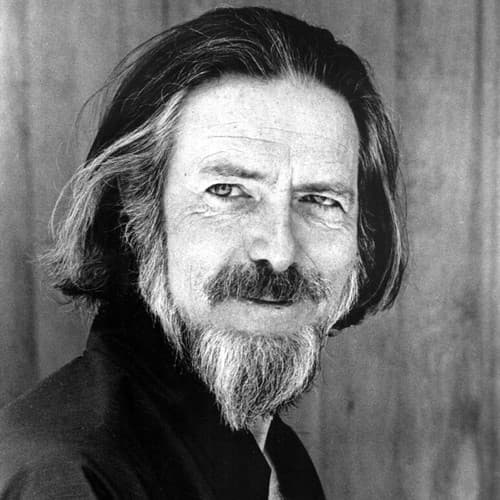
Alan Watts was a British philosopher, writer, and speaker best known for popularizing Eastern philosophies in the Western world. His extensive body of work, including "The Way of Zen," explored the connections between Western and Eastern thought, aiming to make complex spiritual concepts accessible. Watts's lectures and writings continue to influence contemporary discussions on spirituality, mindfulness, and the nature of consciousness.
Similar books
- Zen and Japanese Culture
Daisetz Teitaro Suzuki
4.1 (1k) average on GoodreadsSpiritualitySuzuki's work, particularly Zen and Japanese Culture, is a more scholarly and detailed exploration of Zen's impact on Japanese arts and society. While Watts provides an excellent introduction to Zen philosophy, Suzuki delves deeper into specific cultural manifestations (e.g., swordsmanship, tea ceremony, haiku), often with more direct engagement with original texts. Suzuki's writing, while profound, can be less immediately accessible than Watts' more fluid narrative, making Watts a better starting point for newcomers before engaging with Suzuki's more specialized analyses. Watts builds upon Suzuki's foundational work but aims for broader philosophical appeal rather than specific cultural immersion.
- The Perks of Being a Wallflower
Stephen Chbosky
4.2 (1.3M) average on GoodreadsPsychologyThrough letters, a shy high school freshman learns to navigate first love, trauma, and self-discovery, stepping off the sidelines and into life.
- Eleanor Oliphant Is Completely Fine
Gail Honeyman
4.3 (708k) average on GoodreadsLiterary FictionA lonely woman's structured life changes when an IT guy and an elderly man help her learn to open her heart.
- One Flew Over the Cuckoo's Nest
Ken Kesey
4.2 (631k) average on GoodreadsPsychologyIn a mind-bending asylum, the boisterous Randle McMurphy wages a defiant war against the tyrannical Nurse Ratched, inspiring his fellow inmates, including the seemingly catatonic Chief Bromden, to reclaim their lost humanity.
- The Bell Jar
Sylvia Plath
4.0 (591k) average on GoodreadsPsychologyIn the suffocating grip of 1950s expectations, a brilliant young woman's descent into mental illness is painted with such vivid, internal clarity that her 'insanity' feels terrifyingly rational and inevitable.
- The Subtle Art of Not Giving a F*ck: A Counterintuitive Approach to Living a Good Life
Mark Manson
3.9 (530k) average on GoodreadsBusinessEmbrace your flaws and stomach life's lemons, because true happiness isn't about relentless positivity, but about choosing what truly matters to give a f*ck about.





Enjoyed the summary?
A summary gives you the shape of the book. The book itself has the detail, the examples and the voice.
Find The Way of Zen on AmazonAs an Amazon Associate, BookBrief earns from qualifying purchases. How we're funded