
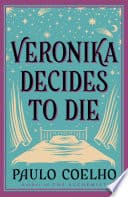
Synopsis
Covers the whole plot, including the ending.
- Difficulty
- Medium
- Read it if
- You are questioning societal norms, feel stifled by convention, or are seeking a philosophical exploration of life, death, and the meaning of sanity. Ideal for those who enjoy allegorical tales with a spiritual and psychological bent.
- Skip it if
- You prefer empirically-backed psychology over philosophical parables, dislike existential themes, or are looking for a straightforward, action-driven narrative without much introspection.
Veronika Decides to Die Quotes
“The greatest adventure is to live the life of your dreams.”
“The problem is, she thinks she doesn't have time.”
“Each day is a new day, a new opportunity to change your life.”
“Madness is the inability to communicate your ideas. It's as if you no longer have a common language to express your thoughts.”
“She was not crazy, she was just a woman trying to escape the monotony of her life.”
“When you're different, sometimes you don't see the millions of people who accept you for what you are. All you notice is the person who doesn't.”
“The wise are wise only because they love. The foolish are foolish only because they think they can understand love.”
“If you want to be successful, you must respect one rule: Never lie to yourself.”
“Everyone has a purpose in life, a unique gift or special talent to give to others. And when we blend this unique talent with service to others, we experience the ecstasy and exultation of our own spirit, which is the ultimate goal of all goals.”
“The fact that she had decided to die had given her the will to live.”
“What is freedom? Freedom is the right to choose, the right to create for yourself the alternative of choice.”
“It was the day she realized that she was still alive, and that life, despite everything, was worth living.”
“You have to take risks. We will only understand the miracle of life fully when we allow the unexpected to happen.”
“The world is a divine play, a divine dream, a divine illusion. But within this divine illusion, there is a divine reality.”
Quiz
10 questions on the plot and the characters. Each answer comes with a short explanation.
Question 1
What is Veronika's primary reason for deciding to die at the beginning of the novel?
- She has a terminal illness and wants to end her suffering.
- She is experiencing unrequited love and feels heartbroken.
- She feels that her life is monotonous and lacks meaning or excitement.
- She is deeply in debt and sees no way out.
Show answer
C. She feels that her life is monotonous and lacks meaning or excitement. Veronika, despite having what many would consider a 'normal' and 'comfortable' life, feels a profound sense of boredom and meaninglessness, leading her to attempt suicide.
Question 2
Which mental institution does Veronika wake up in after her suicide attempt?
- The House of Tranquility
- Villete
- St. Jude's Asylum
- The Serenity Clinic
Show answer
B. Villete Veronika wakes up in Villete, a mental institution where she learns the consequences of her suicide attempt.
Question 3
What medical condition is Veronika diagnosed with after her suicide attempt, which gives her only a few days to live?
- Severe kidney failure
- Irreversible brain damage
- A ruptured aorta due to the overdose
- A severe form of cancer
Show answer
C. A ruptured aorta due to the overdose Dr. Igor informs Veronika that her overdose caused irreversible damage to her heart, specifically a ruptured aorta, giving her only a few days to live.
Question 4
Dr. Igor, the director of Villete, is portrayed with a specific philosophical approach towards his patients. What is a key aspect of his treatment philosophy?
- Strict medication regimens and isolation.
- Encouraging patients to confront their 'madness' and live authentically.
- Focusing solely on traditional psychotherapy sessions.
- Preparing patients for immediate reintegration into society.
Show answer
B. Encouraging patients to confront their 'madness' and live authentically. Dr. Igor believes that 'madness' is simply a different way of perceiving the world and encourages his patients to embrace their unique perspectives, arguing that society often labels those who differ as insane.
Question 5
How does Veronika's perception of life and death change during her time at Villete?
- She becomes more resigned to her fate and accepts death peacefully.
- She develops a newfound appreciation for life and a desire to live.
- She becomes more determined to find another way to end her life.
- Her perspective remains unchanged, but she finds solace in the institution.
Show answer
B. She develops a newfound appreciation for life and a desire to live. Faced with imminent death, Veronika begins to truly live, experiencing emotions and desires she had suppressed, and developing a strong desire to survive.
Question 6
Who is Eduard, and what is his significance to Veronika?
- He is her estranged brother who visits her in the institution.
- He is a fellow patient at Villete with whom Veronika develops a deep connection.
- He is one of the doctors who tries to convince her to live.
- He is Veronika's former lover who visits her in the institution.
Show answer
B. He is a fellow patient at Villete with whom Veronika develops a deep connection. Eduard is a schizophrenic patient at Villete who Veronika initially fears but later connects with deeply, sharing moments of vulnerability and understanding that contribute to her change of heart.
Question 7
The novel explores the concept of 'madness' in society. What is the book's implied stance on who is truly 'mad'?
- Those who attempt suicide are inherently mad.
- Society often labels individuals as 'mad' when they deviate from conventional norms.
- Madness is a purely biological condition with no societal influence.
- Only those confined to institutions are truly mad.
Show answer
B. Society often labels individuals as 'mad' when they deviate from conventional norms. The book, through Dr. Igor's philosophy and the experiences of the patients, suggests that 'madness' is often a societal construct, labeling those who refuse to conform or who experience life differently.
Question 8
What specific musical talent does Veronika rediscover and share during her time at Villete, bringing joy to other patients?
- Playing the guitar
- Singing opera
- Playing the piano
- Composing poetry
Show answer
C. Playing the piano Veronika, who had suppressed her passion for playing the piano, rediscovers it at Villete, playing for the other patients and herself, which is a significant part of her reawakening.
Question 9
The novel's central message about 'living' can be best summarized as:
- Embracing routine and stability to avoid chaos.
- Finding joy in everyday monotony and avoiding extremes.
- Confronting fears, embracing individuality, and experiencing life fully, even its uncomfortable aspects.
- Prioritizing societal expectations over personal desires.
Show answer
C. Confronting fears, embracing individuality, and experiencing life fully, even its uncomfortable aspects. The entire narrative arc of Veronika's journey is about learning to truly live by shedding societal expectations, embracing her unique self, and experiencing the full spectrum of emotions and possibilities, even with the knowledge of impending death.
Question 10
What is the ultimate twist or revelation regarding Veronika's diagnosis and Dr. Igor's intentions?
- Veronika was never actually diagnosed with a ruptured aorta; it was a misdiagnosis.
- Dr. Igor intentionally misled Veronika about her imminent death to shock her into wanting to live.
- Veronika had been in a coma the entire time, and her experiences at Villete were a dream.
- Dr. Igor was a patient himself, not a real doctor.
Show answer
B. Dr. Igor intentionally misled Veronika about her imminent death to shock her into wanting to live. It is revealed that Dr. Igor fabricated the severity of Veronika's condition, telling her she had only days to live, as a radical form of therapy to make her appreciate life and fight for it.
Veronika Decides to Die FAQ
What is the central theme of 'Veronika Decides to Die'?
'Veronika Decides to Die' explores the profound choice between living and dying, examining the societal pressures that lead to feelings of despair and the unexpected paths to rediscovering the joy of existence. It delves into themes of mental health, conformity, and the liberating power of embracing one's true self.
Is 'Veronika Decides to Die' based on a true story?
While the character of Veronika and her specific story are fictional, Paulo Coelho has stated that the novel was inspired by his own experiences with mental institutions and depression. The book draws on universal struggles with existential angst and the search for meaning.
Does 'Veronika Decides to Die' offer practical advice for dealing with depression?
The book is a work of fiction and not a self-help guide or medical advice. However, through Veronika's journey and the philosophical insights presented, it offers a powerful narrative exploration of mental health challenges, resilience, and the importance of finding one's unique purpose. Readers may find solace and perspective rather than direct practical steps.
What is the significance of the mental asylum, Villete, in the story?
Villete initially represents a place of confinement and perceived madness, yet it paradoxically becomes a crucible for Veronika's transformation. Within its walls, she encounters diverse individuals whose unconventional perspectives challenge her prior understanding of sanity and ultimately help her rediscover a will to live.
How does 'Veronika Decides to Die' differ from other books about mental health?
Unlike many non-fiction books or clinical accounts of mental health, Coelho's novel approaches the subject through a deeply philosophical and spiritual lens, embedded within a compelling narrative. It focuses less on diagnosis and treatment and more on the existential choices, the search for meaning, and the societal constructs of 'normality' that can contribute to despair.
What role does love play in Veronika's journey?
Love, particularly the unconventional connection Veronika forms with Eduard, plays a crucial role in her reawakening. It's not just romantic love, but also a profound human connection that allows her to feel seen, understood, and ultimately inspires her to embrace life and its complexities.
What is the 'madness' concept explored in the book?
The book challenges conventional definitions of 'madness,' suggesting that what society labels as insane might often be a refusal to conform or an authentic expression of self. It posits that true madness might lie in a life lived without passion, curiosity, or the courage to be different.
Is 'Veronika Decides to Die' a spiritual book?
Yes, while not explicitly religious, the novel carries strong spiritual undertones, exploring the human soul, the search for purpose, and the profound connection between life, death, and self-discovery. It delves into the internal journey of finding one's spirit and embracing the present moment.
Does Veronika actually die at the end of the book?
Without revealing the full ending, the narrative masterfully navigates the tension between life and death, culminating in a powerful resolution that emphasizes the choice to live fully. The book's conclusion focuses on the transformative power of embracing life's precious moments, regardless of the ultimate outcome.
About the author

Paulo Coelho de Souza is a Brazilian lyricist and novelist and a member of the Brazilian Academy of Letters since 2002. His novel The Alchemist became an international best-seller and he has published 30 more books since then.
Similar books
- THE ALCHEMIST
Paulo Coelho
3.6 (3k) average on GoodreadsFictionShares Coelho's signature allegorical style, spiritual themes, and focus on personal journeys and self-discovery.
- One Flew Over the Cuckoo's Nest
Ken Kesey
4.2 (631k) average on GoodreadsPsychologyExplores themes of sanity, rebellion against institutional control, and the definition of madness within a psychiatric setting.
- The Myth of Sisyphus
Albert Camus
4.2 (25k) average on GoodreadsPhilosophyDelves into existential philosophy, the absurd nature of life, and finding meaning and rebellion in the face of ultimate futility.
- The Bell Jar
Sylvia Plath
4.0 (591k) average on GoodreadsPsychologyPlath's novel provides a far more visceral, psychologically intricate, and unflinching portrayal of depression and mental breakdown. Unlike Coelho's often optimistic and spiritually guided narrative, Plath offers a deeply personal and often bleak account of suffering, with little of Coelho's redemptive hope or romanticization of 'madness.' Plath delves into the internal experience of mental illness with greater realism and less philosophical abstraction.
- The Perks of Being a Wallflower
Stephen Chbosky
4.2 (1.3M) average on GoodreadsPsychologyThrough letters, a shy high school freshman learns to navigate first love, trauma, and self-discovery, stepping off the sidelines and into life.
- Eleanor Oliphant Is Completely Fine
Gail Honeyman
4.3 (708k) average on GoodreadsLiterary FictionA lonely woman's structured life changes when an IT guy and an elderly man help her learn to open her heart.




Enjoyed the summary?
A summary gives you the shape of the book. The book itself has the detail, the examples and the voice.
Find Veronika Decides to Die on AmazonAs an Amazon Associate, BookBrief earns from qualifying purchases. How we're funded