
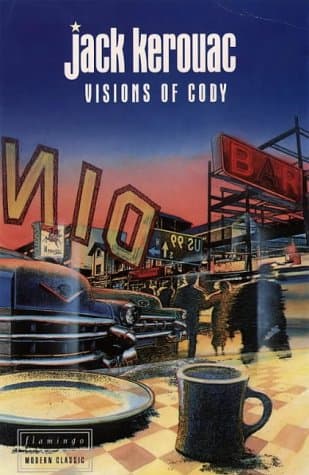
Synopsis
Covers the whole plot, including the ending.
- Difficulty
- Hard
- Pacing
- Variable
- Mood
- Experimental, Raw, Obsessive, Rhapsodic, Unfiltered
- Read it if
- You are a Kerouac enthusiast, interested in the raw, experimental roots of Beat literature, or fascinated by the character of Neal Cassady.
- Skip it if
- You prefer traditional narrative structures, find stream-of-consciousness writing challenging, or dislike explicit content and lengthy, unpunctuated prose.
Visions of Cody Plot Summary
Covers the whole plot, including the ending.
The Introduction to Cody Pomeray
The novel begins with a wide-ranging, stream-of-consciousness introduction to Cody Pomeray. He is presented not just as a friend but as a force of nature, an American figure showing freedom, recklessness, and an untamed spirit. Kerouac, through his alter ego Jack Duluoz, sets the stage for an exploration of their friendship, shared adventures, and Duluoz's intense interest in Cody's life and unique way of being. He describes Cody's early life in Denver, his difficult family background, and his natural charm that draws people to him, even as his actions often cause trouble. This first part establishes the book's main point: Duluoz's attempt to capture Cody's essence through words, a hard task given Cody's changing nature.
Early Denver Days and Restless Youth
Duluoz tells of Cody's early life in Denver, showing his upbringing in poverty, often with his alcoholic, transient father. Cody's mother left the family early, leaving him to deal with a hard world with little guidance. These early experiences gave Cody a deep restlessness and a survival instinct, seen in his early adventures: petty theft, hustling in pool halls, and a strong desire for experience. Duluoz details Cody's first times stealing cars, his time in reform school, and his growing sexual awareness, all adding to the legend of the 'wild boy' that Duluoz admires. The story highlights Cody's charm and intelligence, which often helped him avoid the full results of his actions.
The Road to New York and First Encounters
The story moves to Cody's arrival in New York City, where he first meets Jack Duluoz and their group of bohemian friends. Cody's raw, unrestrained energy immediately clashes with and enlivens Duluoz's more intellectual, thoughtful world. Duluoz is fascinated by Cody's fast speech, his street knowledge, and his sheer energy. This period marks the start of their intense friendship, defined by long, philosophical talks, shared drug experiences, and a mutual respect for each other's views. Duluoz sees in Cody a true American spirit, a living example of the freedom and recklessness he himself wants but often struggles to fully embrace. Their early interactions set up their famous cross-country trips.
Cross-Country Adventures and the Open Road
A large part of the book covers the famous cross-country road trips Duluoz and Cody take. These journeys are shown as a search for meaning, experience, and the true soul of America. They drive constantly, often fueled by Benzedrine and a desire for adventure, crossing highways, back roads, and empty landscapes. Duluoz carefully records their talks, their observations of roadside America, and their meetings with different people along the way. Cody's driving style, his improvisational approach to life, and his constant pursuit of pleasure and experience are central to these parts. The road itself becomes a character, a symbol of freedom and escape, but also of the endless, sometimes pointless, search for something undefined.
Cody's Marriages and Domestic Turmoil
Duluoz explores Cody's troubled personal life, focusing on his many marriages and the domestic disorder that often surrounds him. He describes Cody's strong attraction to women and their equal fascination with his wild charm, but also the instability his lifestyle brings to these relationships. Special attention goes to Cody's marriage to Evelyn, a woman who tries to steady him but often struggles with his cheating and restlessness. Duluoz shows Cody as a man torn between wanting a home life and a strong need for freedom and constant movement. These sections highlight the difference between Cody's public image as an adventurer and the private struggles of his emotional life, showing a deeper vulnerability beneath his outward confidence.
The World of Work and Hustle
Cody's constant need for money and his cleverness in getting it are a repeated theme. Duluoz describes Cody's many jobs, from railroad brakeman and car attendant to various hustles and schemes. These episodes show Cody's resourcefulness, his ability to charm and manipulate, and his endless energy. Whether he's working on the railroad, dealing cards, or doing small cons, Cody approaches everything with an intensity Duluoz finds both admirable and puzzling. These sections also highlight how uncertain Cody's life is, how close he always is to breaking the law, and his ability to survive and even thrive in difficult situations, always with a certain detached amusement at his own problems.
The Interview Transcripts and Direct Speech
A unique part of 'Visions of Cody' is Kerouac's inclusion of what he says are direct transcriptions of Cody's talks and monologues, often recorded on tape. These sections break from the story, showing Cody's fast, improvisational speech patterns directly to the reader. This technique aims to capture the raw, pure essence of Cody's voice and mind, giving an unfiltered look into his thoughts, observations, and unique way of speaking. Duluoz uses these 'interviews' to further analyze Cody's character, looking at his tone, his gestures, and the deeper meaning of his seemingly spontaneous statements. This experimental approach blurs the lines between fiction and documentary, emphasizing Kerouac's search for authenticity in showing his muse.
Duluoz's Obsession and Literary Experimentation
Beyond Cody's life story, the book is also about Duluoz's writing process and his almost obsessive attempt to capture Cody on the page. Duluoz often thinks about how language fails to convey Cody's full being, experimenting with different story styles, stream-of-consciousness, and direct transcription. He questions memory, perception, and literary representation. This meta-narrative layer shows Duluoz's deep admiration for Cody, almost a spiritual quest to understand and remember his friend forever. The struggle to describe Cody's core becomes a main conflict, making the book a meditation on art, friendship, and the elusive nature of truth.
The Shadow of Death and Mortality
Despite the energy that fills the book, a subtle but constant sense of death and the temporary nature of life appears in Duluoz's thoughts. He often considers the eventual fate of his friends, the passing of time, and the unavoidable decay that comes with existence. This sad tone adds depth to the celebration of Cody's life, suggesting that even the most energetic spirits are limited by time and biology. Duluoz's intense focus on keeping Cody's image in words can be seen as a desperate attempt to defy death, to create a lasting monument to a life lived so fully and intensely. The joyful chaos has a hint of coming loss.
Cody as a Symbol of America
Throughout the story, Duluoz raises Cody from a mere friend to a symbol of a certain American spirit. He sees Cody as embodying the country's restless energy, its ability to change, its mix of innocence and corruption, and its endless promise. Cody represents the frontier spirit, the individualist, the drifter, and the hustler—types deeply rooted in the American mind. Duluoz projects onto Cody his own ideals of freedom, authenticity, and the pursuit of experience, making the book not just a friend's biography, but a meditation on America's identity through one extraordinary, flawed person. This symbolic meaning gives the personal story a wider cultural importance.
The Beat Generation's Genesis
While not explicitly a Beat statement, 'Visions of Cody' is a key text that captures the early spirit of what became the Beat Generation. The constant pursuit of experience, the rejection of typical society, the exploration of jazz, drugs, and spontaneous prose, and the celebration of the marginalized are all central themes. Duluoz and Cody's adventures, their intellectual discussions, and their shared desire to break free from social norms represent the Beat way of life. The book is a raw, unfiltered record of the early years of this cultural movement, showing the people and experiences that shaped its distinct voice and ideas, even before the term 'Beat' was widely known.
The Epilogue: A Lingering Vision
The novel ends not with a clear conclusion, but with a lasting, almost mythical thought on Cody's ongoing presence in Duluoz's mind and in the world. Duluoz admits it is impossible to fully capture Cody, but confirms the deep impact his friend has had on his life and art. The final sections are less about specific events and more about the impressionistic afterglow of their friendship, the 'visions' that continue to shape Duluoz's view. Cody remains an elusive, larger-than-life figure, a source of endless fascination and inspiration, forever moving through the American landscape in Duluoz's imagination. The book ends with a sense of wonder and a testament to how extraordinary people can leave a lasting mark.
Visions of Cody Characters
Jack Duluoz
Protagonist/Narrator
The author's alter ego, an introspective writer obsessed with capturing the essence of his friend, Cody.
Jack Duluoz is the introspective, highly verbose narrator, a stand-in for Jack Kerouac himself. He is a writer, constantly observing and analyzing the world around him, particularly the figure of Cody Pomeray. Duluoz is driven by a profound need to articulate experience, to find the perfect language to convey the raw truth of life. He is intellectual, poetic, and deeply sensitive, often feeling a sense of longing and spiritual searching. While he participates in many of Cody's adventures, he often remains a slightly detached observer, his primary role being to document and interpret.
Relationships: Cody Pomeray (Intense, almost obsessive friendship; Duluoz is Cody's biographer and mythologizer.); Evelyn (Acquaintance through Cody; Duluoz observes her struggles with Cody's lifestyle.)
Cody Pomeray
Central Figure/Inspiration
A charismatic, wild, and restless individual who embodies the untamed American spirit, based on Neal Cassady.
Cody Pomeray is the novel's magnetic center, a whirlwind of energy, charm, and recklessness. Based on Neal Cassady, he is depicted as a natural-born hustler, a gifted talker, and an insatiable seeker of experience. Cody is driven by an instinctual desire for freedom, immediate gratification, and perpetual motion. He is intelligent and quick-witted but often lacks foresight or concern for consequences, leading a life on the fringes of society. He embodies both the romantic ideal of the American individualist and the darker aspects of a life lived without conventional boundaries, a true force of nature that captivates all who meet him.
Relationships: Jack Duluoz (Close, intense friendship; Cody is Duluoz's muse and subject.); Evelyn (His wife, a complex and often tumultuous relationship marked by his infidelity and restlessness.)
Evelyn
Supporting
Cody's long-suffering wife, who attempts to bring stability to his chaotic life.
Evelyn is Cody's wife, a character who represents a yearning for domesticity and stability in contrast to Cody's wildness. She is often portrayed as attempting to ground Cody, to create a home and a family life, but she constantly struggles with his infidelity, his restlessness, and his inability to conform to conventional expectations. Duluoz observes her with a mix of sympathy and a certain detachment, seeing her as an essential but often tragic figure in Cody's life. Her presence highlights Cody's inability to fully commit to a settled existence, despite his occasional desires for it.
Relationships: Cody Pomeray (His wife; a tumultuous relationship marked by his absences and infidelities.); Jack Duluoz (Acquaintance; Duluoz observes her relationship with Cody.)
Cody's Father
Supporting/Mentioned
An alcoholic, transient figure whose early neglect shaped Cody's independent spirit.
Cody's father is a largely absent and alcoholic figure in Cody's early life, frequently mentioned as a source of his son's initial instability and homelessness. He represents the rough, transient underbelly of Depression-era America. While not a present character in most of the narrative, his influence is profound, as his neglect forces Cody to become self-reliant and resourceful from a very young age. Duluoz often reflects on the impact of this father figure on Cody's development, seeing it as contributing to both Cody's street smarts and his deep-seated restlessness.
Relationships: Cody Pomeray (His estranged and neglectful father; a formative influence on Cody's early life.)
Other Beat Friends
Supporting/Mentioned
Various poets, writers, and artists who form the periphery of Duluoz and Cody's social circle.
Throughout the narrative, Duluoz mentions or briefly interacts with various other figures who are part of the burgeoning Beat scene. These characters, often thinly veiled versions of real-life figures like Allen Ginsberg and William S. Burroughs, provide context for Duluoz and Cody's intellectual and social environment. They engage in philosophical discussions, share drug experiences, and contribute to the vibrant, experimental atmosphere of the time. While not deeply developed, their presence reinforces the sense of a collective artistic and cultural movement forming around Duluoz and Cody's adventures.
Relationships: Jack Duluoz (Friends and collaborators in the Beat scene.); Cody Pomeray (Acquaintances or friends who are fascinated by Cody's energy.)
Visions of Cody Themes
The Search for Authenticity and Freedom
The novel constantly explores what it means to live truly and freely, often through Cody Pomeray's life. Duluoz sees Cody as the example of an unrestrained existence, free from social rules. Their cross-country road trips are physical examples of this search, always moving, always seeking new experiences and truths on the open road. Cody's rejection of traditional jobs, home life, and social norms, and Duluoz's interest in it, show a desire for a life lived on one's own terms, even if it leads to disorder. This theme is clear in Duluoz's detailed descriptions of Cody's hustles and his endless energy, always trying to break free.
“What is that feeling when you're driving away from people and they recede on the plain till you see their specks dwindling? – it's the too-huge world again, and we're on our way. But what is that feeling? – it's the great North American sadness.”
The Nature of Friendship and Obsession
At its core, the book deeply explores an intense, almost obsessive friendship between Jack Duluoz and Cody Pomeray. Duluoz's admiration for Cody is close to hero-worship, and his constant attempt to capture Cody's essence in words shows a deep psychological bond. Duluoz is not just recording a friend's life; he is trying to understand and remember a figure who represents something vital and elusive to him. This theme appears in Duluoz's detailed observations of Cody's actions, speech, and life choices, as well as in the sheer amount of text about his friend. The friendship drives Duluoz's creative process and is a source of both inspiration and deep self-reflection.
“I was writing about Cody because he was the only hero I could possibly find in America.”
The American Myth and Identity
Kerouac uses Cody Pomeray to explore and redefine the American myth. Cody embodies classic American figures: the pioneer, the cowboy, the hobo, the hustler, the restless individualist. Duluoz sees in Cody a raw, untamed spirit he believes is central to the American character, free from European tradition. The endless road trips across the vast American landscape are a literal and symbolic journey into the heart of this identity. The book considers what it means to be American after the war, questioning traditional ideas of success and stability and celebrating the marginalized, the spontaneous, and the wild.
“He was the Saint of the Railroads, the American Saint of the Railroads.”
The Power and Limitations of Language
A main meta-theme is Duluoz's struggle with language itself—its ability to capture experience and its limits. He constantly experiments with story forms, stream-of-consciousness, and direct speech transcriptions to convey Cody's 'truth.' Duluoz often expresses frustration with words, feeling they cannot fully represent Cody's dynamic, elusive nature. This theme is clear in the novel's experimental structure, its changes in style, and Duluoz's direct thoughts on writing. The book becomes a testament to the writer's endless effort to connect lived experience and its literary portrayal.
“The only truth is the immediacy of the word.”
Existentialism and the Search for Meaning
Beneath the frantic energy and celebration of life is a deep existential questioning. Duluoz and Cody, through their talks and travels, grapple with the meaning of existence, the nature of time, and the search for spiritual truth. Cody's constant movement can be seen as an attempt to outrun or fill an inner emptiness, while Duluoz's self-reflection often leads to moments of deep doubt and a longing for something more. The temporary nature of their lives, the constant movement, and the fleeting meetings with others all add to a sense of impermanence, pushing the characters to face their own death and the ultimate purpose of their lives.
“Ah, life is a dream, and we are but shadows in it, and sometimes the shadows touch.”
Plot Devices & Literary Techniques
Stream of Consciousness
Narrative technique mimicking the unfiltered flow of thoughts, feelings, and memories.
Kerouac employs stream of consciousness extensively, particularly in Jack Duluoz's narration. This device allows Duluoz's thoughts to spill onto the page in an unedited, associative manner, often characterized by long, rambling sentences, rapid shifts in topic, and a blending of past and present. It aims to capture the raw, immediate experience of perception and memory, immersing the reader directly into Duluoz's mind and his obsessive process of trying to understand Cody. This technique mirrors the improvisational spirit of jazz and the spontaneous nature of Cody's own life.
The Road as Metaphor
The physical journey across America symbolizing spiritual quest, freedom, and escape.
The open road is a central and recurring motif, functioning as a powerful metaphor. It represents freedom, escape from societal constraints, and a continuous search for meaning and experience. The endless movement of Duluoz and Cody across the American landscape symbolizes their spiritual quest, their rejection of stagnation, and their embrace of the unknown. The road is also a place of discovery, where new characters are met, new insights are gained, and the vastness of America itself becomes a character in the narrative, reflecting the boundless possibilities and inherent loneliness of their journey.
Interspersed Transcriptions
Inclusion of supposedly verbatim recordings of Cody's conversations and monologues.
A unique structural device is the integration of sections presented as direct transcriptions of Cody Pomeray's speech, often indicated by specific formatting. These 'interviews' and monologues break the conventional narrative flow, offering an unfiltered, raw glimpse into Cody's distinctive voice, rapid-fire delivery, and idiosyncratic thought process. This device serves to heighten the sense of authenticity and immediacy, allowing the reader to 'hear' Cody directly. It also underscores Duluoz's intense focus on capturing Cody's essence, even experimenting with quasi-documentary techniques within his fiction.
Mythologizing the Ordinary
Elevating everyday events and individuals to legendary status through hyperbolic and poetic language.
Kerouac consistently uses highly poetic, often hyperbolic language to elevate the seemingly ordinary events of Cody's life – his hustles, his driving, his conversations – into something grand and mythical. Cody himself is portrayed not just as a friend, but as an archetypal figure, an 'American Saint.' This device imbues the narrative with a sense of epic scale and spiritual significance, transforming personal anecdotes into universal statements about human experience. It reflects Duluoz's awe and reverence for Cody, and his artistic ambition to create a lasting legend out of his friend's unconventional life.
Visions of Cody Quotes
“I want to work in the world, be on the streets instead of in a room, and I want to write, and I want to be great, and I want to be good.”
“The only people for me are the mad ones, the ones who are mad to live, mad to talk, mad to be saved, desirous of everything at the same time, the ones who never yawn or say a commonplace thing, but burn, burn, burn like fabulous yellow roman candles exploding like spiders across the stars and in the middle you see the blue centerlight pop and everybody goes 'Awww!'”
“All of life is a foreign country.”
“What is that feeling when you're standing on a mountain in a thunderstorm and you've just been struck by lightning? Is that God or is that just electricity?”
“He was a great man, a great father, a great husband, a great friend, a great lover, and a great bum.”
“The world is a great big movie, and I'm just a little guy in the audience.”
“And the only way to say it is to say it, and the only way to write it is to write it.”
“The greatest poet in America is Cody Pomeray.”
“I want to be a writer, and I want to be a good one, and I want to be a great one, and I want to be remembered.”
“There was nothing to do but burn, burn, burn.”
“You can't get away from yourself by going from one place to another.”
“And the great thing about Cody was that he didn't care what anybody thought of him.”
“The world is a great big poem, and I'm just trying to read it.”
“Everything is holy, everything is a miracle, everything is impossible.”
Quiz
10 questions on the plot and the characters. Each answer comes with a short explanation.
Question 1
Which real-life friend of Jack Kerouac is 'Cody Pomeray' a fictionalized version of?
- Allen Ginsberg
- William S. Burroughs
- Neal Cassady
- Herbert Huncke
Show answer
C. Neal Cassady Cody Pomeray is Kerouac's fictionalized portrayal of his close friend and muse, Neal Cassady.
Question 2
What primary city is often associated with Cody's early life and exploits in the novel?
- New York City
- San Francisco
- Denver
- Los Angeles
Show answer
C. Denver Cody's early life, marked by his father's homelessness and his own wild youth, is primarily set in Denver.
Question 3
What is the narrator's (Jack Duluoz's) primary goal in writing 'Visions of Cody'?
- To write a conventional biography of Cody
- To objectively analyze Cody's psychological state
- To capture and celebrate the essence and spirit of Cody's life through memory and observation
- To condemn Cody's reckless lifestyle
Show answer
C. To capture and celebrate the essence and spirit of Cody's life through memory and observation The narrator aims to capture the raw, vibrant spirit of Cody, celebrating his life rather than simply documenting it, using a stream-of-consciousness style.
Question 4
Which of these activities is NOT typically associated with Cody's early 'wild' life as depicted in the novel?
- Hustling in pool halls
- Stealing cars
- Working as a librarian
- Living a generally 'wild' and uninhibited existence
Show answer
C. Working as a librarian Cody's early life is characterized by hustling and stealing, not by conventional employment like working as a librarian.
Question 5
The novel employs a distinct narrative style, often characterized by which of the following?
- Strict chronological order and formal prose
- Stream-of-consciousness, jazz-like rhythms, and spontaneous prose
- Third-person omniscient narration with objective distance
- Dialogue-heavy scenes with minimal description
Show answer
B. Stream-of-consciousness, jazz-like rhythms, and spontaneous prose Kerouac's 'Visions of Cody' is a prime example of his spontaneous prose, characterized by stream-of-consciousness and a free-flowing, jazz-influenced rhythm.
Question 6
What role does the 'tape recording' section play within the structure of 'Visions of Cody'?
- It is a fictional device to show Cody's love for music.
- It represents an attempt by Kerouac to capture Cody's actual voice and improvisational speech patterns directly.
- It serves as a formal interview transcript for biographical purposes.
- It's a metaphor for the unreliability of memory.
Show answer
B. It represents an attempt by Kerouac to capture Cody's actual voice and improvisational speech patterns directly. The 'tape recording' section is a unique stylistic choice by Kerouac to directly transcribe conversations with Cassady, attempting to capture his authentic voice and spontaneous energy.
Question 7
Cody's relationship with his father is often depicted as:
- Loving and supportive, despite their poverty.
- Distant and marked by his father's alcoholism and homelessness.
- Strictly authoritarian, driving Cody to rebellion.
- Non-existent, as Cody was an orphan.
Show answer
B. Distant and marked by his father's alcoholism and homelessness. Cody's father is portrayed as a Denver drop-out, often homeless and alcoholic, which profoundly shaped Cody's upbringing and character, leading to a distant and complex relationship.
Question 8
How does 'Visions of Cody' differ fundamentally from Kerouac's earlier work like 'On the Road' in its portrayal of Cody/Dean Moriarty?
- It presents a more romanticized and idealized version of Cody.
- It offers a more fragmented, introspective, and deeply analytical exploration of Cody's character, delving beyond the surface excitement.
- It focuses more on the physical journeys and less on the internal landscape.
- It is written in a much more conventional, plot-driven style.
Show answer
B. It offers a more fragmented, introspective, and deeply analytical exploration of Cody's character, delving beyond the surface excitement. While 'On the Road' celebrated Dean Moriarty's wild energy, 'Visions of Cody' delves much deeper into his psyche, exploring his complexities, flaws, and origins with a more fragmented and introspective narrative.
Question 9
The 'Visions' in the title refers to:
- Cody's own dreams and aspirations for the future.
- Jack Duluoz's various mental images, memories, and interpretations of Cody's life and personality.
- Supernatural encounters experienced by Cody.
- Prophecies about Cody's eventual fate.
Show answer
B. Jack Duluoz's various mental images, memories, and interpretations of Cody's life and personality. The 'Visions' represent the narrator's subjective, multifaceted, and often fragmented perceptions, memories, and attempts to grasp the essence of Cody's being.
Question 10
How does Kerouac's use of language in 'Visions of Cody' contribute to its overall thematic impact?
- Its formality and precision create a sense of scholarly detachment.
- Its raw, improvisational, and often unpunctuated flow mirrors Cody's own chaotic and spontaneous life, immersing the reader in his experience.
- Its simplistic vocabulary and sentence structure emphasize Cody's lack of formal education.
- Its reliance on classical allusions elevates Cody's story to a mythical status.
Show answer
B. Its raw, improvisational, and often unpunctuated flow mirrors Cody's own chaotic and spontaneous life, immersing the reader in his experience. The 'spontaneous prose' style, with its long sentences, lack of conventional punctuation, and raw energy, is designed to reflect the frenetic and uninhibited nature of Cody's life, creating an immersive experience for the reader.
Visions of Cody FAQ
What is the core premise of 'Visions of Cody'?
'Visions of Cody' is a sprawling, experimental homage to Neal Cassady, fictionalized as Cody Pomeray. It explores the intense friendship between Sal Paradise (Kerouac's alter ego) and Cody, detailing Cody's tumultuous life, his unique charisma, and the profound impact he had on Sal's perception of life and art, all while experimenting with narrative form.
Who is Cody Pomeray based on, and what aspects of his real life are explored?
Cody Pomeray is a direct fictionalization of Neal Cassady, Kerouac's close friend and muse. The book delves into Cassady's impoverished Denver upbringing, his early life of petty crime, car theft, and hustling, and his magnetic personality that captivated Kerouac and many others in the Beat generation.
What role does Sal Paradise play in the narrative, and how does his perspective shape the book?
Sal Paradise is Jack Kerouac's alter ego, serving as the primary narrator and observer of Cody's life. His perspective is one of profound admiration, fascination, and at times, envy, as he attempts to capture Cody's essence through stream-of-consciousness prose, interviews, and detailed recollections, making the book as much about Sal's artistic process as it is about Cody.
How does 'Visions of Cody' differ stylistically from Kerouac's more famous work, 'On the Road'?
'Visions of Cody' is significantly more experimental and raw than 'On the Road,' employing techniques like stream-of-consciousness, transcribed conversations, internal monologues, and even fictionalized interviews. It's less a linear narrative and more a multi-faceted portrait, reflecting Kerouac's evolving 'spontaneous prose' style.
What is the significance of the 'Denver drop-out' background for Cody?
Cody's background as the son of a Denver drop-out, raised homeless and motherless during the Depression, is crucial to understanding his character. It forged his resilience, his survival instincts, his disregard for societal norms, and his restless energy, all of which contribute to his mythic status in the narrative.
Are there any subtle references or allusions to other Beat figures beyond Cody/Cassady?
While Cody is central, the narrative implicitly and explicitly connects to the broader Beat milieu. Figures like Allen Ginsberg and William S. Burroughs are present, sometimes thinly veiled or alluded to through their shared experiences and intellectual exchanges with Kerouac and Cassady, solidifying the book's place within the Beat canon.
How does Kerouac use specific geographical locations, like Denver, to enhance Cody's character?
Denver is presented not just as a setting but as a crucible for Cody's formative years. The descriptions of its streets, pool halls, and transient life are imbued with a sense of gritty authenticity, highlighting the challenging environment that shaped Cody's hustling skills and his untamed spirit, making the city almost a character itself.
What is the significance of the recurring motif of trains and travel in relation to Cody?
Trains and travel are deeply symbolic of Cody's restless, transient nature and his constant search for experience. They represent freedom, escape, and the relentless forward motion that defines his life. The imagery of freight trains and cross-country journeys underscores his rootlessness and his perpetual movement.
Are there any recurring symbols or objects that point to deeper meanings about Cody's life?
The automobile is a potent symbol, representing Cody's mastery over machines, his desire for speed and escape, and his rebellious spirit. His skill at stealing and driving cars highlights his daring and his ability to navigate the fringes of society, embodying both freedom and danger.
How does Cody's 'raw' and 'wild' existence contribute to his psychological profile?
Cody's 'raw' and 'wild' existence suggests a profound lack of conventional social conditioning and a strong id-driven personality. He lives impulsively, seeking immediate gratification and intense experiences, which points to a primal energy and a rejection of societal constraints, often without regret or self-reflection.
What psychological needs does Sal Paradise seem to fulfill through his relationship with Cody?
Sal Paradise appears to fulfill needs for inspiration, vicarious experience, and a sense of vital authenticity through Cody. Cody represents an uninhibited life that Sal, as an artist, perhaps yearns for but cannot fully embody himself, making Cody a muse for Sal's artistic and existential explorations.
Does Cody exhibit any signs of a specific personality type or disorder, based on Kerouac's portrayal?
Based on Kerouac's portrayal, Cody exhibits traits often associated with an antisocial personality, characterized by a disregard for social norms, impulsivity, charm, and a lack of empathy or remorse for his actions like stealing cars. He also displays narcissistic tendencies in his need for admiration and his self-centered pursuits.
How does the author's own psychological state seem to influence the narrative's tone and structure?
Kerouac's own psychological state, characterized by intense admiration bordering on obsession, a desire for spiritual meaning, and a restless search for authentic experience, deeply influences the narrative. The stream-of-consciousness style reflects his mind's frenetic energy and his attempt to capture the fleeting essence of Cody and their shared moments.
Is 'Visions of Cody' primarily a biography, an autobiography, or something else entirely?
'Visions of Cody' defies easy categorization; it's less a straightforward biography and more an experimental literary portrait. It blends biographical elements of Neal Cassady's life with autobiographical reflections of Kerouac's experiences and his artistic process, creating a unique hybrid that explores the nature of memory, friendship, and writing itself.
How does the book's experimental style contribute to its overall message or theme?
The experimental style, with its raw, unedited feel, aims to capture the chaotic, spontaneous energy of Cody's life and the immediacy of Kerouac's own thoughts. It suggests that life itself is not a neat narrative but a flood of impressions, conversations, and fleeting moments, reinforcing the theme of living fully and authentically in the present.
What is the central debate or question the book implicitly poses about the nature of its subject?
The book implicitly poses the question of whether Cody is a hero, a tragic figure, or simply a force of nature. It debates whether his untamed life is something to aspire to or to observe with a degree of critical distance, leaving the reader to interpret the ultimate value and consequences of his 'wild' existence.
Does Kerouac ultimately glorify Cody's lifestyle, or does he present a more nuanced view?
While Kerouac's admiration for Cody is undeniable and often borders on glorification, the narrative also presents a nuanced view. It shows the destructive aspects of Cody's impulsivity and the toll his lifestyle takes, hinting at the potential for self-destruction alongside the vibrant freedom he embodies, offering a complex portrait.
How does the title 'Visions of Cody' reflect the book's content and Kerouac's approach?
The title 'Visions of Cody' perfectly reflects the book's content. It implies that what is presented are not objective facts but subjective, kaleidoscopic impressions, memories, and dream-like interpretations of Cody by Sal Paradise/Kerouac. It underscores the idea that Cody is seen through a highly personal, artistic lens, rather than a factual one.
What is the lasting legacy or impact of 'Visions of Cody' within the Beat Generation and literary fiction?
'Visions of Cody' is considered a seminal, albeit challenging, work within the Beat Generation, pushing the boundaries of spontaneous prose and narrative form. Its raw honesty and deep dive into the psyche of a central Beat figure have made it an important text for understanding Kerouac's artistic evolution and the experimental spirit of the era.
About the author
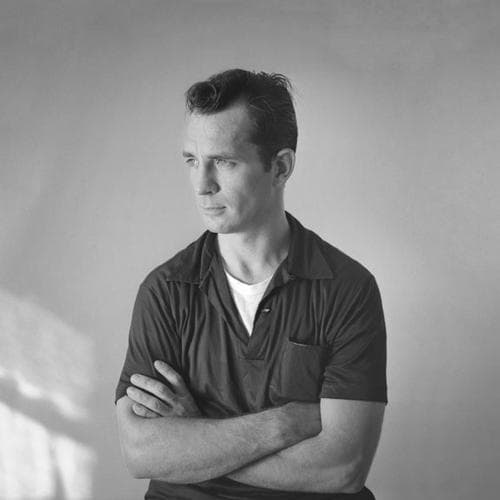
Jean-Louis Lebris de Kérouac, known as Jack Kerouac, was an American novelist and poet who, alongside William S. Burroughs and Allen Ginsberg, was a pioneer of the Beat Generation.
Similar books
- On The Road
Jack Kerouac
3.6 (349k) average on GoodreadsLifestyleFeatures the same characters and themes of wanderlust and Beat generation life, though 'Visions of Cody' is far more experimental in form.
- The Dharma Bums
Jack Kerouac
3.9 (84k) average on GoodreadsLifestyleExplores similar themes of spiritual searching, friendship, and counter-cultural life, with a more conventional narrative than 'Visions of Cody'.
- The Old Man and the Sea
Ernest Hemingway
3.8 (831k) average on GoodreadsLiterary FictionA Cuban fisherman's long struggle with a giant marlin becomes a story of endurance and dignity, now retold for young adults with illustrations, phonetic guides, and writing prompts in Traditional Chinese.
- One Hundred Years of Solitude
Gabriel García Márquez
4.1 (753k) average on GoodreadsLiterary FictionThrough the multi-generational story of the Buendía family, a mythical town deals with the repeating patterns of time, love, and solitude, as the extraordinary mixes with the ordinary.
- The Goldfinch
Donna Tartt
3.9 (720k) average on GoodreadsLiterary FictionHaunted by a tragic explosion and clutching a stolen Dutch masterpiece, a young orphan navigates the opulent drawing rooms of New York and the gritty underbelly of the art world, desperately seeking connection and redemption amidst a life spiraling into crime and obsession.
- Little Fires Everywhere
Celeste Ng
4.1 (713k) average on GoodreadsLiterary FictionIn Shaker Heights, an artist and her daughter move in, and their free-spirited lives clash with a rule-bound matriarch, revealing hidden conflicts beneath a perfect surface.





Enjoyed the summary?
A summary gives you the shape of the book. The book itself has the detail, the examples and the voice.
Find Visions of Cody on AmazonAs an Amazon Associate, BookBrief earns from qualifying purchases. How we're funded