
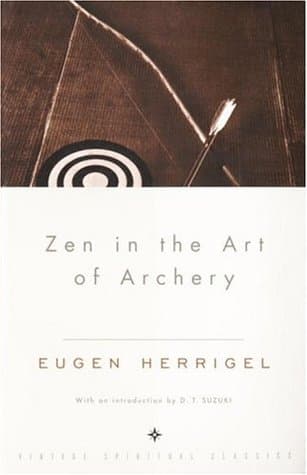
Core Idea
- Difficulty
- Medium
- Read it if
- You are interested in the philosophical and spiritual underpinnings of Eastern arts, seeking a deeper understanding of mindfulness, flow states, or how to transcend ego in pursuit of mastery.
- Skip it if
- You are looking for a practical guide to archery technique, a quick self-help book, or prefer a direct, logical approach to skill acquisition without spiritual or philosophical detours.
Key Takeaways from Zen in the Art of Archery
The Way of No-Way
True mastery emerges from surrendering conscious control and rational thought.
Herrigel found that the Western focus on conscious effort, planning, and getting a specific result actually stops true mastery in Zen arts. He learned that to 'hit the target' was not about aiming better, but about stopping aiming at all. This involves a paradox: the student must use great discipline to reach a point where conscious effort is completely dropped. This 'purposelessness' is not laziness but a state where action flows naturally from an integrated mind and body, free from intention or ego. The goal is not the target, but the transformation of the self through the practice.
“The right art is purposeless, aimless! The more you struggle to attain the goal, the farther you will be from it.”
In the book: Herrigel's early struggles to consciously correct his shots, only to be met with the Master's frustration and the instruction that he was trying too hard, using his intellect rather than letting go. The Master's insistence that the student must 'wait' for the shot to release itself.
Try this: In any skill, identify areas where overthinking or excessive conscious control might be impeding flow. Practice letting go of the outcome and focusing purely on the process, trusting that with sufficient preparation, the desired result will emerge naturally. Cultivate patience and non-striving.
Related ideas: wu-wei, non-striving, flow-state
Beyond Technique: Art as Spiritual Discipline
The true purpose of Zen arts is not skill acquisition but spiritual transformation.
Herrigel quickly learned that Japanese archery, unlike Western archery, was not mainly about hitting a physical target. It was about perfecting the self. The act of shooting an arrow reflects one's inner state. Every posture, breath, and release helps to build presence, discipline, and, in the end, enlightenment. The Master was not teaching him how to shoot, but how to become a different person through shooting. This changes 'art' from just a performance or product to a lifelong process of self-improvement, where the medium is a tool for inner work.
“It is not a sport, not child's play, not a pastime; it is a serious and profound spiritual discipline.”
In the book: The Master's repeated dismissal of Herrigel's concern for hitting the target, instead focusing on the 'right spirit' and the 'right tension.' The Master's statement that the arrow shoots itself, implying the archer's role is to become an empty vessel.
Try this: Approach personal development or skill-building not just as a means to an end, but as a path to inner growth. Ask: 'How does this practice transform me?' rather than just 'What can I achieve with this?' Apply this mindset to hobbies, work, or even daily routines.
Related ideas: spiritual-discipline, self-cultivation, meditation-in-action
The Imperative of Letting Go
Achieving mastery requires abandoning the ego's desire for control and success.
One of Herrigel's hardest lessons was the need to 'let go' – not just of the arrow, but of his conscious self, his intentions, and his desire to succeed. The Master asked for a state where the archer becomes one with the bow, arrow, and target, removing the perceived divisions between them. This dissolving of the ego's control allows the shot to 'shoot itself.' Western thought values individual action and control, making this surrender very hard. Yet, it is the way to real spontaneity and effortless action in Zen.
“The archer ceases to be conscious of himself as the one who draws the bow and takes aim, and equally of the target as something standing over against him.”
In the book: Herrigel's frustration with the Master's elusive instructions like 'It shoots itself' and 'You must wait for it,' which defied his logical attempts to understand and execute. His eventual breakthrough came only after profound exhaustion and mental surrender.
Try this: In moments of high pressure or creative blocks, practice releasing the need for a specific outcome. Engage in activities without judgment or expectation, allowing for spontaneity. Recognize when your ego's desire for control is hindering your performance.
Related ideas: ego-dissolution, surrender, non-duality
Patience as the Path
True learning is a slow, iterative process requiring immense patience and trust.
Herrigel's six-year journey shows the clear difference between Western impatience for quick results and the Zen focus on deep, unhurried development. The Master rarely gave direct instructions, instead guiding Herrigel with subtle corrections and mysterious statements, making him learn the lessons over years. This long period of practice, often without clear progress, needed great patience and strong trust in the Master and the process. It shows that some deep changes cannot be rushed or understood intellectually, but must happen naturally through dedicated, patient repetition.
“You must learn to wait properly. The great art of waiting for the right moment.”
In the book: The Master's refusal to explain 'how' to release the arrow, instead simply repeating 'It shoots itself' for years. Herrigel's initial despair at the lack of measurable progress and the immense time investment required for seemingly simple actions.
Try this: Embrace long-term projects and learning curves, resisting the urge for instant gratification. Practice mindfulness and meditation to cultivate patience. Trust that consistent, dedicated effort, even without immediate results, is building foundational change.
Related ideas: deliberate-practice, long-term-mastery, mindfulness
The Unspeakable Truth
Some profound truths cannot be conveyed through words but must be experienced.
A repeated idea is that language cannot describe the deepest parts of Zen. The Master's instructions were often confusing, metaphorical, or seemed to make no sense to Herrigel's logical Western mind. He realized that the Master was not holding back information, but understood that some insights could only be gained through direct, lived experience, not intellectual understanding. This shows the limits of purely cognitive learning and the importance of embodied knowledge and intuitive grasp, which go beyond words. The 'secret' is not hidden; it is simply beyond words.
“The Master's business is not to explain things, but to enable his pupils to experience them.”
In the book: The Master's frequent use of koans or seemingly illogical statements, and his expectation that Herrigel would eventually 'understand' without explicit instruction. The moment Herrigel finally experienced the 'correct' release without knowing how he did it.
Try this: Recognize the limits of intellectualizing certain experiences. Engage in practices that cultivate direct experience and intuition, such as art, music, or physical disciplines. Trust your gut feelings more often, even when you can't logically explain them.
Related ideas: koan, embodied-knowledge, intuition
The Invisible Teacher
The true guidance comes not from the external master, but from within the disciplined self.
While Herrigel relies much on his Master, the book subtly shows that the true teacher is the discipline itself, and the inner change it encourages. The Master's job is to create the right conditions for learning, to watch, and to offer minimal, often indirect, guidance. He does not give answers but makes the student find them through their own struggle and eventual breakthrough. This emphasizes self-reliance in the deepest way – not independent action, but the growth of inner wisdom that comes from strict practice and careful presence.
“The Master is a signpost, not a destination. He points the way, but you must walk it yourself.”
In the book: The Master often leaving Herrigel to practice alone for extended periods, only offering a few words upon his return. The Master's consistent refusal to give direct 'how-to' instructions, pushing Herrigel to find the way himself.
Try this: Seek mentors and teachers, but understand their role is to guide, not to spoon-feed. Take ownership of your learning journey, actively seeking internal insights rather than passively waiting for external instructions. Develop an inner critic and guide through consistent self-reflection.
Related ideas: inner-guidance, self-reliance, disciple
Breath as the Foundation
Conscious breathing is the anchor for presence and the key to integrating mind and body.
Through his training, Herrigel is always brought back to the importance of breath. It is not just a body function but a deliberate act that connects the physical body to the mental state. The Master teaches specific breathing techniques – deep, rhythmic, abdominal breathing – to create stillness, focus, and a sense of being grounded. Correct breathing is the base for all other parts of the art, allowing the archer to reach a state of calm focus and to use energy well. It is the most direct way to unify the fragmented self.
“He who has learned to breathe correctly has learned to live correctly.”
In the book: The Master's early and consistent emphasis on proper breathing, often correcting Herrigel's shallow or irregular breath before addressing any other aspect of his technique. The direct link drawn between the quality of breath and the quality of the shot.
Try this: Integrate conscious breathing practices into your daily routine. Use deep, abdominal breathing to manage stress, improve focus, and prepare for challenging tasks. Recognize breath as a powerful tool for self-regulation and presence.
Related ideas: pranayama, mindful-breathing, somatic-awareness
The Great Release
The ultimate act of mastery is an effortless, spontaneous release born from unified being.
The 'release' of the arrow is the peak of the archery process and the ultimate example for Zen. It is not a conscious decision, but an event that 'happens' when the archer has reached a state of complete unity with the bow, arrow, and target. This state, often called 'no-mind' or 'empty mind,' allows the arrow to fly with perfect naturalness and power, without doubt, fear, or conscious intention. It is the result of years of discipline, a moment of deep spontaneity where the 'self' disappears and the art performs itself.
“The archer is no longer himself, but is completely dissolved in the action of shooting.”
In the book: Herrigel's description of his first 'correct' shot, where he felt as if the bowstring simply 'cut through his thumb' and the arrow released itself, without any conscious effort or decision on his part.
Try this: Strive for moments of 'flow' in your activities, where you are completely absorbed and the action feels effortless. Practice deep focus and presence to reduce self-consciousness during performance. Trust your training to take over when the moment of action arrives.
Related ideas: flow-state, spontaneity, no-mind
Beyond Dualities: Unity of Opposites
Zen transcends the Western tendency to separate mind/body, subject/object, effort/effortlessness.
Herrigel's journey is a challenge to the basic divisions in Western thought: mind versus body, subject versus object, effort versus relaxation. The Master constantly pushed him to go beyond these divisions, to experience the unity of all elements in the act of archery. The 'correct' shot is not about the archer acting on the bow or the target, but about a complete event where all elements merge into one seamless process. This non-dualistic view is central to Zen, showing that perceived separations are often mental constructs rather than true realities.
“The archer must become one with the bow, the arrow, and the target.”
In the book: The Master's cryptic statements about the archer and the target not being separate, and the bow and arrow becoming extensions of the archer's being. Herrigel's struggle to reconcile the need for effort with the instruction to let go.
Try this: In your own life, look for areas where you create artificial separations (e.g., work/play, mind/body). Practice integrating these aspects, seeing how they influence each other. Cultivate a holistic perspective in problem-solving and self-awareness.
Related ideas: non-duality, holism, integration
Zen in the Art of Archery Quotes
“The archer ceases to be conscious of himself as the one who is engaged in hitting the bull's-eye which confronts him. This state of unconscious is realized only when, completely empty and rid of the self, he becomes one with the perfecting of his technical skill.”
“The right art is purposeless, aimless! The more obstinately you try to learn how to shoot the arrow for the sake of hitting the goal, the less you will succeed.”
“It is necessary for the archer to become, in spite of himself, an unmoved center. Then comes the supreme and ultimate miracle: art becomes 'artless', shooting becomes not-shooting, a shooting without bow and arrow.”
“The instructor's business is not to show the way itself, but to enable the pupil to get the feel of this way to the goal by adapting it to his individual peculiarities.”
“You must learn to wait properly. Waiting means not to wait for anything in particular.”
“The shot will only go smoothly when it takes the archer himself by surprise.”
“The more you try to make the shot, the more you will miss the mark.”
“The archer aims at himself—and yet not at himself, hits himself—and yet not himself.”
“It is not a matter of indifference how the bow is strung, how the arrow is nocked, how the bow is drawn, how the shot is released.”
“The archer must become, in spite of himself, an unmoved center.”
“The art of archery is not a sport, but a ritual.”
“The instructor said: 'You have described only the outward process. What is essential is the inward process.'”
“The shot is like a ripe fruit falling from the tree.”
“The right shot at the right moment does not come because you do not let go of yourself.”
“The more you concentrate on breathing, the more the shot will happen by itself.”
Quiz
10 questions on the main ideas. Each answer comes with a short explanation.
Question 1
What was the primary reason Eugen Herrigel traveled to Japan to study archery?
- To become a professional archery competitor
- To understand Zen Buddhism through physical discipline
- To write a practical guide on Japanese archery techniques
- To escape post-war Europe and start a new life
Show answer
B. To understand Zen Buddhism through physical discipline Herrigel explicitly states that his goal was not to master archery as a sport, but to use it as a means to comprehend Zen principles, which he believed could be accessed through rigorous physical and spiritual training under a master.
Question 2
How long did Herrigel study archery under his Japanese master?
- 2 years
- 4 years
- 6 years
- 8 years
Show answer
C. 6 years The book is based on Herrigel's six-year apprenticeship with a Zen archery master in Japan, during which he gradually learned to abandon Western concepts of self and control.
Question 3
What does Herrigel describe as the ultimate goal of Zen archery practice?
- Hitting the target with perfect accuracy every time
- Achieving a state where 'it' shoots, not the archer
- Developing superior physical strength and endurance
- Memorizing complex rituals and ceremonies
Show answer
B. Achieving a state where 'it' shoots, not the archer A core concept in the book is the idea of transcending the ego or 'self' so that the shot happens spontaneously without conscious effort—often phrased as 'it shoots' rather than 'I shoot.'
Question 4
Why did Herrigel's master initially refuse to let him shoot at a target?
- Because Herrigel lacked the proper equipment
- To prevent him from developing target fixation and ego attachment
- Because the master believed he was not physically ready
- To save money on arrows and targets
Show answer
B. To prevent him from developing target fixation and ego attachment The master delayed target practice to help Herrigel unlearn Western habits of goal-oriented thinking, emphasizing that Zen archery is about the process and state of mind, not hitting the target.
Question 5
What key Western mindset did Herrigel struggle to overcome in his training?
- The desire for quick results and conscious control
- A lack of interest in spiritual matters
- An aversion to physical exercise
- Skepticism about Japanese culture
Show answer
A. The desire for quick results and conscious control Herrigel repeatedly mentions how his Western education emphasized willpower, analysis, and achievement, which conflicted with Zen's emphasis on effortless action and surrendering the self.
Question 6
According to the book, what is the significance of the breathing exercises in Zen archery?
- They increase lung capacity for better shooting stamina
- They help synchronize body and mind to achieve a state of 'no-mind'
- They are primarily a warm-up routine before practice
- They are used to time the release of the arrow precisely
Show answer
B. They help synchronize body and mind to achieve a state of 'no-mind' Breathing is central to Zen practice in the book; it's described as a method to unify physical and mental states, leading to mushin (no-mind), where action flows naturally without conscious thought.
Question 7
What does Herrigel mean by 'the right art' in the context of Zen archery?
- Using the most advanced archery equipment available
- A technique that is scientifically proven to be effective
- An art pursued without purpose or goal, as an end in itself
- Mastering all the historical styles of Japanese archery
Show answer
C. An art pursued without purpose or goal, as an end in itself Herrigel contrasts Western instrumentalism with Zen's idea of 'art for art's sake,' where the practice itself is the goal, leading to spiritual insight rather than external achievement.
Question 8
How does Herrigel describe the moment when he finally experienced a breakthrough in his archery?
- He hit a perfect bullseye after months of practice
- The master praised him for mastering a complex technique
- He felt the shot happen spontaneously, as if by itself
- He won a local archery tournament in Japan
Show answer
C. He felt the shot happen spontaneously, as if by itself Herrigel recounts a pivotal moment where, after years of struggle, he stopped trying to control the shot and it occurred effortlessly, illustrating the Zen principle of non-action (wu wei).
Question 9
What role does 'detachment' play in Zen archery according to Herrigel's account?
- It helps the archer avoid emotional disappointment when missing the target
- It allows the archer to practice for long hours without fatigue
- It enables the archer to act without ego or desire for results
- It is a strategy to intimidate opponents in competition
Show answer
C. It enables the archer to act without ego or desire for results Detachment is a key Zen concept in the book; it involves letting go of the self, intentions, and outcomes so that action can arise naturally from a state of pure being.
Question 10
Why does Herrigel argue that Zen archery is not about archery at all?
- Because the techniques taught are historically inaccurate
- Because it uses archery merely as a metaphor for life struggles
- Because it is a spiritual discipline that uses archery as a vehicle for self-transcendence
- Because the book is actually a critique of Japanese culture
Show answer
C. Because it is a spiritual discipline that uses archery as a vehicle for self-transcendence Throughout the book, Herrigel emphasizes that the physical act of archery is secondary; it serves as a means to practice Zen principles like mindfulness, detachment, and the unity of body and mind.
Zen in the Art of Archery FAQ
What is Zen in the Art of Archery about?
It's Eugen Herrigel's account of his six-year journey learning archery from Japanese Zen masters, exploring how the discipline serves as a path to Zen—achieving balance between body and mind through the abandonment of self.
Does Zen in the Art of Archery teach actual archery?
No, it's not a practical guide to archery. Instead, it uses archery as a metaphor to illustrate Zen principles, focusing on spiritual and mental lessons rather than technical skills.
What is the concept of 'abandonment of the self' in the book?
It refers to letting go of the Western ego-driven mindset, where one stops trying to control outcomes consciously and instead allows action to flow naturally from a state of unity between body and mind.
How is Zen in the Art of Archery different from other Zen books?
Unlike theoretical texts, it offers a personal, experiential narrative based on Herrigel's training with masters, making Zen principles accessible through a relatable story rather than abstract philosophy.
Does Zen in the Art of Archery work for non-practitioners?
Yes, it's designed for both practitioners and non-practitioners, as it explains Zen principles in a clear, insightful way through Herrigel's journey, without requiring prior knowledge or practice.
What is the role of the Zen master in the book?
The master guides Herrigel not through direct instruction but by challenging his Western assumptions, emphasizing patience, intuition, and the importance of unlearning to achieve spiritual growth.
How does Zen in the Art of Archery compare to The Book of Five Rings?
Both explore discipline and mindset, but Herrigel's book focuses on Zen spirituality through a personal journey in archery, while The Book of Five Rings is more about strategy and martial arts philosophy.
What is the key lesson from Herrigel's six-year quest?
The key lesson is that mastery comes not from forceful effort but from surrendering the self, allowing actions to happen spontaneously through deep integration of body and mind.
Does Zen in the Art of Archery apply to modern life?
Yes, its principles of mindfulness, patience, and overcoming ego are highly relevant today, offering insights for reducing stress and improving focus in various aspects of life.
What is the significance of archery as a metaphor in the book?
Archery symbolizes the Zen path because it requires perfect harmony between intention and action, illustrating how any skill can become a spiritual practice when approached with the right mindset.
About the author

Eugen Herrigel was a German philosopher and author known for his exploration of Zen philosophy and its application to the practice of archery. His most notable work, "Zen in the Art of Archery," details his experiences studying Zen in Japan and emphasizes the spiritual aspects of mastering the bow. Herrigel's writings contribute to the understanding of the intersection between Eastern philosophy and Western thought.
Similar books
- Tao Te Ching
Lao Tzu
4.3 (117k) average on GoodreadsSpiritualityOffers foundational philosophical concepts of the Tao, emphasizing spontaneity, emptiness, and effortless action.
- The Perks of Being a Wallflower
Stephen Chbosky
4.2 (1.3M) average on GoodreadsPsychologyThrough letters, a shy high school freshman learns to navigate first love, trauma, and self-discovery, stepping off the sidelines and into life.
- Eleanor Oliphant Is Completely Fine
Gail Honeyman
4.3 (708k) average on GoodreadsLiterary FictionA lonely woman's structured life changes when an IT guy and an elderly man help her learn to open her heart.
- One Flew Over the Cuckoo's Nest
Ken Kesey
4.2 (631k) average on GoodreadsPsychologyIn a mind-bending asylum, the boisterous Randle McMurphy wages a defiant war against the tyrannical Nurse Ratched, inspiring his fellow inmates, including the seemingly catatonic Chief Bromden, to reclaim their lost humanity.
- The Bell Jar
Sylvia Plath
4.0 (591k) average on GoodreadsPsychologyIn the suffocating grip of 1950s expectations, a brilliant young woman's descent into mental illness is painted with such vivid, internal clarity that her 'insanity' feels terrifyingly rational and inevitable.
- The Subtle Art of Not Giving a F*ck: A Counterintuitive Approach to Living a Good Life
Mark Manson
3.9 (530k) average on GoodreadsBusinessEmbrace your flaws and stomach life's lemons, because true happiness isn't about relentless positivity, but about choosing what truly matters to give a f*ck about.





Enjoyed the summary?
A summary gives you the shape of the book. The book itself has the detail, the examples and the voice.
Find Zen in the Art of Archery on AmazonAs an Amazon Associate, BookBrief earns from qualifying purchases. How we're funded